




 BOM
BOM Cart
Cart Product Catalog
The JRC4558 is one of the most popular dual operational amplifiers used in audio and electronic applications. Known for its high gain, low noise, and versatility, it widely use in audio preamplifiers, mixers, and general-purpose analog circuits. In this guide, we will explore everything you need to know about the JRC4558 - from its features and specifications to applications and alternatives.
3. JRC4558 Operational Amplifier Features & Specifications
4. JRC4558 Equivalent & Alternative
8. JRC4558 vs. TL072 vs. NE5532 Op-Amps
9. Working Principle of Current Loop Tester Circuit
10. Frequently Asked Questions [FAQ]
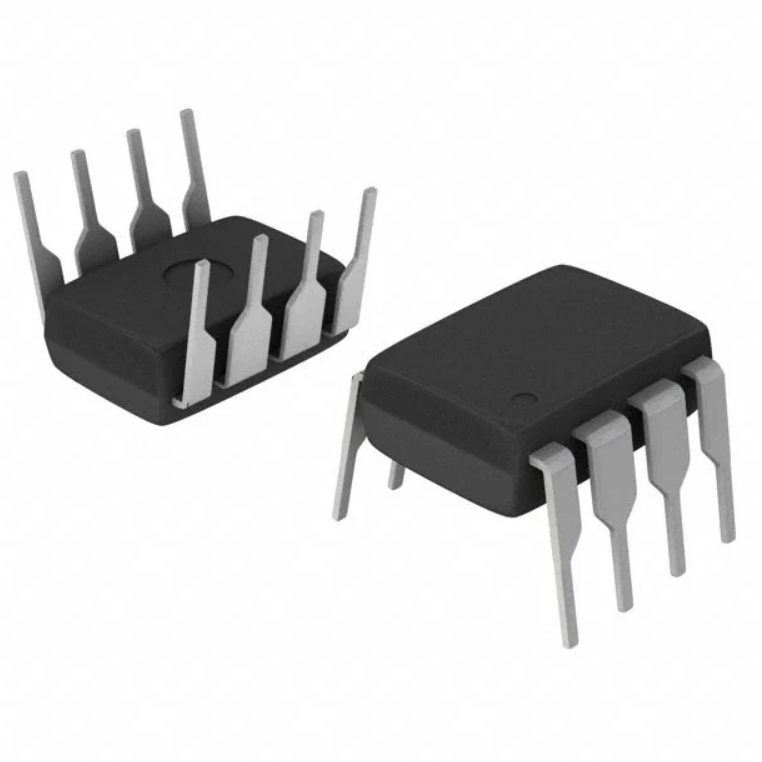
What is JRC4558 Op-Amp?
The JRC4558 (also known as NJM4558) is a dual high-gain operational amplifier (op-amp) designed for general-purpose and audio applications. Constructed on a single silicon chip using an advanced epitaxial process, it is internally compensated, ensuring stable operation over a wide range of voltages and conditions. By combining the features of the classic NJM741 with closely matched dual channels on a monolithic chip, the JRC4558 offers unique performance characteristics not typically found in single op-amps.
One of its standout features is excellent channel separation, which allows the dual op-amp to use in applications that traditionally rely on a single NJM741, effectively providing high-density performance in a single package. This makes it particularly useful in stereo audio circuits, signal processing, and other applications requiring matched channels for consistent gain and phase behavior.
The JRC 4558 is highly versatile, performing well in differential input-differential output circuits, potentiometric amplifiers, and other designs where gain and phase matching are critical. Its combination of high voltage gain, low noise, and reliable operation has made it a popular choice for hobbyists and professional engineers alike, especially in audio preamplifiers, mixers, and instrumentation circuits. Its dual configuration and robust characteristics make it an enduring staple in analog electronics.
JRC4558 Pinout
The JRC 4558 is commonly available in 8-pin DIP and SOP packages. Here’s the standard pin configuration:
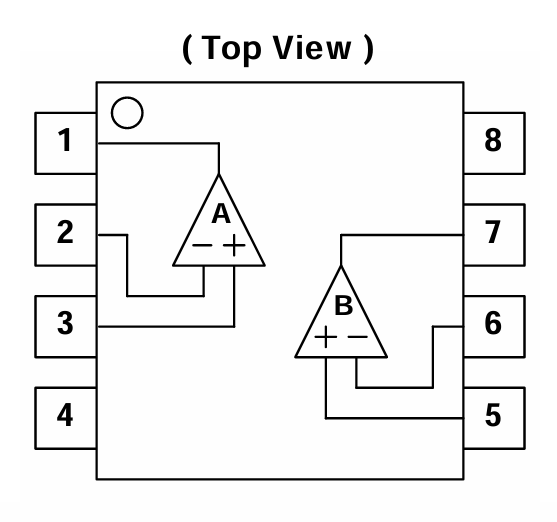
Pin No. | Pin Name | Description |
1 | OUT (A) | Output of op-amp A |
2 | A - INPUT | Inverting input of op-amp A |
3 | A +INPUT | Non-inverting input of op-amp A |
4 | -Vs | Negative power supply |
5 | B +INPUT | Non-inverting input of op-amp B |
6 | B - INPUT | Inverting input of op-amp B |
7 | OUT (B) | Output of op-amp B |
8 | Vcc + | Positive power supply |
This dual configuration allows two independent op-amps in a single IC, which is particularly useful in stereo audio or dual-channel analog circuits.
JRC4558 Operational Amplifier Features & Specifications
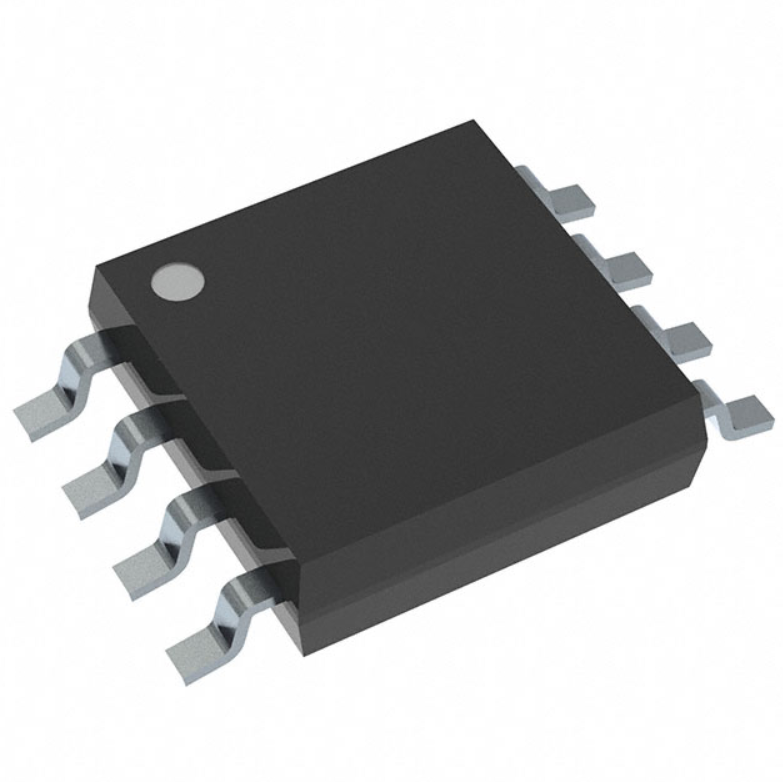
The JRC 4558 is a widely used dual operational amplifier known for its high performance and reliability. Its features make it suitable for audio, instrumentation, and general-purpose analog applications. Key features include:
Dual High-Gain Op-Amp - Contains two independent amplifiers on a single chip, allowing stereo or dual-channel applications.
Wide Operating Voltage - Can operate from ±4V to ±18V, making it flexible for various circuit designs.
High Voltage Gain - Typically 100 dB, ensuring strong signal amplification even in low-level input conditions.
High Input Resistance - Around 5 MΩ, minimizing loading effects on preceding circuits.
Bipolar Technology - Ensures stable operation and low offset voltage, suitable for precision applications.
Excellent Channel Matching - Gain and phase of both channels closely match, ideal for differential circuits or audio stereo applications.
Low Noise - Designed to minimize signal distortion, making it popular in audio preamplifiers, mixers, and guitar pedals.
Internally Compensated - No need for external compensation capacitors, simplifying circuit design.
Package Options - Available in DIP8, SOP8, SSOP8, and other variants, including SMD for compact PCB designs.
These features make the 4558 circuit a reliable choice for both hobbyists and professional engineers, combining flexibility, performance, and ease of integration into analog circuits.
Specifications
Parameter | Value |
Supply Voltage (Vcc) | ±4V to ±18V |
Voltage Gain (Open-Loop, Av) | 100 dB |
Input Resistance (Ri) | 5 MΩ |
Input Offset Voltage (Vio) | 5 mV |
Input Bias Current (Ib) | 25 nA |
Input Offset Current (Ios) | 5 nA |
Input Voltage Range (Common-Mode) | -Vs + 2V to Vcc - 2V |
Output Voltage Swing | ±12V (with ±15V supply) |
Slew Rate | 1V/µs |
Channel Separation | Excellent |
Noise (Voltage, 1 kHz) | 20 nV/√Hz |
Supply Current | 3.5 mA typical |
Large Signal Voltage Gain | 100 dB typical |
Unity Gain Bandwidth | 3 MHz |
Phase Margin | 60° typical |
Package Options | DIP8, SOP8, SSOP8 |
Technology | Bipolar |
Dimensions
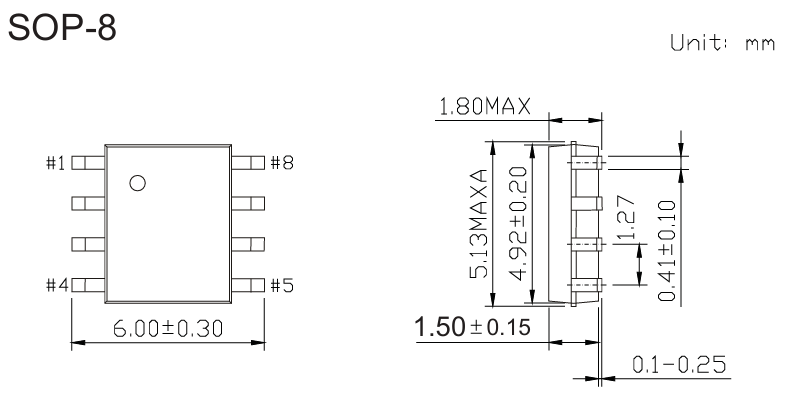
Package | Description |
DIP8 | Dual In-line Package with 8 pins in two parallel rows, designed for through-hole mounting on standard PCBs. Body dimensions are 9.8 × 6.35 × 3.3 mm. Provides robust mechanical stability and easy insertion for prototyping or breadboard use. Ideal for general-purpose analog and audio circuits. |
DMP8 | Mini Dual In-line Package, similar to DIP8 but slightly more compact. Body dimensions are 9.8 × 6.35 × 3.3 mm. Used where PCB space is limited while retaining standard DIP compatibility. |
SIP8 | Single Inline Package with 8 pins in a single row, designed for vertical through-hole mounting. Body dimensions are 9.5 × 3.0 × 3.3 mm. Saves horizontal PCB space, commonly used in compact amplifier modules or current loop circuits requiring a narrow footprint. |
Note: “JRC4558D” often refers to the SMD version for PCB surface mounting.
JRC4558 Equivalent & Alternative
If the JRC 4558 is unavailable, there are several equivalent and alternative operational amplifiers that can use in its place, depending on the application. Choose these alternatives based on similar electrical characteristics, dual op-amp configuration, and audio performance.
NE5532 - Low-noise dual op-amp, widely used in high-fidelity audio applications.
LM158 / LM158A - General-purpose dual op-amps with similar voltage gain and input characteristics.
LM358 / LM358A - Popular low-power dual op-amps suitable for audio and analog circuits.
LM2904 / LM2904Q - Industrial-grade dual op-amps designed for automotive and general-purpose use.
LM4558 - Direct functional equivalent of JRC 4558 with nearly identical characteristics.
LM747 - Dual op-amp with comparable gain and input resistance, usable in similar circuits.
NJM4560 - Higher-performance dual op-amp from the same manufacturer, offering low noise and improved audio quality.
These equivalents allow designers to substitute easily while maintaining circuit performance, whether for audio preamplifiers, mixers, filters, or general-purpose amplification. Always check the supply voltage range, input/output characteristics, and package compatibility before choosing a substitute.
JRC4558 Applications
The JRC 4558 a dual operational amplifier widely used in both audio and general-purpose analog circuits. Its combination of high gain, low noise, and excellent channel matching makes it a popular choice among hobbyists, engineers, and audio enthusiasts.
Common application include:
Audio Preamplifiers - Amplifying weak signals from microphones or instruments before feeding them to power amplifiers.
Guitar and Bass Effects Pedals - Used in overdrive, distortion, and fuzz pedals because its warm analog tone.
Mixers and Equalizers - For signal amplification, filtering, and tone control in stereo audio systems.
Potentiometric Amplifiers - Provides accurate gain and phase-matched channels in differential or bridge circuits.
Active Filters - Low-pass, high-pass, band-pass, and notch filters for audio and instrumentation.
Instrumentation Amplifiers - Differential signal amplification in measurement devices and sensor circuits.
Voltage Followers / Buffers - To provide high input resistance and low output impedance.
Current Loop / Signal Conditioning Circuits - Converts and amplifies signals for precise current or voltage monitoring.
Its dual-channel configuration allows designers to implement stereo or dual-signal circuits efficiently, making it ideal for compact PCB designs and audio modules.
JRC4558 Datasheet
Where to Use IC JRC4558?
The JRC 4558 is a dual high-gain operational amplifier suitable for a wide range of audio, analog, and general-purpose electronics applications. Its versatility comes from its low noise, high gain, and closely matched dual channels, making it a reliable choice in circuits requiring precision and stability.
Typical use cases include:
Audio Circuits - Ideal for preamplifiers, mixers, equalizers, and guitar pedals, where low noise and good channel separation are important.
Signal Amplification - Amplifying weak analog signals in sensor circuits, measurement devices, and instrumentation.
Differential Amplifiers - Used in circuits that require matched gain and phase across two channels.
Filters and Oscillators - Active filters (low-pass, high-pass, band-pass) and signal conditioning circuits.
Voltage Followers / Buffers - Provides high input resistance and low output impedance, protecting sensitive circuits.
Current Loop or Control Systems - Amplifying or conditioning signals for current loop testers, analog controllers, and monitoring circuits.
Compact PCB Designs - Its dual-channel package allows for space-efficient designs in both through-hole and SMD applications.
In short, the 4558 chip is a go-to op-amp wherever need stable amplification, low noise, and dual-channel performance. Its widespread availability and reliability make it a staple in audio electronics and general analog designs.
How to Use JRC4558 Op-Amp?
The JRC4558 is a dual operational amplifier that can use in a variety of analog circuits, including audio, signal conditioning, and sensor applications. To use it correctly, it is important to understand the pin configuration, power supply requirements, and basic op-amp connections.
For power supply, connect pin 8 (Vcc +) to the positive voltage supply, typically ranging from +5V to +15V, and pin 4 (Vss or -Vs) to the negative voltage supply, usually -5V to -15V. For single-supply operation, can connected Vss to ground, but ensure input signals remain within the valid common-mode range. Recommend bypass capacitors of 0.1µF to 1µF near the supply pins to reduce noise and improve stability.
For the inputs, op-amp A uses pin 3 as the non-inverting input (+) and pin 2 as the inverting input (-), while op-amp B uses pin 5 as the non-inverting input and pin 6 as the inverting input. Taken the outputs from pin 1 for op-amp A and pin 7 for op-amp B.
Circuit configuration depends on the desired mode of operation. In an inverting amplifier, connect the input signal to the inverting input through a resistor, with the non-inverting input grounded. In a non-inverting amplifier, apply the input to the non-inverting pin and connect the inverting pin to the output via a feedback resistor. For a voltage follower or buffer, directly connect the output to the inverting input to achieve unity gain. Can build a differential amplifier by connecting signals to both inverting and non-inverting inputs with appropriate resistor values.
Once connected, apply a small input signal and measure the output to ensure proper amplification. Adjust resistor values as needed to set the desired gain, and ensure signals remain within the input common-mode range to avoid distortion. By following these steps, can effectively use the 4558 component in audio circuits, filters, signal amplifiers, and differential applications, taking advantage of its dual op-amp configuration and low-noise characteristics.
JRC4558 vs. TL072 vs. NE5532 Op-Amps
Feature | JRC4558 | TL072 | NE5532 |
Noise | Low | Average-low | Ultra low |
Voltage Gain | 100dB | 100dB | 100dB |
Input Bias | Moderate | Average-low | Low |
Package | DIP8/SOP8 | DIP8/SOP8 | DIP8/SOP8 |
Audio Quality | Good | Excellent | Excellent |
Applications | Audio | Audio/high-speed | Professional audio |
JRC4558
A dual bipolar high-gain operational amplifier widely used in audio and general-purpose analog circuits. It features low noise, excellent channel separation, and closely matched dual op-amps on a single chip. With an operating voltage of ±4V to ±18V and a typical voltage gain of 100 dB, it is ideal for preamplifiers, mixers, filters, and differential amplifier circuits. Its dual configuration and low-cost availability make it popular among hobbyists and professional audio designers alike.
TL072
A low-noise JFET-input dual operational amplifier designed for high-fidelity audio and precision analog applications. It offers high input impedance, low input bias current, and wide bandwidth, making it excellent for high-quality audio circuits, active filters, and instrumentation applications. Unlike the bipolar JRC 4558, the TL072 uses JFET inputs, which results in low noise and minimal offset voltage, giving it an edge in audio fidelity and precision analog circuits.
NE5532
A low-noise, high-performance bipolar dual operational amplifier optimized for professional audio applications. It provides ultra-low distortion, low noise, high output drive capability, and excellent channel matching, making it ideal for mixers, audio preamplifiers, active filters, and studio-grade audio equipment. Compared to JRC 4558, prefer the NE5532 when high-fidelity audio reproduction and minimal signal distortion are critical.
Summary:
JRC4558: Affordable, reliable, widely used in general-purpose and audio circuits.
TL072: Best for low-noise, high-impedance applications requiring high audio fidelity.
NE5532: Preferred in professional audio and studio-grade applications because ultra-low noise and distortion.
Working Principle of Current Loop Tester Circuit
A current loop tester circuit is used to monitor or measure the current flowing through a 4-20 mA current loop or similar analog control system. The JRC 4558 operational amplifier can use in such a circuit to amplify and condition the signal for accurate detection and display.
The working principle involves using the op-amp as a voltage-to-current converter, differential amplifier, or signal conditioner. A typical configuration places a precision resistor in series with the loop. The voltage drop across this resistor is proportional to the current flowing through the loop. One of the op-amps in the JRC 4558 can configure as a differential amplifier, which measures the voltage across the resistor and amplifies it to a usable level for an indicator or microcontroller input.
For increased accuracy, the dual-channel nature of JRC 4558 allows matched differential measurement, ensuring both gain and phase consistency. The amplified output can drive an analog meter, LED bar graph, or ADC input in a microcontroller system.
Because the JRC 4558 has low offset voltage, high gain, and low noise, it provides stable and precise readings, making it ideal for current loop monitoring in industrial automation, sensor interfaces, and process control applications.
Frequently Asked Questions [FAQ]
What is the use of JRC4558?
The JRC 4558 is a dual high-gain operational amplifier used to amplify analog signals. Widely applied in audio preamplifiers, guitar pedals, mixers, filters, differential amplifiers, and signal conditioning circuits, providing low noise, excellent channel separation, and reliable dual-channel performance for both hobbyist and professional designs.
What is the equivalent of JRC4558?
Equivalent operational amplifiers include NE5532, LM4558, LM358, LM358A, LM158, LM158A, LM2904, LM2904Q, LM747, and NJM4560. These alternatives match the dual op-amp configuration, supply voltage range, and general performance characteristics, allowing designers to replace the JRC 4558 without significantly affecting circuit functionality or audio performance.
What is the maximum input voltage for 4558?
The maximum differential input voltage for the JRC4558 is approximately ±30V, while the input common-mode voltage range is typically -Vs + 2V to Vcc - 2V. Exceeding these limits can cause distortion or damage the op-amp. Operating within specified supply and input ranges ensures accurate amplification.
What is the difference between LM741 and 4558?
The LM741 is a single-channel general-purpose op-amp, while the 4558 is a dual op-amp with closely matched channels. The 4558 provides better channel separation, lower noise, and is more suitable for audio applications, whereas LM741 commonly use in basic analog circuits and educational projects.
What are the primary advantages of using the JRC4558 in audio circuits?
The JRC4558 offers low noise, high voltage gain, excellent channel matching, and reliable dual-channel operation, making it ideal for stereo audio circuits, preamplifiers, and guitar pedals. Its bipolar design ensures stable performance, and it maintains audio fidelity while amplifying weak signals effectively.
Is TL072 better than JRC4558?
The TL072 is a JFET-input op-amp offering high input impedance, lower noise, and better offset performance than the JRC4558. It is superior in high-fidelity audio and precision analog circuits, but the JRC 4558 remains popular for general-purpose audio and dual-channel applications where cost and availability matter.
What is a substitute for 4558 op-amp?
Substitutes for the 4558 include NE5532, LM4558, LM358, LM158, and NJM4560. When replacing, ensure the substitute matches dual-channel configuration, voltage supply range, and input/output characteristics to maintain circuit functionality, especially in audio and differential applications.
What is the slew rate of JRC4558?
The typical slew rate of the JRC4558 is 1V/µs, meaning it can change output voltage at a maximum rate of 1 volts per microsecond. This makes it suitable for audio and general analog applications, though not ideal for high-speed or RF circuits requiring faster response.
Conclusion
The JRC4558 remains a trusted choice for audio enthusiasts, DIY electronics builders, and professionals looking for a dual op-amp with reliable performance, high gain, and good audio quality. Its versatility and widespread availability make it a staple in both hobby and professional circuits.
Read More:
1. NE5534 Op-Amp: Specifications, Applications, and Datasheet
2. NE5532 Op Amp Datasheet, Pinout, Equivalent
3. LM324N Operational Amplifiers - Guide Pinout and Datasheet
HOT NEWS
TP4056 Charging Module Pinout, Working, and Applications
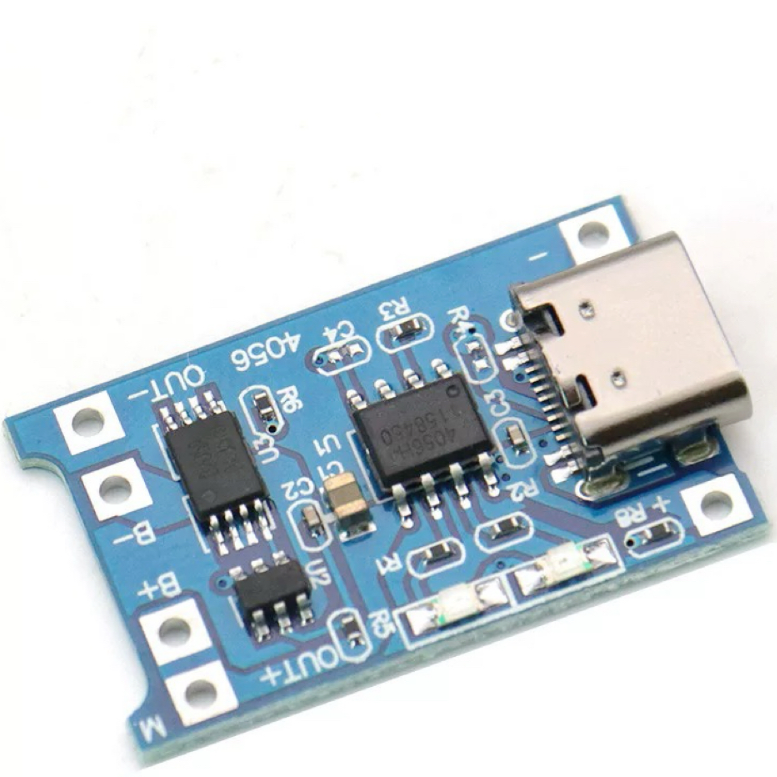
TP4056 Charging Module Pinout, Working, and Applications
2026-01-23
LR41 Battery Guide: Specifications, Equivalents, and Uses
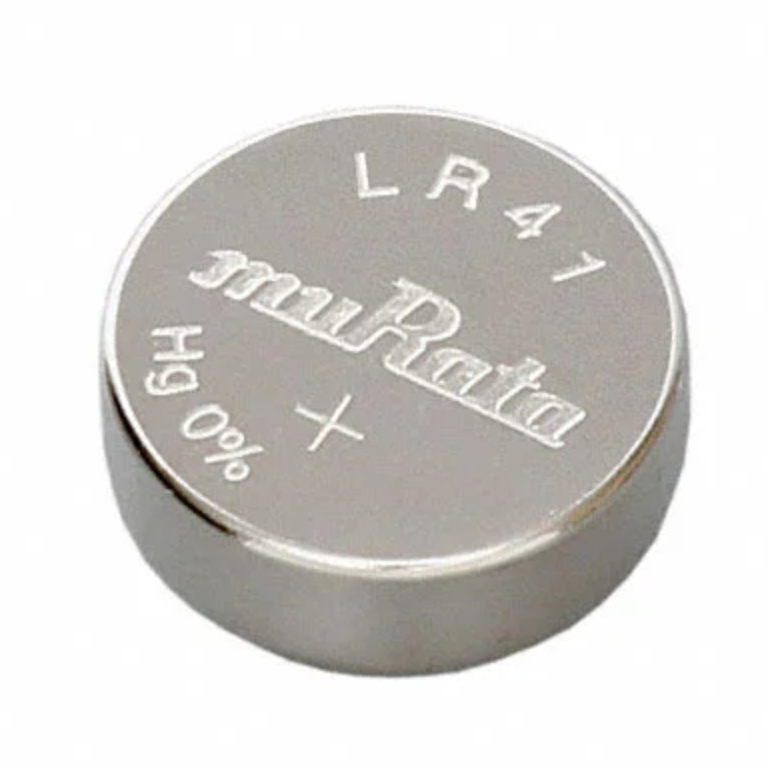
LR41 Battery Specifications, Equivalents, and Uses
2025-12-14
Understanding The CD4051 Analog Multiplexer
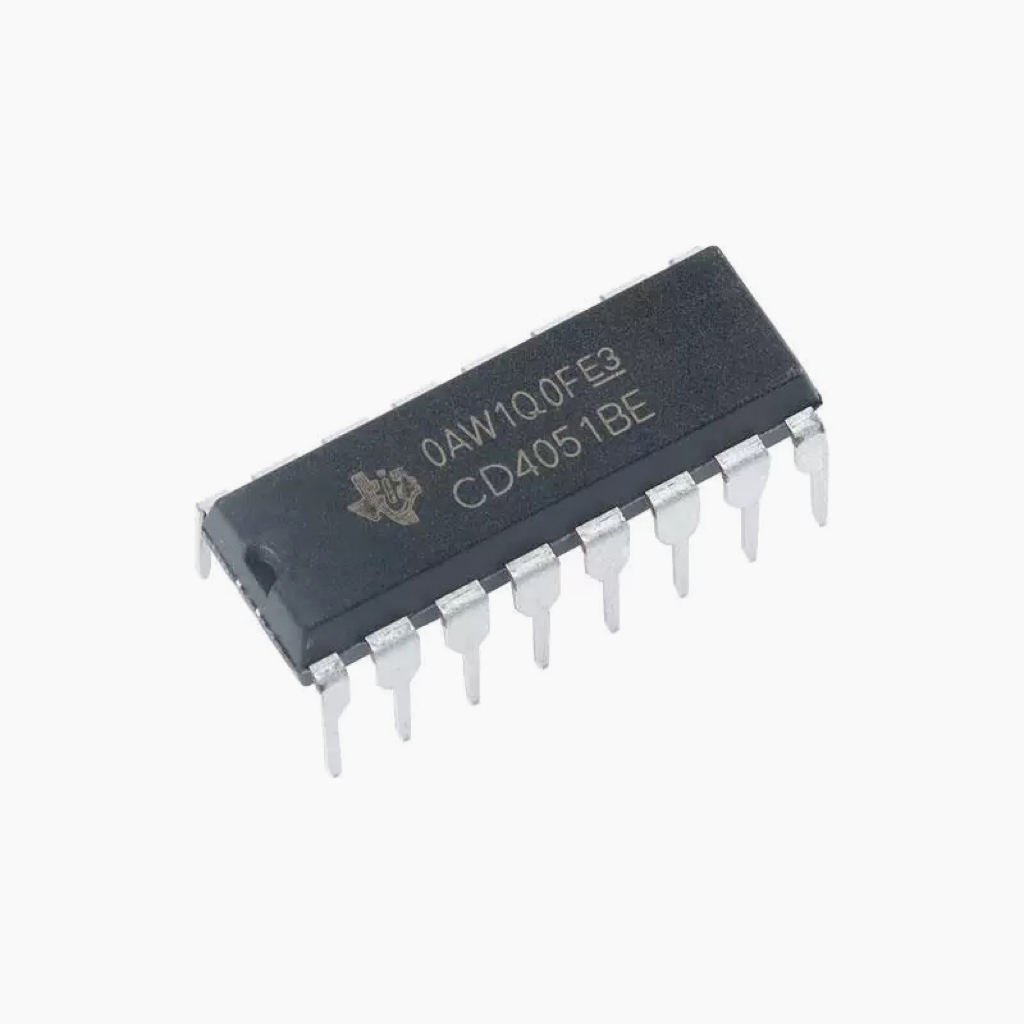
CD4051 analog multiplexer
2025-06-30
Understanding A 0603 Resistor
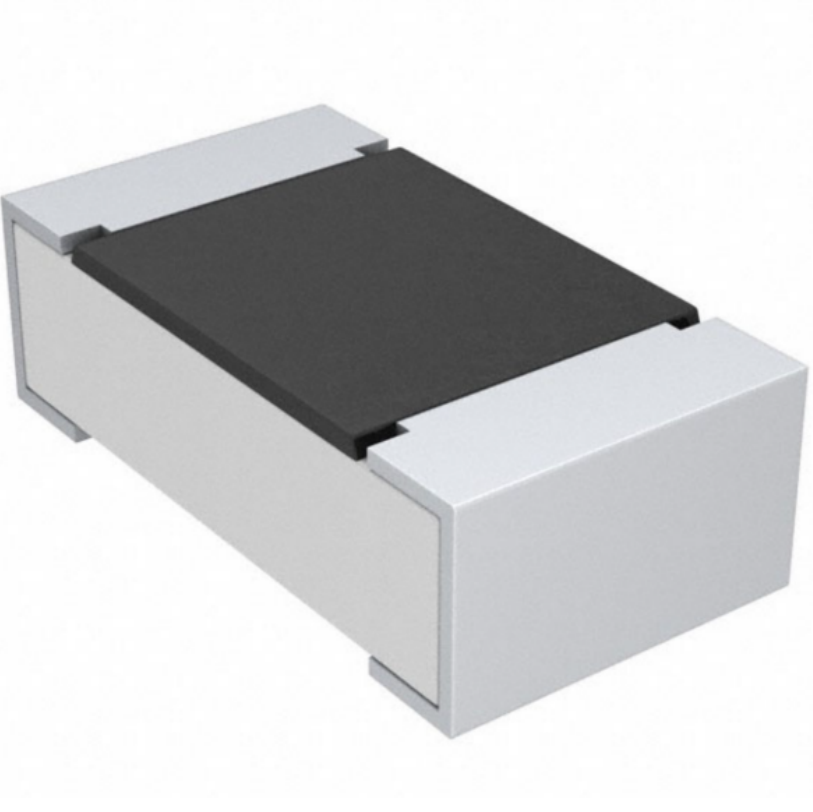
0603 resistor,dimensions,marking code, values
2025-05-29
MT3608 Boost Converter - An In-Depth Guide
MT3608 Boost Converter
2025-09-04
Complete Guide to the 220 Ohm Resistor
220 Ohm Resistor
2025-07-28
The 0402 Resistor: A Comprehensive Guide
0402 Resistor
2025-05-06
Mini MP1584 DC-DC 3A Buck Converter Module: Complete Guide
Mini MP1584 DC-DC 3A Buck Converter Module: Complete Guide
2026-03-26
Guide To The XL6009 Boost Converter
XL6009 Boost Converter
2025-09-05
What Is A 1206 Resistor?
1206 resistor dimensions,footprint,value
2025-06-05