




 BOM
BOM Cart
Cart Product Catalog
Operational amplifiers are a core building block in analog electronics, and few ICs as widely use as the LM324N. Known for its reliability, low power consumption, and flexible single-supply operation, the LM 324N has remained a go-to solution for designers across consumer, industrial, and power-related applications.
The circuit integrates four independent operational amplifiers into a single package, making it ideal for compact circuit designs that require multiple amplification stages. With support for wide supply voltages, ground-referenced inputs, and stable performance in noisy environments, this device continues to be a practical choice for signal conditioning, voltage amplification, and control circuits. In this article, we’ll explore the LM324N’s features, pin configuration, specifications, applications, and common alternatives in detail.
2. LM324N Pinout, CAD Model and Circuit Diagram
5. LM324N Chip Application and Working Principle
6. LM324N Equivalent and Substitutes
8. Amplifying DC Voltage with LM324N
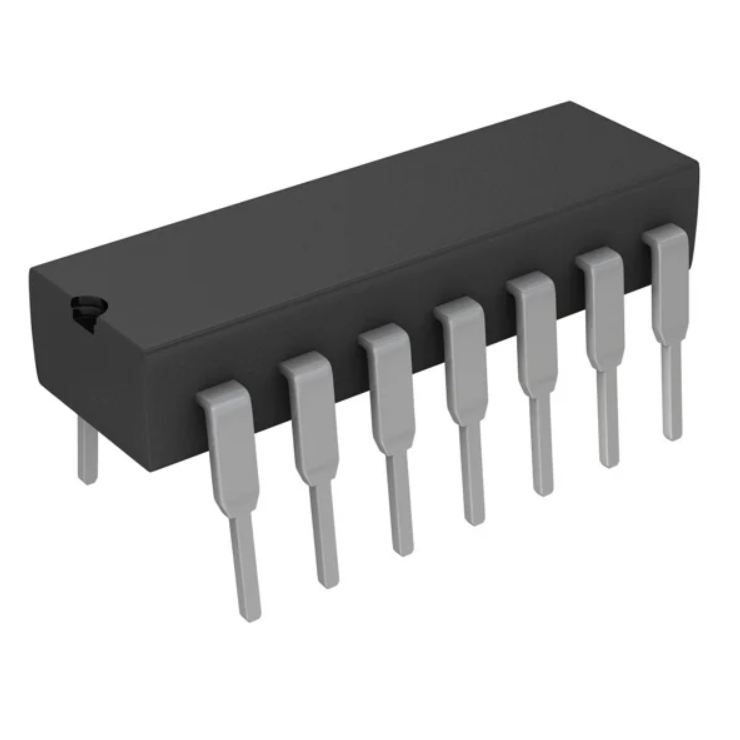
What is LM324N?
The LM 324N is a popular quad operational amplifier IC that integrates four independent op amps in a single 14-pin package. It belongs to the well-known LM324 family and widely use in cost-sensitive analog and mixed-signal designs.
The latest LM324B device represent next-generation improvements over the original LM324. They retain full pin-to-pin compatibility while offering enhanced electrical performance. Each device contains four high-voltage operational amplifiers capable of operating from a single supply of up to 36V.
Key improvements include a low input offset voltage of 600 µV (typical), common-mode input range that includes ground, and the ability to tolerate high differential input voltages. The B and BA versions are unity-gain stable, making them suitable for voltage followers, amplifiers, and signal conditioning circuits.
With a typical quiescent current of only 240 µA per amplifier, the LM 324N is well suited for low-power applications. Enhanced ESD protection (2 kV HBM, 1.5 kV CDM) and integrated EMI/RF filters allow reliable operation in electrically noisy and harsh environments.
LM324N Pinout, CAD Model and Circuit Diagram
LM324N Pin Configuration DIP-14
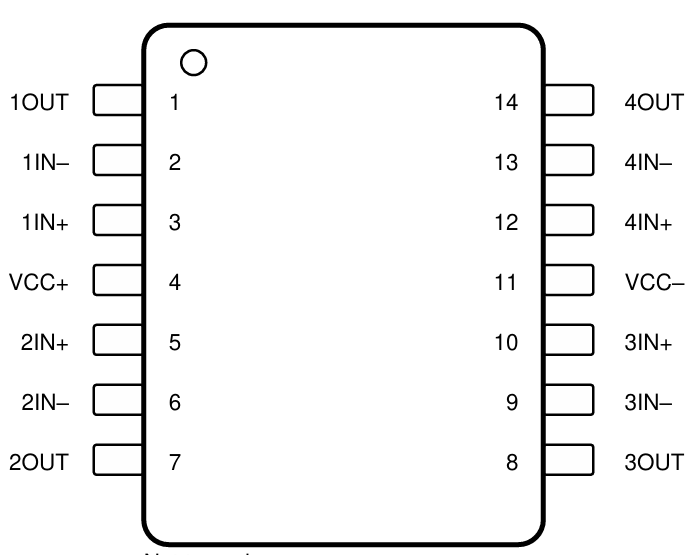
Pin No. | Pin Name | Description |
1 | 1OUT | Output of Op-Amp-1 |
2 | 1IN− | Inverting input of Op-Amp 1 |
3 | 1IN+ | Non-inverting input of Op-Amp 1 |
4 | VCC+ | Positive supply voltage |
5 | 2IN+ | Non-inverting input of Op-Amp 2 |
6 | 2IN− | Inverting input of Op-Amp 2 |
7 | 2OUT | Output of Op-Amp-2 |
8 | 3OUT | Output of Op-Amp-3 |
9 | 3IN− | Inverting input of Op-Amp 3 |
10 | 3IN+ | Non-inverting input of Op-Amp 3 |
11 | VCC− | Negative supply / Ground |
12 | 4IN+ | Non-inverting input of Op-Amp 4 |
13 | 4IN− | Inverting input of Op-Amp 4 |
14 | 4OUT | Output of Op-Amp-4 |
CAD Model and Circuit Diagram
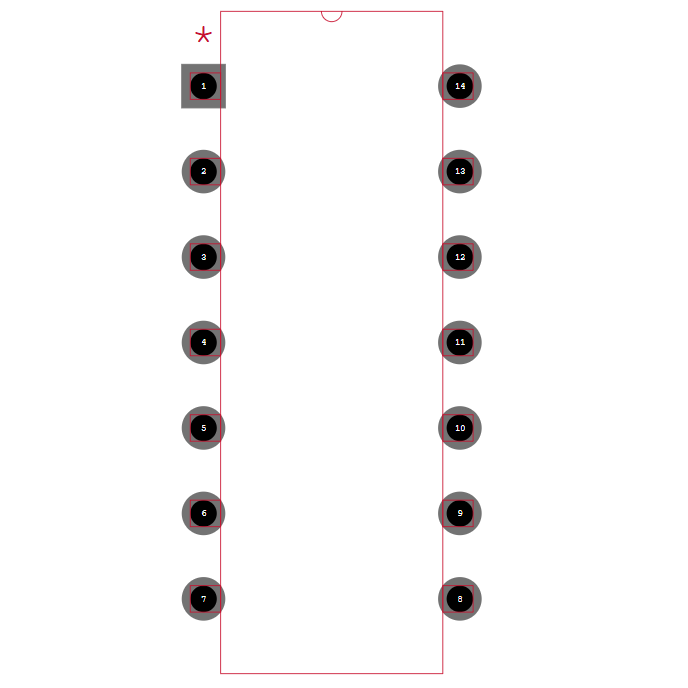
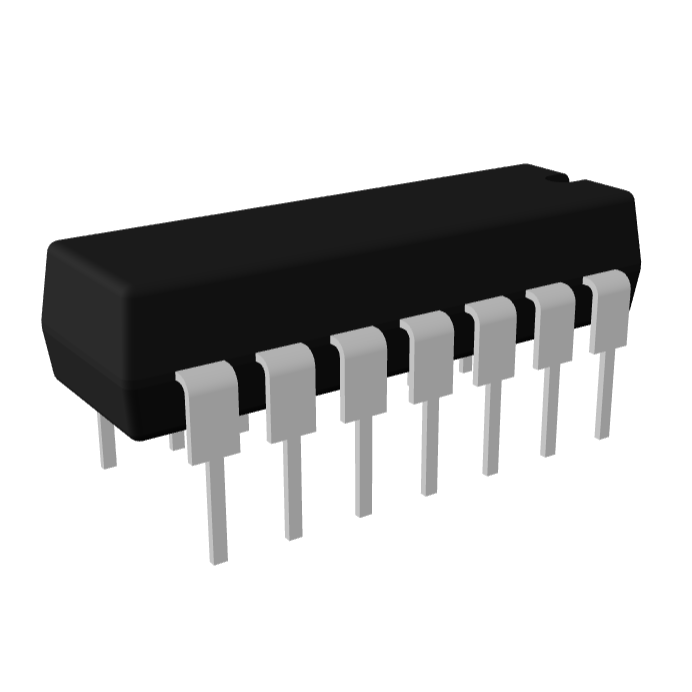
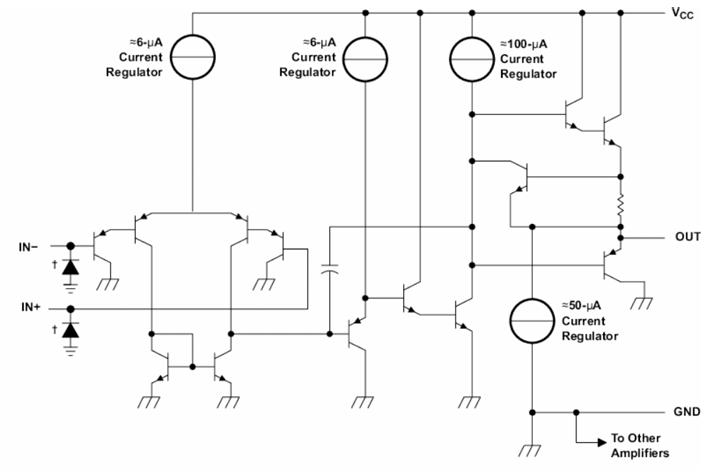
The LM324N CAD symbol typically shows four independent op-amp triangles sharing common VCC+ and VCC− pins. In circuit diagrams, unused amplifiers should have their inputs properly biased to avoid noise or oscillation.
LM324N Specifications
General Electrical Characteristics
Parameter | Value |
Device Type | Quad Operational Amplifier |
Number of Op-Amps | 4 |
Supply Voltage Range | 3V to 32V(36 V max) |
Dual Supply Voltage | ±1.5V to ±16V |
Input Offset Voltage | 2mV |
Input Bias Current | 50 nA max |
Common-Mode Input Range | Includes V− (Ground) |
Differential Input Voltage | Up to supply voltage |
Slew Rate | 0.5 V/µs (typical) |
Gain Bandwidth Product | ~1.2MHz |
Open-Loop Voltage Gain | 100 dB (typical) |
Output Current | 40 mA (typical) |
Quiescent Current | 240 µA per amplifier (typical) |
Operating Temperature Range | 0°C to +70°C |
ESD Protection | 2 kV (HBM), 1.5 kV (CDM) |
Stability | Unity-gain stable |
Mounting Type | Through Hole |
LM324N Package
Package Type | Description |
14-DIP LM324N | Through-hole dual in-line package with a 0.300" (7.62 mm) body width, easy to handle, breadboard-friendly, and commonly used for prototyping, testing, and educational or low-volume production designs |
14-SOIC (SMD) LM324DR, LM324ADR | Surface-mount small-outline package with a 0.154" (3.90 mm) body width, designed for space-saving PCB layouts, automated assembly, and high-density consumer or industrial electronics |
LM324N Manufacturer
The LM 324N produce by several well-known semiconductor manufacturers, including Texas Instruments, STMicroelectronics, and Fairchild Semiconductor (onsemi). These manufacturers provide consistent electrical performance, detailed datasheets, long-term availability, and broad support, making the circuit suitable for both commercial and industrial electronic designs.
IC LM324N Features
Supply Voltage: These versions support a wide supply range from 3 V to 36 V, making them suitable for diverse applications.
Offset Voltage: The input offset voltage is low, with ±2 mV for BA versions and 3 mV for B versions, ensuring accurate amplification.
Protection: High ESD protection of 2 kV (HBM) and 1.5 kV (CDM), along with integrated RF and EMI filtering, improves reliability in electrically noisy environments.
Input Bias: The LM 324N features a low input bias current of 50 nA maximum across −40°C to +125°C, supporting precision applications.
Input Range: The common-mode input voltage range includes V− (ground), and differential input voltage can drive up to the supply voltage, enabling flexible single-supply operation.
LM324N Chip Application and Working Principle
Common Applications
Power Supplies: LM 324N widely use in merchant network and server power supply units, providing stable signal amplification and voltage regulation.
Printers: Multi-function printers utilize LM 324N for precise sensor interfacing and signal conditioning.
Chargers: Power supplies and mobile chargers employ the IC to ensure accurate current and voltage control.
Computers: Desktop PCs and motherboards integrate LM 324N in monitoring circuits and analog signal processing.
Air Conditioners: Indoor and outdoor air conditioning systems use this circuit for temperature sensing and control circuits.
Home Appliances: Washers, dryers, and refrigerators rely on the chip for operational control and sensor amplification.
Inverters: AC inverters, string inverters, central inverters, and voltage frequency drives use LM 324N for control, feedback, and voltage regulation.
UPS Systems: Uninterruptible power supplies implement LM 324N in monitoring, voltage sensing, and protection circuits to maintain reliability.
Working Principle
Signal Comparison: The LM 324N operates by comparing the voltages at its inverting (−) and non-inverting (+) inputs for each of the four internal op-amps.
Voltage Amplification: The difference between these input voltages is amplified according to the external feedback network, allowing precise control of the output voltage.
Single-Supply Operation: The IC can operate from a single positive supply, with the common-mode input range including ground, making it suitable for battery-powered and low-voltage systems.
Differential Handling: The differential input voltage can drive up to the supply voltage, enabling flexible use in high-voltage single-supply applications.
Stability: Each amplifier is unity-gain stable, ensuring consistent performance in voltage follower, buffer, and active filter configurations.
Noise Immunity: Integrated EMI and RF filters enhance signal integrity, allowing the circuit to function reliably in electrically noisy environments.
LM324N Equivalent and Substitutes
LF444ACN/NOPB (Texas Instruments / National Semiconductor)
This quad op-amp is a reliable alternative to the LM 324N, offering similar performance and stability for general-purpose analog circuits.
LM248N (Texas Instruments)
Provides comparable quad amplifier functionality with matching voltage ranges and low offset, suitable for industrial and consumer designs.
LM2902KN and LM2902N/NOPB (Texas Instruments)
Pin-to-pin compatible replacements for LM324N, delivering the same electrical characteristics and wide supply voltage operation.
LM324AN and LM324KAN (Texas Instruments)
Upgraded versions of the LM324 family, designed for drop-in replacement in legacy circuits while improving reliability and tolerance.
LT1214CN#PBF (Linear Technology / Analog Devices)
High-performance quad op-amp suitable for precision applications that require low noise and stable operation.
MC3303N (Texas Instruments)
Quad op-amp with similar input and output characteristics, often used in industrial and automotive applications.
OP490GPZ (Analog Devices)
Alternative quad amplifier with comparable supply range and gain specifications for general analog processing.
TL064IN (Texas Instruments)
Low-power JFET-input quad op-amp, ideal for high-impedance signal amplification and a viable substitute in LM324N circuits.
These ICs offer similar quad-op-amp functionality, though bandwidth, offset, and power consumption vary.
LM324N Power Supply
Single-Supply Operation: The LM324N can operate from a single positive supply voltage ranging from 3V to 32V, with an absolute maximum rating of 36 V. This allows it to use in low-voltage circuits, battery-powered devices, and portable electronics without requiring a negative voltage rail. Designers can directly connect the IC to common single-supply systems, simplifying circuit design.
Dual-Supply Operation: In addition to single-supply operation, the LM 324N also supports dual-supply configurations, typically from ±1.5V to ±16V. Dual supplies provide a symmetric voltage range, enabling the IC to handle signals that swing both above and below ground. This is especially useful in precision analog applications and AC signal amplification.
Quiescent Current: Each internal amplifier of the LM 324N draws a low quiescent current of approximately 240 µA, ensuring energy-efficient operation even in multi-amplifier circuits. Low power consumption reduces heat generation and makes the IC suitable for continuous operation in industrial and consumer electronics.
Voltage Flexibility: The wide supply voltage range ensures that the component can deploy across a variety of applications, from microcontroller-based systems to industrial control circuits, without worrying about compatibility issues.
Stability and Reliability: The chip maintains stable operation across its entire supply range, even in noisy electrical environments, thanks to integrated EMI and RF filters. This ensures consistent performance in sensitive measurement, amplification, and control applications.
Practical Considerations: When designing circuits with the LM324N, it is important to ensure that the supply voltage does not exceed the maximum rating. Adequate decoupling capacitors near the IC can help reduce voltage spikes, improve noise immunity, and maintain stable operation under varying load conditions.
Amplifying DC Voltage with LM324N
Signal Amplification: The LM 324N can amplify small DC voltages from sensors, transducers, or other low-voltage sources, making weak analog signals strong enough for measurement, processing, or control circuits. Its low input offset voltage and high input impedance ensure minimal error and accurate amplification.
Non-Inverting Configuration: In a standard non-inverting amplifier setup, the gain determine by two external resistors using the formula Gain = 1 + (R2 / R1). This allows designers to set precise amplification levels based on their circuit requirements while maintaining signal stability.
Single-Supply Advantage: One of the key benefits of the circuit is that its common-mode input range includes ground, enabling accurate DC signal amplification near 0 V without requiring a negative voltage rail. This makes it ideal for battery-powered, portable, or low-voltage electronic systems.
Flexibility: The differential input voltage of the operational amplifiers can drive up to the supply voltage, providing versatility for handling both small and moderately high DC signals. Its internal unity-gain stability ensures reliable operation in buffer or follower configurations.
Stability and Reliability: Each amplifier design to maintain stable operation without oscillation, even when driving capacitive loads or operating in electrically noisy environments. Integrated EMI and RF filters further enhance signal integrity.
Practical Applications: This functionality makes the circuit suitable for a wide range of real-world applications, including amplifying outputs from temperature sensors, current shunts, pressure sensors, or other low-level DC sources in industrial, consumer, and embedded electronics. It also commonly use in precision measurement and control circuits where accurate voltage amplification is critical.
LM324N Datasheet PDF
For complete electrical characteristics, application circuits, and package drawings, refer to the official data sheet PDF.
Frequently Asked Questions
What is the difference between LM324 and LM324N?
The LM324 is the general family name for a quad operational amplifier IC, whereas LM324N specifically refers to the DIP-14 package version. Functionally, they are identical, but the “N” denotes a through-hole package suitable for prototyping or PCB insertion, while LM324 also include SMD versions and other package types.
What is the difference between LM324A and LM324N?
The LM324A is an upgraded variant of the LM324 series with improved electrical specifications, including lower input offset voltage, tighter tolerance, and better temperature performance. The LM324N typically refers to the standard DIP-14 package. In essence, LM324A provides more precise operation, while LM324N represents the standard version used in general-purpose applications.
What is the normal working voltage of LM324N?
The LM 324N operates with a single supply voltage from 3V to 32V, with an absolute maximum rating of 36V. It also supports dual supply operation from ±1.5V to ±16V. This wide voltage range allows flexible use in battery-powered, industrial, or consumer electronic circuits requiring quad amplifier functionality.
What is the difference between LM348N and LM324N?
The LM348N is typically a quad op-amp designed for dual-supply operation, often requiring positive and negative voltage rails, whereas the LM324N can operate on a single supply, making it more suitable for low-voltage or ground-referenced circuits. Electrical performance is similar, but LM324N offers more versatility in single-supply and battery-powered applications.
What is the slew rate of the LM324N?
The LM324N has a typical slew rate of 0.5 V/µs, which defines how quickly the output voltage can change in response to a step input. This moderate slew rate makes it suitable for low- to medium-speed analog signal amplification, DC and sensor signal processing, and general-purpose analog applications without high-frequency or fast transient requirements.
What is the input voltage range of the LM324N?
The LM324N’s common-mode input voltage range extends from the negative rail (ground for single-supply operation) up to slightly below the positive supply voltage. This allows it to accurately sense signals near 0 V and operate reliably without distortion in single-supply circuits, giving flexibility for DC and low-voltage signal amplification.
What is the offset voltage of the LM324N?
The LM324N has a maximum input offset voltage of 3mV in the standard B version and ±2mV in the BA version, ensuring precise amplification of small differential signals. Low offset voltage reduces measurement error in DC applications, making it suitable for sensor interfacing, instrumentation, and low-level signal processing.
What is LM324N used for?
The LM324N widely use for signal amplification, buffering, and analog signal processing. Ideal for sensor interfacing, voltage followers, DC amplification, active filters, and control circuits. Its ability to operate on single or dual supplies makes it versatile for consumer electronics, industrial systems, power supplies, and embedded microcontroller applications.
What is the function of LM324 IC?
The LM324 integrates four independent operational amplifiers in a single IC, designed to amplify voltage differences between its inputs. Its function is to provide accurate signal amplification, voltage buffering, filtering, and control in analog circuits. It can work with single or dual supplies, making it suitable for a wide range of measurement, sensor, and control applications.
Conclusion
The LM324N remains one of the most versatile and widely used quad operational amplifiers in electronics. Its combination of low power consumption, wide supply voltage range, single- or dual-supply operation, and reliable performance makes it ideal for both hobbyist and industrial applications. With features like low input offset, unity-gain stability, and EMI protection, the LM324N excels in amplifying, buffering, and controlling analog signals. Whether in power supplies, sensors, consumer electronics, or industrial control systems, this IC provides a robust, cost-effective solution for precise analog signal processing. Understanding its specifications, applications, and alternatives helps designers make informed choices for reliable circuit performance.
Read More:
1. LM393: Guide to the Dual Comparator IC
2. NE5534 Op-Amp: Specifications, Applications, and Datasheet
HOT NEWS
TP4056 Charging Module Pinout, Working, and Applications
TP4056 Charging Module Pinout, Working, and Applications
2026-01-23
LR41 Battery Guide: Specifications, Equivalents, and Uses
LR41 Battery Specifications, Equivalents, and Uses
2025-12-14
Understanding A 0603 Resistor
0603 resistor,dimensions,marking code, values
2025-05-29
MT3608 Boost Converter - An In-Depth Guide
MT3608 Boost Converter
2025-09-04
The 0402 Resistor: A Comprehensive Guide
0402 Resistor
2025-05-06
Complete Guide to the 220 Ohm Resistor
220 Ohm Resistor
2025-07-28
What Is A 1206 Resistor?
1206 resistor dimensions,footprint,value
2025-06-05
Guide To The XL6009 Boost Converter
XL6009 Boost Converter
2025-09-05
Understanding The CD4051 Analog Multiplexer
CD4051 analog multiplexer
2025-06-30
120 Ohm Resistor- Specifications, Applications, and Features
2025-05-12