




 BOM
BOM Cart
Cart Product Catalog
The LM2576 voltage regulator is a widely used step-down (buck) switching regulator IC designed for reliable, high-current DC-DC power conversion. Known for its simplicity, efficiency, and robustness, frequently select the circuit for industrial, embedded, and power supply designs where require stable voltage regulation up to 3 A output current.
This article provides a comprehensive overview of the voltage regulator, including its features, internal structure, pin configuration, applications, equivalent parts, and practical design considerations.
3. LM2576 Pinout, Pin Configuration and CAD Design
4. LM2576 Voltage Regulator Internal Structure
5. LM2576 IC Technical Specifications
8. Peripheral Components Selection for LM2576
10. LM2576 Voltage Regulator Application Circuit
11. DC-DC Buck Converter Module Board 3A Adjustable Voltage Regulator LM2576 12/24V to 12/5/3.3V
12. Frequently Asked Questions [FAQ]
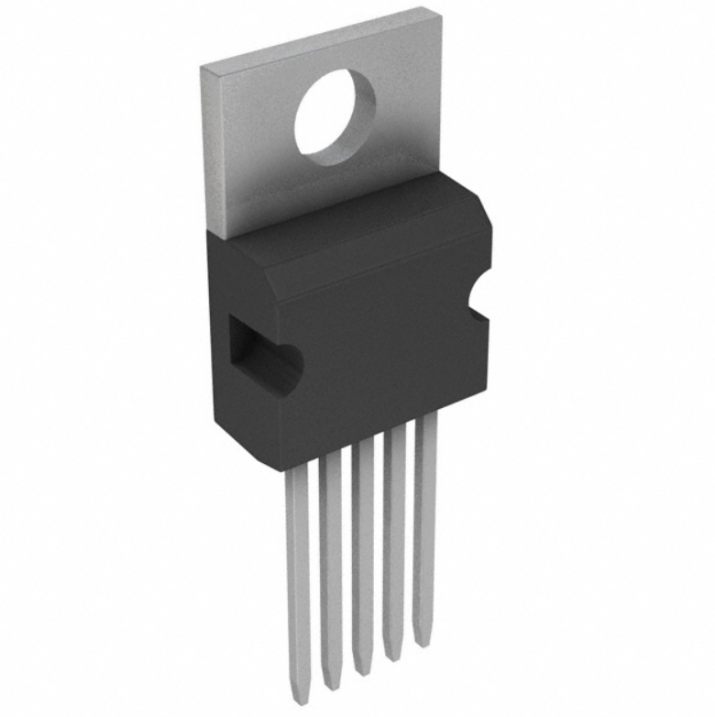
LM2576 Voltage Regulator
The LM2576’s series consists of monolithic integrated circuits designed to perform all the active functions required for a step-down (buck) switching regulator. These devices can deliver a continuous output current of up to 3 A while maintaining excellent line and load regulation, making them suitable for a wide range of power supply applications. The LM2576 is available in fixed output voltage options of 3.3 V, 5 V, 12 V, and 15 V, as well as an adjustable version that allows designers greater flexibility.
One of the main advantages of the chip is its ability to operate with a minimal number of external components, which simplifies circuit design and reduces overall system cost. The IC integrates a fixed-frequency oscillator, internal power switch, and comprehensive fault protection features, including cycle-by-cycle current limiting and thermal shutdown.
Compared with traditional three-terminal linear regulators, the LM2576 provides a high-efficiency solution, significantly lowering power dissipation. As a result, the size of the heat sink can greatly reduce, and in some designs, not require a heat sink at all. Additionally, manufacturers offer standard inductors optimized for LM 2576 operation, further simplifying switch-mode power supply design. The regulator also features ±4% output voltage accuracy, ±10% oscillator frequency tolerance, and an external shutdown function with a typical standby current of just 50 μA, ensuring reliable and efficient performance under various operating conditions.
LM2576 Alternative and Equivalent
CS51411
LM2575
LM2596
LM2940
MP2307
LM7805
LM2576 Circuit Features
The IC offers a versatile set of circuit features that make it suitable for a wide range of DC-DC step-down applications. It is available in fixed output voltage versions of 3.3V, 5V, 12V, and 15V, along with an adjustable version that provides added design flexibility. The adjustable variant supports an output voltage range from 1.23 V to 37 V, and up to 57 V for the high-voltage (HV) version, with a ±4% maximum variation over line and load conditions.
The device is specified to deliver a continuous output current of 3 A, ensuring reliable operation for medium-power loads. It supports a wide input voltage range, up to 40 V, and 60 V for the HV version, making it compatible with many industrial and automotive power sources. One of the key advantages of the circuit is that it requires only four external components, which simplifies circuit design and reduces component count.
An internal 52 kHz fixed-frequency oscillator ensures stable switching operation, while TTL-compatible shutdown control allows the regulator to enter a low-power standby mode when disabled. Combined with its high efficiency and compatibility with readily available standard inductors, the IC provides a robust and easy-to-implement buck regulator solution.
LM2576 Pinout, Pin Configuration and CAD Design
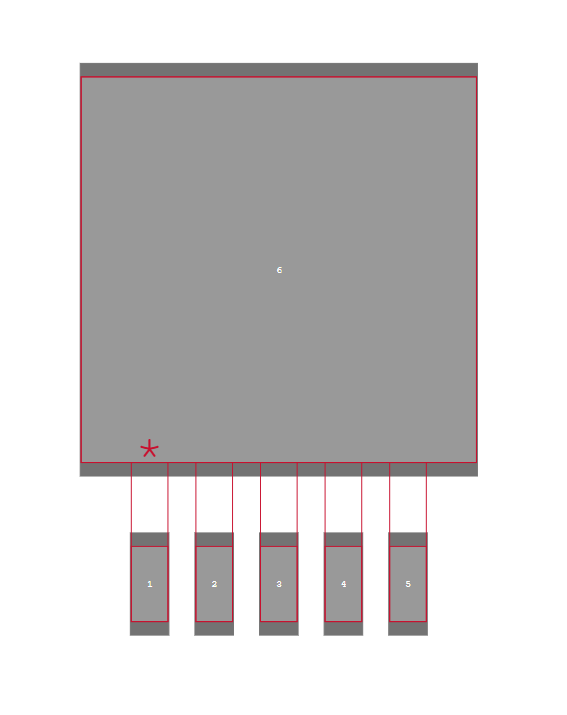
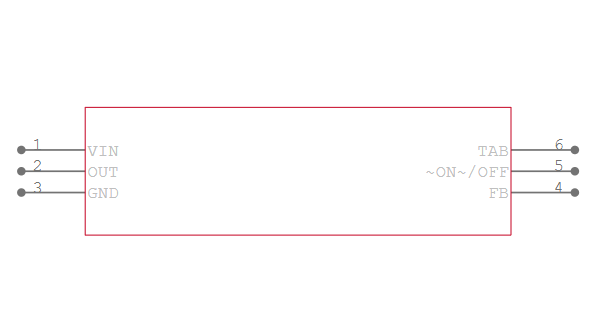
LM2576 Pin Configuration
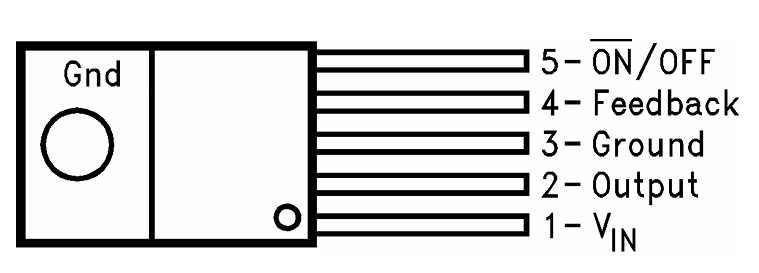
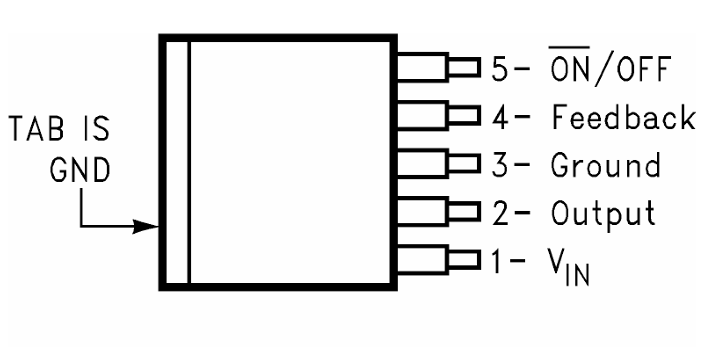
The IC features a simple five-pin configuration designed to support efficient power conversion and easy PCB layout. Each pin has a specific role in ensuring stable operation and proper regulation.
VIN (Pin 1) is the supply input pin connected to the collector of the internal high-side power transistor. This pin must connect to the input power source along with the input bypass capacitor (CIN). For optimal performance, the connection between VIN, the high-frequency bypass capacitor, and ground should keep as short as possible to minimize noise and switching losses.
OUTPUT (Pin 2) is the emitter of the internal power transistor and serves as the switching node. This pin connects directly to the inductor and the cathode of the external Schottky diode, forming the main energy transfer path in the buck converter.
GROUND (Pin 3) provides the common ground reference for the device. A low-impedance, short path to the input capacitor is critical to reduce ground noise and improve stability.
FEEDBACK (Pin 4) is the feedback sense input. In adjustable versions, it connects to the midpoint of the resistor divider that sets the output voltage. In fixed-voltage versions, this pin connect directly to the output capacitor.
ON/OFF (Pin 5) controls the enable function. A low level turns the regulator on, while a high level disables it. This pin should never leave floating.
The TAB internally connect to ground and should attach to a heatsink or a grounded copper plane for effective thermal management.
LM2576 Voltage Regulator Internal Structure
The voltage regulator integrates all the critical functional blocks required for a step-down (buck) switching power supply within a single monolithic IC. At the core of the device is an internal power switching transistor, capable of handling load currents up to 3 A. This switch drive by a pulse-width modulation (PWM) control circuit that regulates the output voltage by adjusting the duty cycle of the switching signal.
A precision voltage reference and an error amplifier continuously monitor the feedback voltage and compare it with the internal reference. Any deviation in the output voltage correct by the control loop, ensuring stable regulation under varying line and load conditions. The circuit operates with a fixed 52 kHz internal oscillator, which simplifies external component selection and ensures predictable switching behavior.
For protection and reliability, the internal structure includes cycle-by-cycle current limiting, which prevents excessive current through the power switch during overload or short-circuit conditions. Additionally, thermal shutdown circuitry disables the regulator if the junction temperature exceeds safe limits, protecting the device from overheating.
The IC also incorporates a shutdown control circuit that places the regulator into a low-power standby mode when disabled. By combining control logic, power switching, and protection features into one device, the IC provides a stable, efficient, and robust solution for DC-DC buck voltage regulation in industrial and embedded applications.
LM2576 IC Technical Specifications
Mfr | Texas Instruments |
Packaging | Tube, Reel |
Function | Step-Down |
Output Configuration | Positive |
Topology | Buck |
Output Type | Fixed, Adjustable |
Number of Outputs | 1 |
Voltage - Input (Min) | 4V |
Voltage - Input (Max) | 40V, 60V |
Voltage - Output (Min/Fixed) | 1.2V, 1.23V, 3.3V, 5V, 12V, 15V |
Current - Output | 3A |
Frequency - Switching | 52kHz |
Synchronous Rectifier | No |
Operating Temperature | -40°C ~ 125°C (TJ) |
Mounting Type | Through Hole, Surface Mount |
Package / Case | TO-220-5, TO-263-5 |
Efficiency | Up to ~80–88% (application-dependent) |
LM2576 Packaging Information
The voltage regulator is available in multiple package options to suit both through-hole and surface-mount designs.
LM2576 (TO-220-5) Through-Hole
The standard TO-220 (5-pin) package measures 10.16 mm × 8.51 mm and widely use in applications where require easy mounting, higher power dissipation, and optional external heat sinking. The metal tab of the TO-220 package internally connect to ground, allowing it to attach directly to a heatsink or a grounded copper area for improved thermal performance.
LM2576 SMD
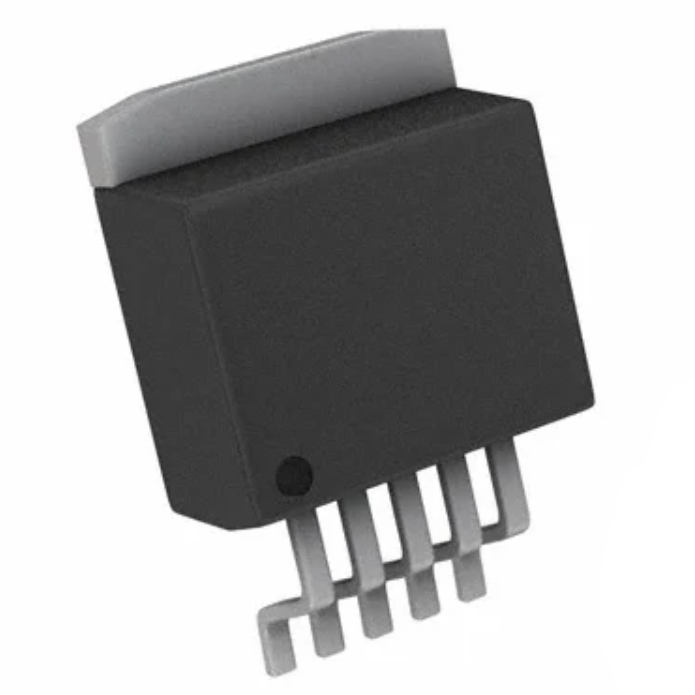
For compact and surface-mount applications, the LM2576HV SMD package (DDPAK / TO-263) is available with dimensions of 10.16 mm × 8.42 mm. This package is well suited for automated assembly and designs where PCB space optimization is important. The exposed tab in the SMD version also connect to ground and should solder to a large copper plane to enhance heat dissipation.
Both package options provide reliable thermal management and electrical performance, allowing designers to select the most suitable form factor based on power requirements, PCB layout constraints, and manufacturing preferences.
LM2576 Common Applications
The voltage regulator commonly use across a broad range of power management applications. In motor drive power supplies, it delivers stable DC voltage for control logic, sensors, and auxiliary circuits, even in electrically noisy environments. Merchant network and server PSU designs rely on the LM 2576 to efficiently step down higher bus voltages to regulated levels required by communication and monitoring modules.
In home and industrial appliances, the circuit provides reliable power for microcontrollers, displays, and interface circuits while maintaining good thermal performance. It also widely apply in test and measurement equipment, where accurate and stable voltage regulation is necessary to ensure consistent measurement results.
The regulator is well suited for embedded control systems, supplying clean and efficient power to processors and peripheral devices. Additionally, the chip use in battery-powered and automotive electronics, where its wide input voltage range, high efficiency, and built-in protection features support dependable operation under fluctuating supply conditions.
LM2576 TI Manufacturer
The voltage regulator manufacture by Texas Instruments (TI), a leading global semiconductor company known for high-quality analog and power management ICs. The TI LM 2576 series is widely available as genuine parts distributed through authorized electronics suppliers and is supported by comprehensive technical documentation, including datasheets and application notes. The TI versions are reliable, well-tested, and backed by long-term availability, making them a popular choice for both hobbyist and professional power supply designs.
Available documentation:
LM2576 datasheet: PDF
Peripheral Components Selection for LM2576
When designing with the voltage regulator, selecting the right peripheral components is critical for achieving optimal performance, efficiency, and stability.
Schottky Diodes – Recommend a fast-recovery Schottky diode for the output stage to minimize switching losses and voltage drop. Common choices, such as the 1N5822, provide low forward voltage and high current handling, improving overall efficiency.
Inductor Choices – The inductor determines the energy storage and ripple current in the buck converter. Choose an inductor rated for at least the maximum load current (3 A) with low DC resistance to reduce power loss. Standard off-the-shelf inductors recommend in the datasheet simplify component selection.
Significance of Low ESR Capacitors – Using low ESR (Equivalent Series Resistance) capacitors for the output reduces voltage ripple and improves transient response. High-ESR capacitors can cause instability and poor regulation, especially under fast load changes.
Ensuring Output Capacitor Stability – The output capacitor must meet the minimum capacitance and ESR requirements specified in the datasheet to maintain control loop stability. Correct selection prevents oscillation and ensures reliable, ripple-free output voltage.
By carefully choosing these peripheral components, designers can maximize the efficiency, reliability, and performance of LM2576-based power supply circuits.
Comparable Components
Variant | Description |
LM2576-1.23 | 1.23V |
LM2576-3.3 | 3.3V output |
LM2576-5 | 5V output |
LM2576-12 | 12V output (LM2576-12WU) |
LM2576-15 | 15V output |
LM2576-ADJ | Adjustable output |
LM2576-1.23V
It provides a 1.23V fixed-output voltage.
LM2576-3.3V
The 3.3 V fixed-output version delivers a stable 3.3 V DC output at up to 3 A. It commonly use in low-voltage digital circuits, microcontrollers, and logic devices, providing a simple and reliable power solution without the need for external resistors.
LM2576-5V
The 5 V fixed-output variant provides a regulated 5V output with high efficiency. It widely use in microcontroller boards, sensors, and peripheral devices, where require a standard 5.0V supply.
LM2576-12V (LM2576-12WU)
The 12 V fixed-output version design for applications that require a higher voltage supply, such as industrial circuits, relay drives, or power modules. It maintains stable regulation up to a 3 A load with minimal external components.
LM2576-15V
The 15 V fixed-output variant is suitable for analog circuits, op-amp power rails, and industrial instrumentation, providing a robust 15V regulated output while reducing heat generation compared to linear regulators.
LM2576-ADJ (Adjustable)
The adjustable version allows designers to set output voltages from 1.23 V up to 37 V, or 57 V for the high-voltage (HV) version. This variant is ideal for applications needing flexible output voltages or custom regulation without changing the IC.
These LM2576 variants allow designers to select the appropriate voltage output for their application while retaining the same reliable, high-efficiency buck regulator functionality.
LM2576 Voltage Regulator Application Circuit
A typical voltage regulator application circuit demonstrates a complete step-down (buck) DC-DC converter capable of delivering a stable output voltage with high efficiency. The main components in the circuit include the LM2576 IC, Schottky diode (commonly 1N5822), input and output capacitors, and an inductor.
In operation, the LM2576 IC switches the input voltage through the internal power transistor. The 1N5822 Schottky diode provides a fast recovery path for current when the transistor switches off, minimizing voltage drop and power loss. Input capacitors (CIN) filter the supply voltage, reducing ripple and ensuring stable operation, while output capacitors (COUT) smooth the switched voltage into a steady DC output.
Connect an inductor between the output of the LM2576 and the diode/capacitor network to store energy during the on-state and release it during the off-state, forming the fundamental energy-transfer mechanism of the buck converter.
For adjustable voltage versions, add a resistor divider between the output, feedback pin, and ground to set the desired output voltage. Fixed-output versions connect the feedback pin directly to the output capacitor.
This simple configuration, with minimal external components, allows the LM2576 to provide efficient, reliable, and stable voltage regulation for a wide range of applications.
DC-DC Buck Converter Module Board 3A Adjustable Voltage Regulator LM2576 12/24V to 12/5/3.3V
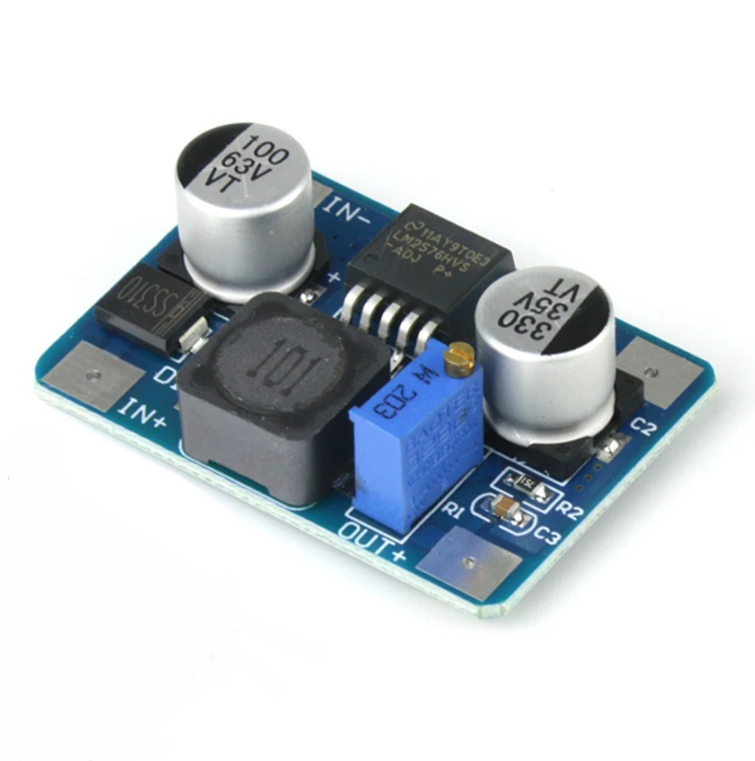
This DC-DC buck converter module uses a high-quality LM2576 chip delivering high efficiency up to 92% with low heat generation. It can handle currents up to 3 A for short periods, but for continuous operation, it recommend to limit the current to 2.5 A and use a heatsink when output power exceeds 10 W.
Application examples include:
Car Voltage Regulator – Connect the module to a car’s cigarette lighter socket. By adjusting the onboard potentiometer, the output voltage can set anywhere between 1.25V and 30V, making it suitable for charging or powering devices like mobile phones, MP3/MP4 players, PSPs, and other electronics.
Powering Electronic Devices – When a device requires 3–30 V, and a matching power supply is unavailable, this module allows precise voltage adjustment, solving compatibility issues and providing a flexible solution for various electronics.
System Working Voltage Testing – During development or debugging, the module can use to test the operating voltage range of circuits or systems, making it a versatile tool for engineers and hobbyists alike.
This adjustable LM2576 module is compact, efficient, and ideal for prototyping, testing, and portable power applications.
Frequently Asked Questions [FAQ]
What is LM2576 price?
The LM2576 price varies depending on the supplier, quantity, and package type. Typically, single units range from $0.7 to $3 each for standard TO-220 or SMD packages. Bulk orders or distributors offer lower pricing. Authorized Texas Instruments suppliers provide genuine LM 2576 ICs, ensuring reliability and datasheet compliance for industrial and hobbyist applications.
What is the LM2576 current regulator?
The LM2576 is primarily a voltage regulator, but it includes cycle-by-cycle current limiting to protect the internal power switch. It regulates output voltage while limiting maximum current to prevent damage during overloads or short circuits. This feature provides partial current regulation but does not make the circuit a dedicated constant-current source.
What is the use of LM2576?
The LM2576 use as a step-down (buck) DC-DC voltage regulator, efficiently converting higher input voltages to lower, stable output voltages. It is ideal for powering microcontrollers, sensors, motor drives, industrial equipment, and embedded systems, providing up to 3 A output current with minimal external components and high efficiency.
What is the difference between LM2596 and LM2576?
The LM2596 and LM2576 are both buck regulators, but the LM2596 operates at a higher switching frequency (typically 150 kHz), allowing smaller inductors and capacitors. The LM2576 runs at 52 kHz, which can handle larger inductors for lower ripple but larger board space. Both provide similar current ratings, efficiency, and protection features.
What power supply uses LM2576?
LM2576 use in industrial DC-DC power supplies, server PSUs, embedded control systems, battery-powered devices, motor drive circuits, and appliances. Any application requiring efficient step-down voltage conversion with up to 3 A output current, stable regulation, and built-in protection can use LM2576 as the primary regulator IC.
How does LM2576 work?
The LM2576 works by switching the internal power transistor at a fixed frequency (52 kHz), transferring energy through an inductor and smoothing it with capacitors to provide a stable output voltage. Feedback from the output ensures correct voltage, while current limiting and thermal shutdown protect the IC. PWM control adjusts duty cycle for voltage regulation.
Can LM2576 be used for boosting?
No, the LM2576 cannot use as a boost (step-up) regulator. It is a buck (step-down) converter only, designed to reduce input voltage to a lower regulated output. Using it to increase voltage would damage the IC or result in improper operation, as the topology does not support voltage step-up functionality.
What is the maximum voltage for LM2576?
The maximum input voltage for the standard LM2576 is 40 V, while the high-voltage (HV) version supports up to 60 V. Exceeding these limits can permanently damage the IC. The output voltage depends on the selected fixed or adjustable version and regulate up to 3 A load current with proper thermal management.
Conclusion
The LM2576 voltage regulator remains a reliable and widely adopted solution for medium-power DC-DC buck conversion. With simple implementation, strong protection features, and proven performance, it continues to serve industrial, commercial, and embedded applications effectively.
Read More:
1. LM317T Voltage Regulator: Pinout, Datasheet and Equivalent
HOT NEWS
TP4056 Charging Module Pinout, Working, and Applications
TP4056 Charging Module Pinout, Working, and Applications
2026-01-23
LR41 Battery Guide: Specifications, Equivalents, and Uses
LR41 Battery Specifications, Equivalents, and Uses
2025-12-14
Understanding A 0603 Resistor
0603 resistor,dimensions,marking code, values
2025-05-29
Understanding The CD4051 Analog Multiplexer
CD4051 analog multiplexer
2025-06-30
MT3608 Boost Converter - An In-Depth Guide
MT3608 Boost Converter
2025-09-04
Complete Guide to the 220 Ohm Resistor
220 Ohm Resistor
2025-07-28
The 0402 Resistor: A Comprehensive Guide
0402 Resistor
2025-05-06
Guide To The XL6009 Boost Converter
XL6009 Boost Converter
2025-09-05
Mini MP1584 DC-DC 3A Buck Converter Module: Complete Guide
Mini MP1584 DC-DC 3A Buck Converter Module: Complete Guide
2026-03-26
What Is A 1206 Resistor?
1206 resistor dimensions,footprint,value
2025-06-05