




 BOM
BOM Cart
Cart Product Catalog
The LM2903 is a popular dual voltage comparator integrated circuit widely used in industrial, automotive, consumer electronics, and power management systems. Designed for low-power operation and can work from both single and dual power supplies, making it suitable for a broad range of analog signal comparison applications.
This article explains the LM 2903 pin configuration, technical specifications, features, applications, equivalents, and frequently asked questions.
7. Frequently Asked Questions [FAQ]
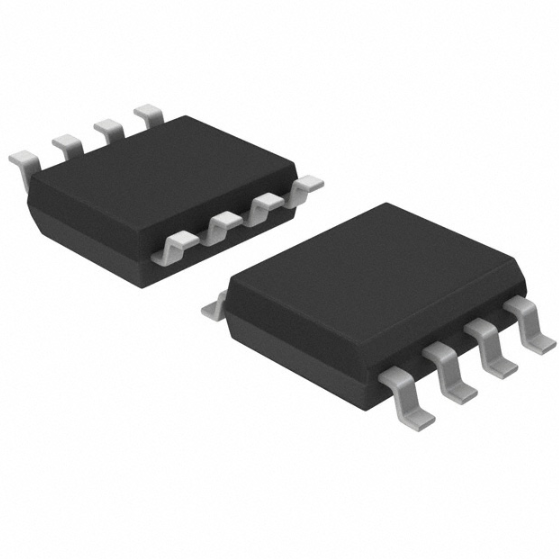
What is LM2903?
The LM 2903 is a dual low-power voltage comparator IC designed to operate from a single power supply across a wide voltage range. It contains two independent comparators inside one package, allowing it to compare two different voltage signals simultaneously in electronic circuits.
The device can also operate using split power supplies, making it flexible for both single-supply and dual-supply applications. One of its notable features is that the input common-mode voltage range includes the negative rail (ground), even when operating from a single power supply. This capability makes the LM2903 highly suitable for low-voltage sensing and signal monitoring applications.
The chip commonly use in industrial control systems, battery monitoring circuits, motor drives, power supplies, automation equipment, and signal conditioning applications because of its low power consumption, fast response time, and reliable performance.
LM2903 Pin Configuration
The LM 2903 is commonly available in an 8-pin package such as SOIC, DIP, or WSON.
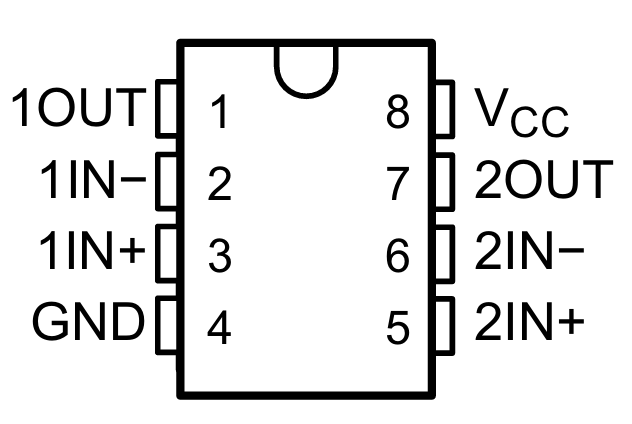
Pin No. | Pin Type | Function Description |
1 | Output | Comparator 1 output terminal |
2 | Input | Inverting input (−) of comparator 1 |
3 | Input | Non-inverting input (+) of comparator 1 |
4 | Power | Ground (GND) connection |
5 | Input | Non-inverting input (+) of comparator 2 |
6 | Input | Inverting input (−) of comparator 2 |
7 | Output | Comparator 2 output terminal |
8 | Power | Positive supply voltage (VCC) |
How Does the LM 2903 Comparator Work?
A comparator compares two analog input voltages:
· Non-inverting input (+)
· Inverting input (−)
When the voltage at the positive input becomes higher than the negative input, the output switches state. If the negative input voltage is higher, the output changes to the opposite state.
The LM 2903 uses an open-collector output, meaning it usually requires an external pull-up resistor for proper operation.
Basic comparator operation:
V+ > V− → Output changes HIGH
V+ < V− → Output changes LOW
This functionality widely use in:
· Voltage threshold detection
· Sensor interfacing
· Overvoltage protection
· Oscillator circuits
· Zero-crossing detectors
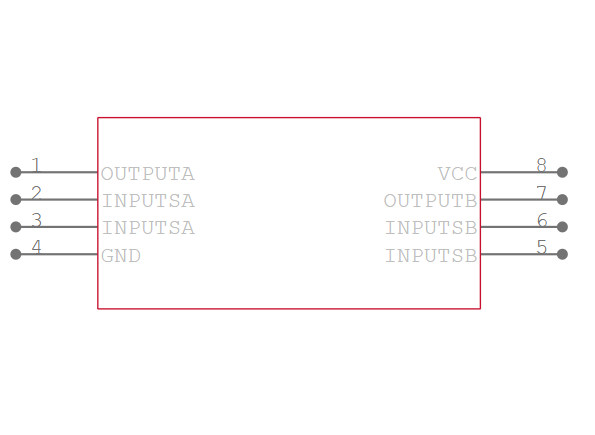
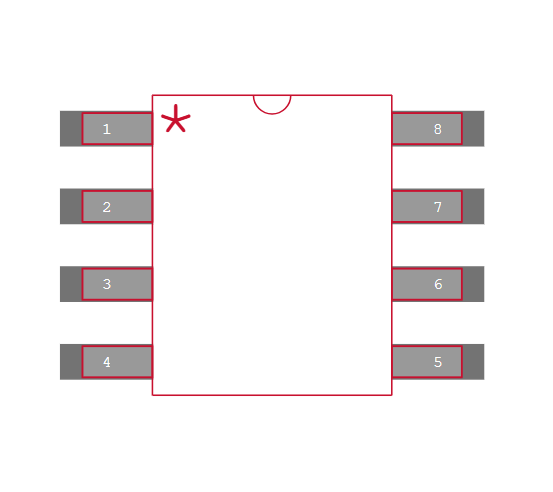
LM2903 CAD Layout
The CAD layout helps PCB designers integrate the comparator into electronic circuits efficiently. The compact package options make it suitable for space-constrained applications.
Symbol
Footprint
3D Model

Technical Specifications
Electrical Specification
Parameter | Specification |
Device Type | Dual Voltage Comparator |
Number of Comparators | 2 |
Supply Voltage Range | Up to 38V |
Operating Supply Type | Single or Dual Supply |
Input Offset Voltage | 0.37mV |
Input Bias Current | 3.5nA |
Supply Current | 200µA per Comparator |
Response Time | 1µs |
Differential Input Voltage | ±38V |
Output Configuration | Open-Collector |
Common-Mode Input Range | Includes Ground |
Logic Compatibility | TTL, MOS, CMOS |
ESD Protection (HBM) | 2kV |
Operating Temperature Range | -40°C ~ 125°C |
Package Types | SOIC, DIP, WSON |
Manufacturers | Texas Instruments, STMicroelectronics |
LM2903 Manufacturer Information
The chip is manufactured by leading semiconductor companies including TI (Texas Instruments) and ST (STMicroelectronics). These manufacturers provide the device in multiple package types for industrial, automotive, consumer electronics, and general-purpose voltage comparator applications.
Both manufacturers provide the LM 2903 in multiple package types such as DIP, SOIC, and compact surface-mount versions, making it suitable for both prototyping and mass production PCB designs. The wide availability from these vendors ensures easy sourcing and long-term supply stability for designers and engineers.
LM2903 Equivalent
Several comparator ICs can use as alternatives to the LM 2903 depending on the application requirements, package type, and operating conditions.
LM393
The LM393 is a widely used general-purpose dual voltage comparator. It features an open-collector output structure and supports rail-to-rail input operation. Commonly use in simple threshold detection, signal conditioning, and low-power analog comparison circuits. Often choose the LM393 for cost-sensitive and general electronic designs.
LM293
The LM293 is a low-power dual comparator designed for general-purpose applications. It supports both open-collector and open-drain output configurations, along with rail-to-rail input capability. This makes it suitable for flexible circuit designs where low power consumption and stable performance are important, especially in battery-powered systems.
LM193
The LM193 is a higher-grade general-purpose comparator designed for more demanding environments. It uses an open-collector output stage and supports rail-to-rail operation. It is often used in industrial control systems, precision monitoring circuits, and applications requiring better stability over temperature variations.
NCV2903
The NCV2903 is an automotive-qualified comparator designed for harsh and high-reliability environments. It supports multiple logic families such as CMOS, DTL, ECL, MOS, and TTL. With its open-collector output structure, it is suitable for automotive electronics, engine control units, and industrial automation systems where durability and noise immunity are critical.
LM2903 Feature
The LM 2903 includes several advanced features that make it suitable for precision voltage comparison applications.
Main Features
Feature | Description |
Maximum Supply Voltage | Up to 38V operation |
ESD Protection (HBM) | 2kV protection level |
Input Offset Voltage | Low value of 0.37mV for accurate comparison |
Input Bias Current | Ultra-low 3.5nA for minimal signal loading |
Supply Current | Low power consumption, about 200µA per comparator |
Response Time | Fast switching speed of 1µs |
Temperature Range | Extended industrial temperature operation |
Package Options | Available in compact 2 × 2mm WSON package |
Common-Mode Input Range | Includes ground (negative rail sensing capability) |
Differential Input Range | Supports up to ±38V, equal to supply rating |
Output Saturation Voltage | Low saturation voltage for better logic level output |
Output Compatibility | Compatible with TTL, MOS, and CMOS logic families |
These characteristics make the component highly reliable for battery-powered and industrial electronics.
LM2903 Application
The circuit widely used in modern electronic systems because of its low power consumption and reliable operation.
Common Applications
Vacuum Robot
Widely used in vacuum robot systems for battery voltage monitoring, motor drive control, and obstacle detection circuits. It compares sensor signals and triggers control actions when predefined voltage thresholds are reached, helping the robot operate safely and efficiently.
Single Phase UPS
In single-phase UPS systems, the LM 2903 plays an important role in detecting voltage drops, power failures, and unstable input conditions. It rapidly compares AC-to-DC converted voltage levels and activates backup switching or protection circuits when needed.
Server PSU
In server power supply units, the chip is used for monitoring critical power rails. It helps detect overvoltage, undervoltage, and fault conditions, ensuring stable power delivery to sensitive server components and improving system reliability.
Cordless Power Tool
The LM 2903 is commonly integrated into cordless power tools for battery protection and motor control functions. It monitors battery voltage levels and prevents deep discharge, while also assisting in overload or overcurrent protection.
Wireless Infrastructure
In wireless communication equipment, use the circuit for power supervision, signal threshold detection, and system monitoring. It helps maintain stable operation in routers, base stations, and RF modules by ensuring proper voltage conditions.
Appliances
Used in home appliances such as washing machines, air conditioners, refrigerators, and microwave ovens. It supports sensor signal comparison, control logic decisions, and safety protection functions to ensure reliable operation.
Building Automation
In building automation systems, use the LM 2903 for HVAC control, smart lighting systems, fire detection circuits, and environmental monitoring. It compares sensor outputs such as temperature, light, and humidity to control building functions.
Factory Automation & Control
Widely use the component in industrial automation systems including PLC modules, sensors, and machine control units. It provides accurate voltage comparison for process monitoring, limit detection, and safety interlocking systems in industrial environments.
Motor Drives
In motor drive applications, used for current sensing, speed feedback, and protection circuits. It helps detect abnormal current conditions such as overload or short-circuit and triggers protective shutdown or control adjustments.
Infotainment & Cluster
In automotive infotainment systems and instrument clusters, the LM 2903 is used for voltage monitoring, signal conditioning, and system diagnostics. It ensures stable operation of display systems, indicators, and control electronics inside vehicles.
LM2903 Datasheet PDF
The LM 2903 data sheet provides complete technical details including:
Electrical characteristics, switching performance, absolute maximum ratings, application circuits, thermal information, package drawings, PCB footprint recommendations.
Frequently Asked Questions [FAQ]
What are the operating conditions for the LM2903?
The LM 2903 operates with supply voltages up to 38V and supports both single-supply and dual-supply configurations. It also supports a wide temperature range suitable for industrial environments.
What is LM2903 price?
The pricing of the LM 2903 depends on package type, manufacturer, and quantity ordered. In bulk quantities, it is generally inexpensive and widely available from electronic component distributors.
What difference is between LM2903 and LM393?
The LM2903 and LM393 are very similar dual comparators. The LM2903 commonly target toward automotive and industrial temperature-grade applications, while the LM393 often use in general-purpose commercial electronics.
What is a comparator and how does it work?
A comparator is an electronic circuit that compares two input voltages and changes its output state depending on which input voltage is higher. Commonly used for threshold detection, signal conditioning, and voltage monitoring applications.
Conclusion
The LM2903 is a versatile dual voltage comparator designed for low-power and high-reliability applications. Its wide operating voltage range, ground-sensing capability, fast response time, and compatibility with multiple logic families make it a preferred choice in industrial, automotive, consumer, and power electronics systems.
With excellent performance, low cost, and easy integration, the LM2903 remains one of the most widely used comparator ICs in modern electronic circuit design.
Read More:
1. LM339 Comparator IC Pinout, Applications, and Alternative
HOT NEWS
TP4056 Charging Module Pinout, Working, and Applications
TP4056 Charging Module Pinout, Working, and Applications
2026-01-23
LR41 Battery Guide: Specifications, Equivalents, and Uses
LR41 Battery Specifications, Equivalents, and Uses
2025-12-14
Understanding A 0603 Resistor
0603 resistor,dimensions,marking code, values
2025-05-29
MT3608 Boost Converter - An In-Depth Guide
MT3608 Boost Converter
2025-09-04
The 0402 Resistor: A Comprehensive Guide
0402 Resistor
2025-05-06
Complete Guide to the 220 Ohm Resistor
220 Ohm Resistor
2025-07-28
Understanding The CD4051 Analog Multiplexer
CD4051 analog multiplexer
2025-06-30
What Is A 1206 Resistor?
1206 resistor dimensions,footprint,value
2025-06-05
Guide To The XL6009 Boost Converter
XL6009 Boost Converter
2025-09-05
120 Ohm Resistor- Specifications, Applications, and Features
2025-05-12