




 BOM
BOM Cart
Cart Product Catalog
MAX31865 PT100 RTD Temperature Sensor Module: Complete Guide with Arduino
2026-07-18
The MAX31865 is a dedicated RTD-to-digital converter designed to simplify the use of PT100 and PT1000 platinum RTD sensors. It features a high-resolution 15-bit ADC, built-in fault detection, and an SPI interface, allowing microcontrollers such as Arduino, ESP32, STM32, and Raspberry Pi to read precise temperature data with minimal external circuitry. The chip also supports 2-wire, 3-wire, and 4-wire RTD configurations, making it suitable for a wide range of applications.
In this guide, you'll learn everything you need to know about the MAX 31865 PT100 Temperature Sensor Module, including its working principle, technical specifications, key features, pinout, Arduino wiring and code example, practical applications, datasheet information, and answers to frequently asked questions. Whether you're building a DIY electronics project or designing a professional temperature measurement system, this guide will help you get started with the MAX 31865.
1. What is the MAX31865 PT100 Temperature Sensor Module?
7. Frequently Asked Questions [FAQ]
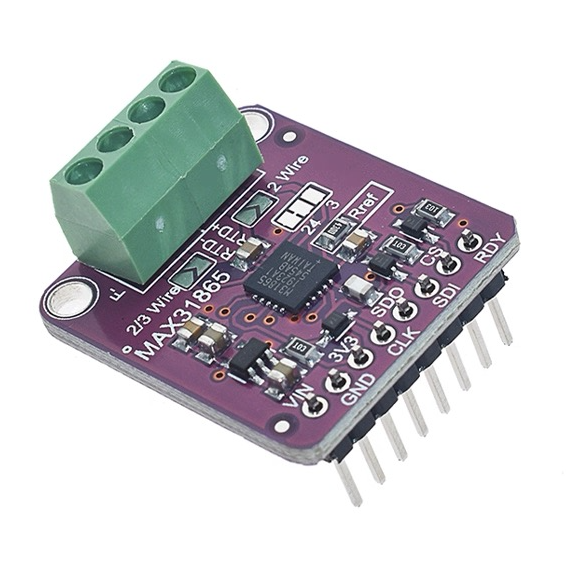
<
What is the MAX31865 PT100 Temperature Sensor Module?
The MAX 31865 PT100 Temperature Sensor Module is a high-precision RTD (Resistance Temperature Detector) interface designed to convert the resistance of platinum RTD sensors into digital temperature data. Optimized for PT100 and PT1000 sensors, the MAX 31865 integrates a 15-bit Delta-Sigma ADC, precision bias circuitry, and an SPI communication interface, allowing microcontrollers to read accurate temperature measurements with minimal external components.
Platinum RTDs are widely recognized for their excellent accuracy, long-term stability, and repeatability. A PT100 sensor has a resistance of 100Ω at 0°C, and its resistance changes predictably as the temperature varies. Compared with common NTC or PTC thermistors, PT100 sensors provide much higher measurement precision and commonly use in industrial automation, laboratory equipment, medical devices, and scientific instrumentation. However, because RTDs have relatively low resistance values, they require specialized signal conditioning to achieve accurate readings.
The MAX31865 solves this challenge by precisely measuring the ratio between the RTD resistance and a reference resistor, then converting it into digital data using its high-resolution ADC. It supports 2-wire, 3-wire, and 4-wire RTD configurations, with automatic lead resistance compensation for 3-wire and 4-wire sensors to improve measurement accuracy.
In addition, the MAX 31865 features ±45V input overvoltage protection and integrated fault detection, including open-circuit, short-circuit, and cable fault monitoring. Most breakout modules include a 430Ω precision reference resistor for PT100 sensors, while replacing it with a 4300Ω resistor allows compatibility with PT1000 sensors. With its simple SPI interface and available Arduino libraries, the module makes professional-grade RTD temperature measurement easy to implement in embedded systems.
MAX 31865 Technical Specifications
The MAX 31865 Sensor Module is designed for accurate and reliable RTD temperature measurement. Below are its main technical specifications:
Parameter | Specification |
ADC Resolution | 15-bit Delta-Sigma ADC |
Operating Voltage | 3.0V – 3.6V DC |
Temperature Measurement Range | -100°C to +800°C |
Nominal Temperature Resolution | 0.03125°C (varies slightly because RTD nonlinearity) |
Accuracy | ±0.5°C (0.05% Full Scale) |
Communication Interface | SPI (supports 2-wire, 3-wire, and 4-wire RTD sensors) |
Maximum Conversion Time | 21 ms |
Supported RTD Types | Platinum RTDs from 100Ω to 1.2kΩ at 0°C (PT100 to PT1000) |
Default Reference Resistor | 430Ω precision resistor for PT100 sensors |
PT1000 Configuration | Replace the 430Ω reference resistor with a 4300Ω precision resistor to support PT1000 sensors |
Input Protection | ±45V Overvoltage Protection |
Fault Detection | Open RTD, short circuit, cable fault, and out-of-range voltage detection |
Key Features
High Precision Measurement
The integrated 15-bit Delta-Sigma ADC delivers precise resistance measurements with a nominal temperature resolution of 0.03125°C, enabling highly accurate temperature monitoring.
Supports PT100 and PT1000
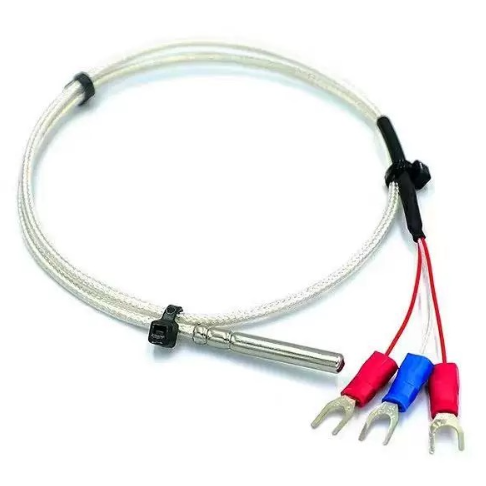
The MAX 31865 supports platinum RTDs from 100Ω to 1kΩ at 0°C, including both PT100 and PT1000 sensors.
Compatible with Multiple Wiring Configurations
The module works with:
· 2-wire RTD
· 3-wire RTD
· 4-wire RTD
This flexibility allows users to choose the appropriate sensor based on cost and required accuracy.
SPI Communication Interface
The SPI-compatible interface enables fast communication with almost every popular microcontroller including Arduino, ESP32, STM32, Raspberry Pi, PIC, and AVR devices.
Built-in Fault Detection
Integrated diagnostics can detect:
· Open RTD
· Shorted RTD
· Short to supply
· Short to ground
· Overvoltage conditions
These features greatly increase system reliability.
Fully Differential Reference Inputs
Differential reference inputs improve measurement accuracy by minimizing electrical noise and common-mode interference.
Fast Conversion Speed
The module completes one temperature conversion in 21 ms (maximum), making it suitable for real-time monitoring applications.
Excellent Measurement Accuracy
The MAX 31865 maintains approximately ±0.5°C accuracy across its operating conditions when used with a quality RTD sensor.
MAX31865 Module Pinout
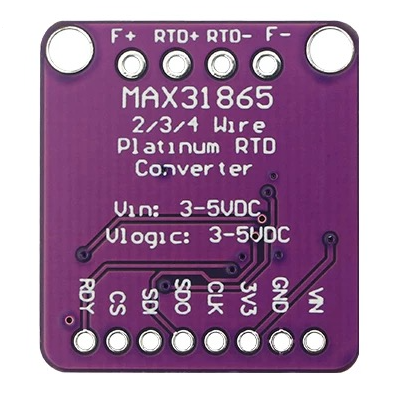
Table
Pin | Description |
FORCE+ | High-side RTD excitation current output. Supplies the excitation current to the RTD sensor for resistance measurement. |
FORCE− | Low-side RTD return path. Completes the excitation current loop through the RTD sensor. |
RTDIN+ | Positive RTD input. Connects to the positive terminal of the RTD sensing element. |
RTDIN− | Negative RTD input. Connects to the negative terminal of the RTD sensing element. |
GND | Ground (0V) reference for the module power supply and SPI interface. |
3V3 | 3.3V power supply input for the MAX31865 module. |
CLK | SPI serial clock input. Synchronizes data transfer between the module and the microcontroller. |
SDO | SPI Serial Data Output (MISO). Sends temperature and status data from the MAX 31865 to the host controller. |
SDI | SPI Serial Data Input (MOSI). Receives configuration commands and register data from the microcontroller. |
CS | Active-low Chip Select (CS) input. Enables SPI communication with the MAX 31865 when pulled low. |
DRDY | Data Ready output. This pin goes LOW when a new temperature conversion is available in the data register and returns HIGH after the RTD resistance data register has been read. |
How the MAX31865 Works
The MAX 31865 operates by passing a precisely controlled current through the RTD sensor and measuring the resulting voltage drop.
Using a precision reference resistor, the converter calculates the resistance ratio between the RTD and the reference resistor. A built-in 15-bit Delta-Sigma ADC digitizes this ratio, which is then transferred to the host microcontroller over SPI.
The microcontroller uses the measured resistance along with the Callendar–Van Dusen equation or library functions to calculate the actual temperature.
For 3-wire and 4-wire RTD configurations, the MAX 31865 automatically compensates for cable resistance, significantly improving measurement accuracy over long cable runs.
Arduino Wiring
Example SPI connections:
MAX31865 → Arduino Uno
· 3V3 → 3.3V
· GND → GND
· CLK → D13
· SDI → D11
· SDO → D12
· CS → D10
Connect the PT100 sensor to the FORCE+, FORCE−, RTDIN+, and RTDIN− terminals according to the sensor wiring type (2-wire, 3-wire, or 4-wire).
MAX31865 Sensor Module Application
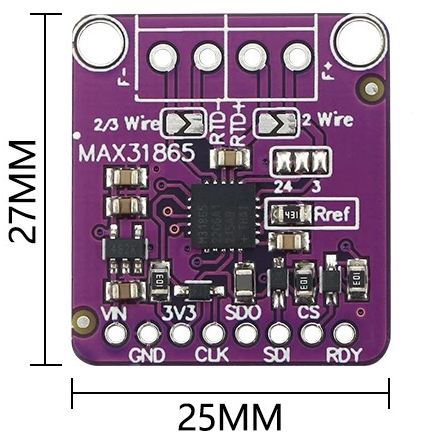
The MAX 31865 widely use wherever require accurate and stable temperature measurement.
Industrial Automation
Used in process control systems, PLCs, industrial ovens, and manufacturing equipment.
Laboratory Equipment
Suitable for precision instruments, scientific research, and calibration systems requiring accurate temperature monitoring.
HVAC Systems
Monitors heating, ventilation, refrigeration, and air conditioning equipment.
Medical Equipment
Provides reliable temperature sensing for laboratory and healthcare devices.
Environmental Monitoring
Used in weather stations, climate monitoring systems, and environmental data loggers.
Food Processing
Measures temperature during food production, storage, and transportation.
Energy Systems
Monitors batteries, solar equipment, and power generation systems.
Educational Projects
Popular among students and hobbyists for learning SPI communication and RTD temperature sensing.
MAX31865 PDF Datasheet
The data sheet provides complete technical information, including electrical characteristics, timing diagrams, SPI communication protocol, application circuits, reference designs, and register descriptions. You can check for more detailed design information.
Frequently Asked Questions [FAQ]
What is the use of MAX31865?
The MAX 31865 is used to interface platinum RTD temperature sensors, such as PT100 and PT1000, with microcontrollers. It converts RTD resistance into digital temperature data, providing high accuracy, fault detection, and SPI communication for industrial, laboratory, HVAC, and embedded temperature measurement applications.
What is the price of MAX31865?
The MAX 31865 IC typically costs around US$4–12, while complete breakout modules usually range from US$9–20, depending on the manufacturer, board quality, included precision components, and supplier.
What is the temperature calculation for MAX31865?
The MAX 31865 measures RTD resistance and calculates temperature using the Callendar–Van Dusen equation or software libraries. Most Arduino libraries automatically convert the measured resistance into temperature, eliminating the need for manual calculations.
Is PT100 a thermistor or RTD?
PT100 is an RTD (Resistance Temperature Detector) rather than a thermistor. It uses platinum as its sensing element and has a resistance of 100Ω at 0°C. RTDs provide higher accuracy, better stability, and improved repeatability compared to most thermistors.
How to connect a PT100 temperature sensor?
Connect the PT100 sensor to the MAX 31865 according to its wiring type. Two-wire sensors connect directly, while three-wire and four-wire sensors use additional leads for cable resistance compensation, resulting in improved measurement accuracy.
Is PT100 2 wire or 3 wire?
PT100 sensors are available in 2-wire, 3-wire, and 4-wire versions. Two-wire models are economical, three-wire versions are the most common in industry due to lead resistance compensation, and four-wire sensors provide the highest measurement accuracy.
Conclusion
The MAX31865 PT100 Temperature Sensor Module is one of the best solutions for precision RTD temperature measurement. With support for PT100 and PT1000 sensors, compatibility with 2-wire, 3-wire, and 4-wire configurations, a high-resolution 15-bit ADC, integrated fault detection, and SPI communication, it offers professional-level performance in an easy-to-use module. Whether you are developing industrial automation equipment, laboratory instruments, HVAC systems, or Arduino-based projects, the MAX 31865 provides reliable, accurate, and stable temperature measurements with minimal hardware complexity.
Read More:
1. MAX31855 Thermocouple Module Board Guide
HOT NEWS
TP4056 Charging Module Pinout, Working, and Applications
TP4056 Charging Module Pinout, Working, and Applications
2026-01-23
LR41 Battery Guide: Specifications, Equivalents, and Uses
LR41 Battery Specifications, Equivalents, and Uses
2025-12-14
Understanding A 0603 Resistor
0603 resistor,dimensions,marking code, values
2025-05-29
Understanding The CD4051 Analog Multiplexer
CD4051 analog multiplexer
2025-06-30
MT3608 Boost Converter - An In-Depth Guide
MT3608 Boost Converter
2025-09-04
Complete Guide to the 220 Ohm Resistor
220 Ohm Resistor
2025-07-28
The 0402 Resistor: A Comprehensive Guide
0402 Resistor
2025-05-06
Guide To The XL6009 Boost Converter
XL6009 Boost Converter
2025-09-05
Mini MP1584 DC-DC 3A Buck Converter Module: Complete Guide
Mini MP1584 DC-DC 3A Buck Converter Module: Complete Guide
2026-03-26
What Is A 1206 Resistor?
1206 resistor dimensions,footprint,value
2025-06-05