




 BOM
BOM Cart
Cart Product Catalog
The SX1276 LoRa Transceiver is a low-power, long-range wireless communication chip developed by Semtech. Widely used in IoT systems because it can transmit data over several kilometers while consuming little power. Using LoRa modulation technology, the SX 1276 achieves high sensitivity and strong noise immunity, making it suitable for applications such as smart meters, remote sensors, and industrial monitoring. In this article, we will explore what the SX 1276 is, how it works, its pin configuration, technical features, module versions, and why it has become a core component in long-distance wireless communication systems.
3. Semtech SX1276 Technical Specifications
4. Wireless SX1276 Lora Module
8. Comparing SX1276 and SX1272
9. Frequently Asked Questions [FAQ]
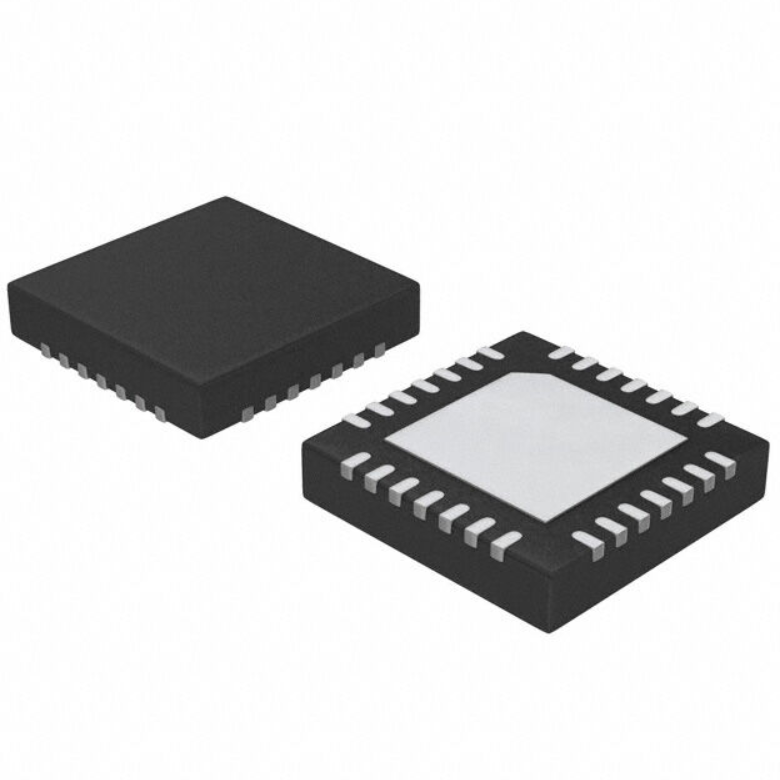
What is SX1276?
The SX 1276 LoRa Transceiver is a high-performance, ultra-long-range wireless transceiver developed by Semtech Corporation. It belongs to the SX1276/77/78 family, designed specifically for low-power, long-distance communication using LoRa (Long Range) modulation.
Semtech’s SX1276/77/78 family provides ultra long range while maintaining low current consumption, making it optimal for numerous applications. With Semtech’s patented modulation technique, the device can achieve sensitivity of over -140 dBm using a low-cost crystal and bill of materials. The high sensitivity combined with the integrated +20 dBm power amplifier creates the highest link budget, making it ideal for applications requiring maximum range.
This modulation technique also provides significant advantages in blocking and selectivity over traditional FSK systems. In addition, SX1276 supports high-performance (G)FSK modes for legacy systems such as WMBus, IEEE 802.15.4g, and FCC Part 90.
The SX1276 family operates across major ISM bands from 137 MHz to 1050 MHz and offers both high-band and low-band configurations for global deployment flexibility.
SX1276 Pinout
The SX 1276 comes in a 28-pin QFN package with exposed pad grounding.
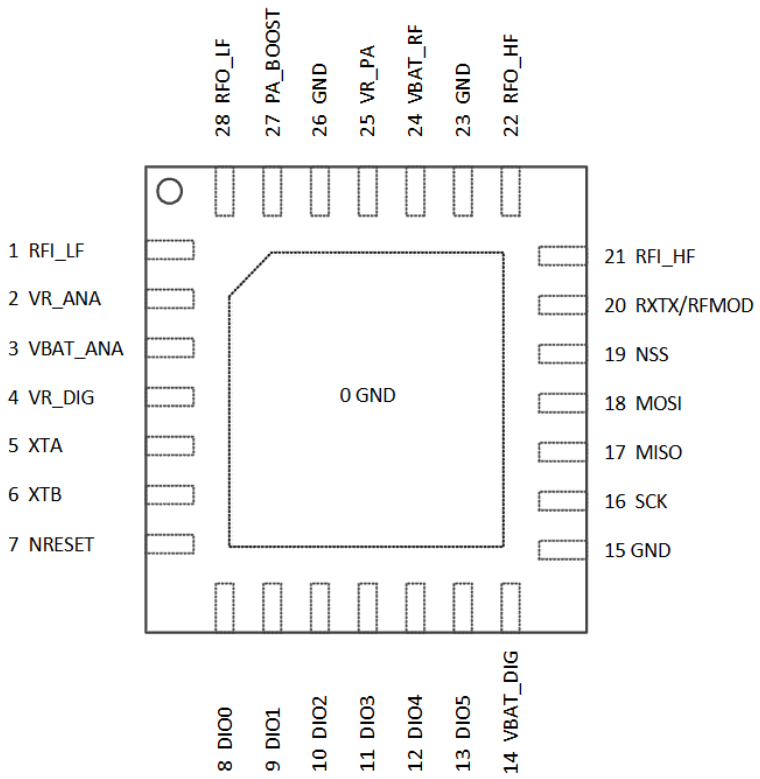
Pin | Name | Description |
0 | GROUND | Exposed ground pad |
1 | RFI_LF | RF input for bands 2 & 3 |
2 | VR_ANA | Regulated supply voltage for analog circuitry |
3 | VBAT_ANA | Supply voltage for analog circuitry |
4 | VR_DIG | Regulated supply for digital blocks |
5 | XTAI/O | Crystal or TCXO input |
6 | XTBI/O | Crystal connection |
7 | NRESET | Reset input |
8 | DIO0 | Digital I/O (configurable) |
9 | DIO1 / DCLK | Digital I/O (configurable) |
10 | DIO2 / DATA | Digital I/O (configurable) |
11 | DIO3 | Digital I/O (configurable) |
12 | DIO4 | Digital I/O (configurable) |
13 | DIO5 | Digital I/O (configurable) |
14 | VBAT_DIG | Digital supply voltage |
15 | GND | Ground |
16 | SCK | SPI clock input |
17 | MISO | SPI data output |
18 | MOSI | SPI data input |
19 | NSS | SPI chip select |
20 | RXTX / RF_MOD | TX/RX switch control (High = TX) |
21 | RFI_HF (GND) | RF input for band 1 (ground) |
22 | RFO_HF (GND) | RF output for band 1 (ground) |
23 | GND | Ground |
24 | VBAT_RF | Supply voltage for RF blocks |
25 | VR_PA | Regulated supply for power amplifier |
26 | GND | Ground |
27 | PA_BOOST | High-power RF output (all bands) |
28 | RFO_LF | RF output for bands 2 & 3 |
This pin configuration allows the SX 1276 to support flexible RF band operation, SPI communication with microcontrollers, and efficient power control for long-range LoRa communication systems.
Semtech SX1276 Technical Specifications
The LoRa Transceiver is a high-performance LoRa chip designed for long-range, low-power wireless communication. Below is a summarized technical specification table based on Semtech datasheet data.
Parameter | Specification |
Manufacturer | Semtech Corporation |
Frequency Range | 137 MHz – 1020 MHz |
Modulation | LoRa™, (G)FSK, MSK, GMSK, OOK |
Max Output Power | +20 dBm |
Receiver Sensitivity | Down to –148 dBm |
Link Budget | Up to 168 dB |
Max Data Rate | Up to 300 kbps |
RF Interface | SPI-controlled transceiver |
Operating Voltage | 1.8 V – 3.7 V |
RX Current | ~9.9 mA – 12 mA |
TX Current | ~20 mA – 120 mA |
Sleep Current | ~200 nA |
FIFO Size | Up to 256 bytes |
RSSI Dynamic Range | ~127 dB |
Synthesizer Resolution | 61 Hz |
Operating Temperature | –40°C to +85°C |
Package Type | 28-QFN (6 × 6 mm) |
Key Features | LoRa modem, CAD, AFC, packet engine, low power design |
Semtech Corporation
The Semtech Corporation is a semiconductor company based in the United States, and it is the original designer and developer of the SX1276 LoRa transceiver chip. Semtech created the LoRa (Long Range) wireless modulation technology and owns the SX1276/77/78 family of chips used widely in IoT and wireless communication systems.
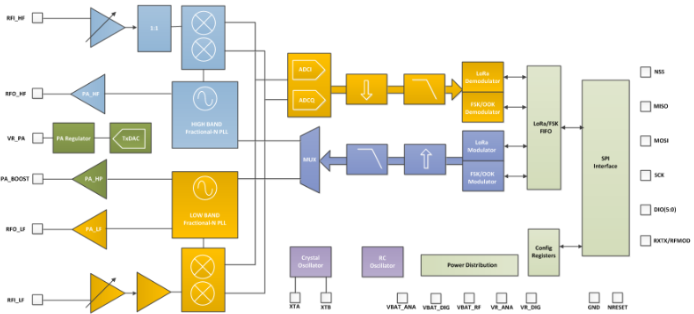
Block Diagram of SX1276
Wireless SX1276 Lora Module
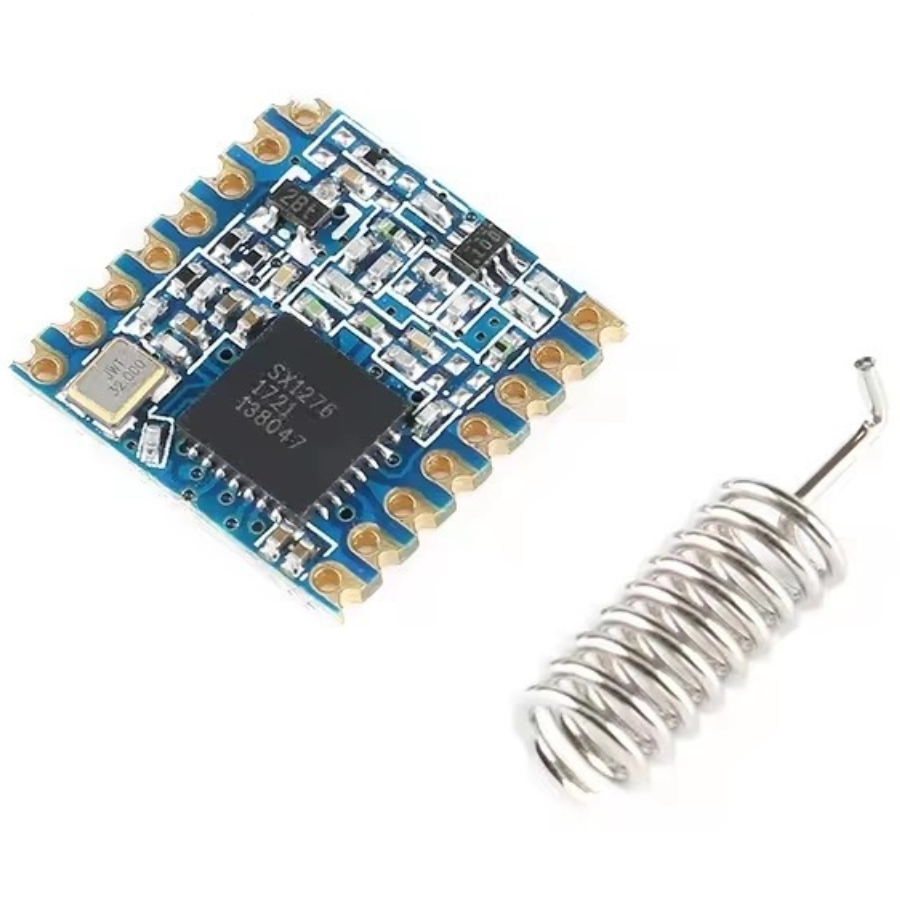
The Wireless SX1276 LoRa module is based on the SX 1276 LoRa Transceiver chip from Semtech. It uses LoRa spread-spectrum technology to achieve long-range communication, low power consumption, and strong anti-interference performance.
The module parameters like frequency, transmit power, and data rate can configure via an MCU using a SPI interface. It supports bidirectional communication, and the interrupt pin (NIRQ) can notify the MCU when receive data.
Key Specifications Table
Parameter | Specification |
Frequency Band | 868 MHz / 915 MHz |
Module Size | 16.5 × 17 mm (Pin pitch: 1.27 mm) |
Output Power | 20 dBm / 100 mW |
Transmit Current | 120 mA @ 100 mW (3.3 V) |
Receive Sensitivity | –139 dBm @ 146 bps |
Receive Current | ~10 mA @ 3.3 V |
Modulation | LoRa / GFSK |
Sleep Current | ~0.2 µA |
Interface | 4-wire SPI |
Frequency Accuracy | ±5 kHz |
Key Advantages
Long-distance communication capability, ultra-low power consumption, strong resistance to interference, easy MCU integration via SPI, and flexible configuration of RF parameters.
RFM95W vs SX1276
The RFM95W module and SX1276-based module both build on Semtech LoRa technology, but they differ mainly in integration level, RF optimization, and ease of deployment.
Key Difference
The RFM95W module is a fully integrated, factory-tuned LoRa module with pre-matched RF components, stable performance, and plug-and-play usability. Designed for fast development with minimal RF design effort.
The SX1276 module is a more flexible implementation based on the SX 1276 LoRa Transceiver IC, where RF performance depends on external matching circuits, PCB layout, and antenna design. It provides greater customization but requires more engineering effort to achieve optimal performance.
Summary of Difference
RFM95W module: Ready-to-use, pre-optimized RF design, stable out-of-box performance
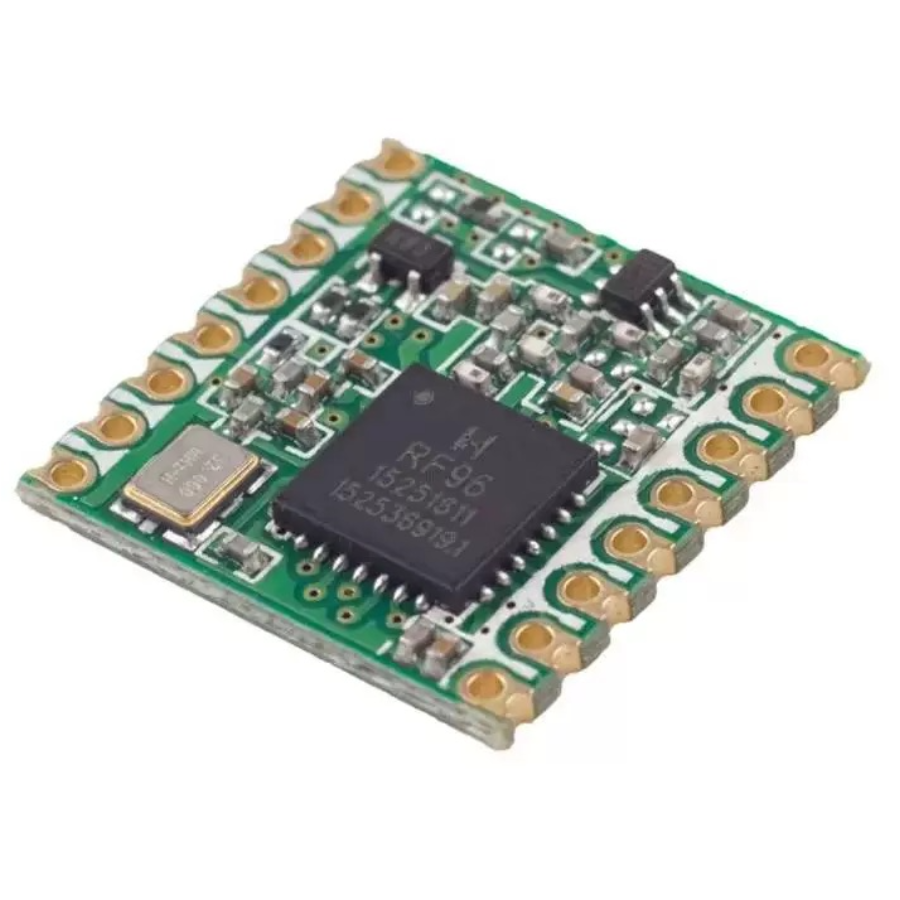
SX1276 module: Flexible design, lower cost potential, but requires RF tuning and careful hardware layout
Feature | RFM95W Module | SX1276 Module |
Core Chip | Semtech LoRa chipset (SX127x family) | SX1276 LoRa Transceiver |
Integration Level | Fully integrated LoRa module | Basic RF module design |
RF Matching | Pre-tuned and factory optimized | Requires external RF matching |
Ease of Use | Plug-and-play, easy | Needs RF design knowledge |
PCB Design Complexity | Low | High (RF layout critical) |
Performance Stability | High and consistent | Depends on external design quality |
Antenna Design | Pre-optimized support | Needs custom antenna tuning |
Development Speed | Fast prototyping | Slower development cycle |
Flexibility | Limited (fixed design) | High customization possible |
Cost | Slightly higher | Lower (depends on design) |
Target Users | IoT product developers | RF engineers / custom hardware designers |
SX1276 Features
Link Budget (168 dB maximum link budget)
Provides up to 168 dB link budget for ultra-long-range communication.
Output Power (+20 dBm RF output)
Delivers up to +20 dBm (100 mW) transmission power for strong signal coverage.
Power Amplifier (+14 dBm high efficiency PA)
Integrated high-efficiency PA improves power performance while reducing energy use.
Data Rate (up to 300 kbps)
Supports programmable bit rates up to 300 kbps for flexible data transmission.
Sensitivity (down to –146.5 dBm)
Extremely high sensitivity allows reception of weak signals over long distances.
RF Performance (IIP3 = –12 dBm, 100 dB blocking immunity)
Strong interference resistance and high linearity ensure stable communication in noisy environments.
Low Power (10 mA RX current, 200 nA sleep)
Low receive and ultra-low sleep current make it ideal for battery-powered devices.
Modulation (FSK, GFSK, MSK, GMSK, LoRa, OOK)
Supports multiple modulation types for wide application compatibility.
Signal Processing (Sync word, preamble detection, bit sync)
Built-in features improve data accuracy and communication reliability.
RSSI (115 dB+ dynamic range)
Wide RSSI range enables accurate signal strength detection.
Packet Engine (64 bytes with CRC)
Integrated packet handling with CRC ensures reliable data transfer.
Extras (AFC, RF Sense, temperature sensor, low battery indicator)
Includes automatic frequency control and system monitoring features for improved performance.
SX1276 Application
Automated Meter Reading
The LoRa Transceiver widely use in smart utility meters for remote reading of electricity, water, and gas consumption with long-range wireless communication.
Wireless Sensor Networks
Commonly use in distributed sensor networks where multiple low-power nodes transmit environmental or industrial data over long distances.
Home and Building Automation
The SX 1276 enables smart home systems such as lighting control, HVAC monitoring, and remote device management through reliable IoT connectivity.
Wireless Alarm and Security Systems
Ideal for alarm systems, intrusion detection, and security monitoring because its strong interference resistance and long transmission range.
Industrial Monitoring and Control
The SX 1276 widely apply in industrial environments for machine monitoring, automation systems, and real-time data communication in harsh conditions.
Comparing SX1276 and SX1272
The SX 1276 LoRa Transceiver and SX1272 are both Semtech LoRa transceivers, but they differ mainly in frequency range and receiver performance.
Comparison Table
Feature | SX1276 | SX1272 |
Type | Tx/Rx Only | Tx/Rx Only |
RF Standard | 802.15.4 | 802.15.4 |
Protocol | LoRa™ | LoRa™ |
Modulation | FSK, GFSK, GMSK, MSK, OOK | FSK, GFSK, GMSK, MSK, OOK |
Frequency Range | 137 MHz – 1.02 GHz | 860 MHz – 1.02 GHz |
Max Data Rate | 300 kbps | 300 kbps |
Output Power | +20 dBm | +20 dBm |
Sensitivity | –148 dBm | –137 dBm |
SPI Interface | Yes | Yes |
GPIO | 6 | 6 |
Supply Voltage | 1.8 V – 3.7 V | 1.8 V – 3.7 V |
RX Current | 10.8 – 12 mA | 10.5 – 11.2 mA |
TX Current | 20 – 120 mA | 18 – 125 mA |
Operating Temperature | –40°C to 85°C | –40°C to 85°C |
Package | 28-QFN (6×6 mm) | 28-QFN (6×6 mm) |
Key Differences
Frequency Range: SX1276 supports a wider frequency range (137 MHz to 1.02 GHz), while SX 1272 mainly operates above 860 MHz.
Sensitivity: SX 1276 has better sensitivity (–148 dBm vs –137 dBm), giving it longer communication range.
Performance: SX 1276 is more optimized for low-frequency and long-range applications.
Frequently Asked Questions [FAQ]
What is SX1276 price?
The SX 1276 LoRa Transceiver typically costs around $0.5 to $5 per IC depending on quantity and supplier. Complete LoRa modules based on SX 1276 usually range from $3 to $5, depending on features, antenna design, and manufacturer.
What does the SX1276 transceiver offer?
SX 1276 offers long-range LoRa communication, high sensitivity up to –148 dBm, and low power operation. It supports multiple modulation types, SPI control, and strong interference resistance, making it ideal for IoT, smart metering, and wireless sensor networks.
How does a LoRa module work?
A LoRa module works by using spread-spectrum modulation to encode data over wide frequency bands. This allows signals to travel long distances with low power consumption while maintaining strong resistance to noise and interference.
Can LoRa module work without an antenna?
No, a LoRa module cannot work properly without an antenna. Without it, signal transmission is inefficient, range is extremely reduced, and the RF power stage may even get damaged because impedance mismatch.
What is the difference between SX1278 and SX1276?
SX 1276 supports a wider frequency range (137 MHz–1.02 GHz) and better sensitivity, making it more versatile. SX1278 mainly operates in sub-GHz ISM bands like 433 MHz and 868/915 MHz with slightly narrower flexibility.
What is the range of the LoRa SX1276?
The SX 1276 can achieve 2–5 km in urban environments and up to 15–20 km or more in open rural areas. Range depends on antenna quality, data rate, power settings, and environmental conditions.
Conclusion
The SX1276 is one of the most powerful and widely used LoRa transceiver chips in IoT development. With its ultra-low power consumption, high sensitivity, and long-range capability, it enables reliable communication for smart cities, industrial automation, and remote monitoring systems.
Its flexibility across multiple frequency bands and modulation schemes makes it a preferred choice for modern wireless embedded systems.
Read More:
1. Guide to The PIC18F25K20 Microcontroller Chip
2. Mini MP1584 DC-DC 3A Buck Converter Module: Complete Guide
3. ATMEGA32 Microcontroller: Pinout, Features and Alternative
HOT NEWS
TP4056 Charging Module Pinout, Working, and Applications
TP4056 Charging Module Pinout, Working, and Applications
2026-01-23
LR41 Battery Guide: Specifications, Equivalents, and Uses
LR41 Battery Specifications, Equivalents, and Uses
2025-12-14
Understanding The CD4051 Analog Multiplexer
CD4051 analog multiplexer
2025-06-30
Understanding A 0603 Resistor
0603 resistor,dimensions,marking code, values
2025-05-29
MT3608 Boost Converter - An In-Depth Guide
MT3608 Boost Converter
2025-09-04
The 0402 Resistor: A Comprehensive Guide
0402 Resistor
2025-05-06
Complete Guide to the 220 Ohm Resistor
220 Ohm Resistor
2025-07-28
Mini MP1584 DC-DC 3A Buck Converter Module: Complete Guide
Mini MP1584 DC-DC 3A Buck Converter Module: Complete Guide
2026-03-26
Guide To The XL6009 Boost Converter
XL6009 Boost Converter
2025-09-05
What Is A 1206 Resistor?
1206 resistor dimensions,footprint,value
2025-06-05