




 BOM
BOM Cart
Cart Product Catalog
The INMP441 module is a compact digital MEMS microphone designed for embedded audio applications, voice recording, speech recognition, IoT devices, and microphone arrays. Unlike traditional analog microphone modules, the INMP441 provides a 24-bit I²S digital audio output, allowing it to connect directly to microcontrollers and digital signal processors without requiring an external audio codec or analog-to-digital converter.
With its high signal-to-noise ratio, low power consumption, wide frequency response, and small size, the INMP 441 is particularly suitable for applications where require clear digital audio capture.
1. What is INMP441 Microphone Module?
4. Specifications and Features
5. Other Popular MEMS Microphones
7. How to Use INMP441 Microphone?
8. Frequently Asked Questions [FAQ]
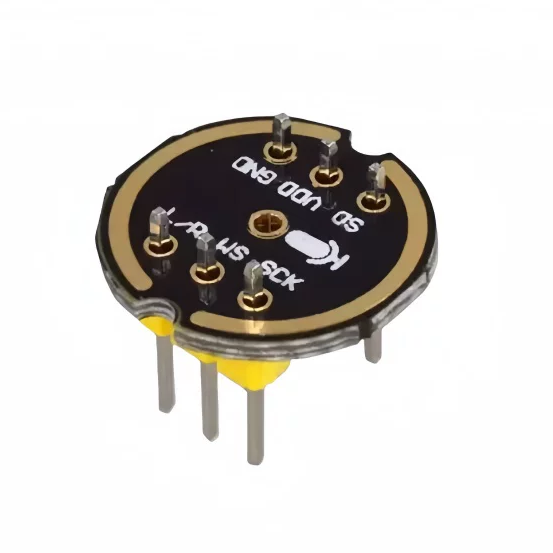
What is INMP441 Microphone Module?
The INMP441 is a high-performance, low-power, omnidirectional MEMS microphone with a digital output and bottom sound port. The complete INMP 441 solution integrates a MEMS sensor, signal conditioning circuitry, analog-to-digital conversion, anti-aliasing filtering, power management, and a standard 24-bit I²S interface.
The I²S interface allows the INMP 441 to connect directly to digital processors such as DSPs and microcontrollers. This eliminates the need for a separate audio codec or external ADC in many embedded audio systems.
One of the main advantages of the module is its high signal-to-noise ratio, making it a good choice for near-field voice and audio applications. Its relatively flat broadband frequency response also helps provide natural-sounding audio with good voice clarity.
Because the microphone produces digital audio data, it is especially convenient for modern development boards such as the ESP32, which includes hardware I²S peripherals.
INMP441 Microphone Pinout
The INMP 441 microphone module provides six pins for power supply, I²S digital audio communication, and left/right channel selection. The pin functions are shown below.
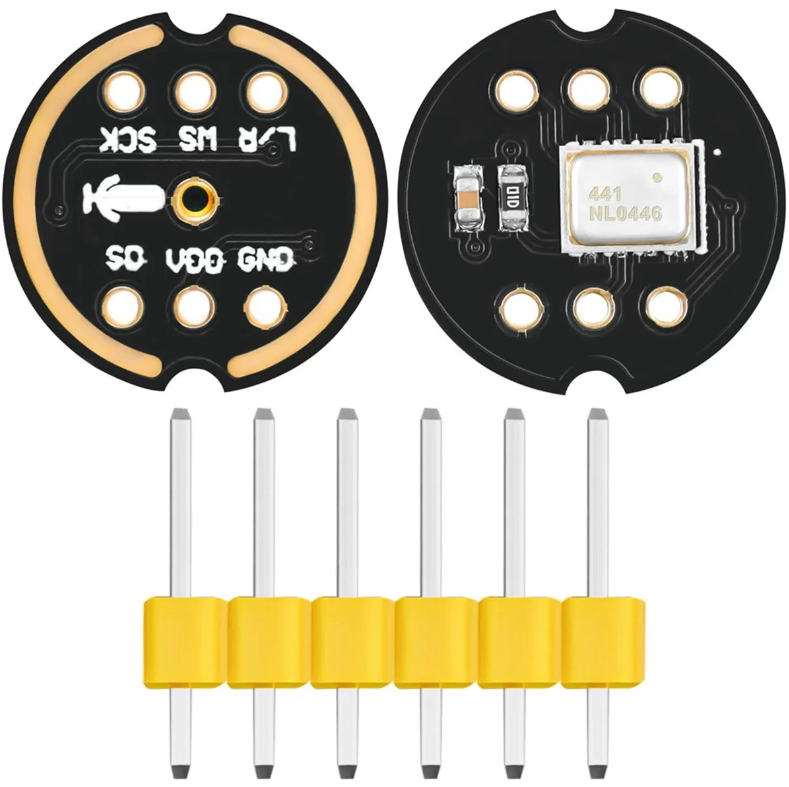
Pin | Function |
SCK | Serial-data clock for the I²S interface. It provides the clock signal used to synchronize digital audio data. |
SD | Serial-data output for the I²S interface. This pin outputs the microphone's digital audio data and is tri-stated when it is not driving the selected output channel. |
WS | Serial data word-select signal for the I²S interface. It identifies the audio channel and synchronizes the data frame. |
L/R | Left/right channel select. When set LOW, the microphone outputs its signal on the left channel of the I²S frame. When set HIGH, it outputs on the right channel. |
VDD | Power supply input. The operating voltage is 1.8V to 3.3V. |
GND | Ground connection. Connect this pin to the ground of the microcontroller or development board. |
The SCK, WS, and SD pins form the main I²S digital audio connection. The L/R pin is useful when configuring multiple microphones, allowing different microphones to occupy different channels within an I²S audio frame.
INMP441 ESP32 Wiring
The ESP32 is one of the most popular platforms for working with the INMP441 because it provides hardware support for I²S audio communication.
A typical connection is shown below:
INMP441 | ESP32 |
SCK | GPIO14 |
SD | GPIO32 |
WS | GPIO15 |
L/R | GND |
GND | GND |
VDD | 3.3V |
With L/R connected to GND, the INMP441 is configured as the left-channel microphone.
The ESP32 provides the I²S clock and word-select signals while the INMP441 sends digital audio data through the SD pin. Once the I²S peripheral is configured, the ESP32 can continuously receive PCM audio samples from the microphone.
When wiring the module, keep the connections short where possible and ensure that the microphone and ESP32 share a common ground.
INMP441 Specifications and Features
The module combines a MEMS microphone element with integrated signal processing and a digital I²S interface.
Technical Specifications
Parameter | Specification |
Microphone Type | Omnidirectional MEMS microphone |
Audio Interface | 24-bit I²S |
Signal-to-Noise Ratio | 61 dBA |
Sensitivity | -26 dBFS |
Frequency Response | 60 Hz to 15 kHz |
Current Consumption | Approximately 1.4 mA |
PSR | -75 dBFS |
Supply Voltage | 1.8V to 3.3V |
Output | Digital |
Features
24-Bit I²S Digital Interface
The module uses a 24-bit I²S interface to output digital audio directly to compatible microcontrollers and DSPs, without requiring an external audio codec or ADC.
High Signal-to-Noise Ratio
With a 61 dBA SNR, the INMP441 provides clear audio capture with reduced background noise, making it suitable for voice applications.
High Sensitivity
The -26 dBFS sensitivity enables the microphone to capture sound clearly in near-field voice and audio applications.
Wide Frequency Response
The INMP441 offers a frequency response of approximately 60 Hz to 15 kHz, suitable for voice recording, sound detection, and embedded audio systems.
Low Power Consumption
With a typical current consumption of about 1.4 mA, the INMP 441 is well suited for low-power and battery-operated devices.
Omnidirectional Detection
The omnidirectional MEMS microphone can capture sound from different directions, making it useful for voice and environmental sound monitoring.
Direct Digital Connection
Its integrated I²S interface allows direct connection to compatible microcontrollers and DSPs, simplifying digital audio system design.
Other Popular MEMS Microphones
The INMP 441 is not the only digital MEMS microphone available for embedded audio projects. Several other microphones use similar digital interfaces and can be considered depending on the application.
ICS-43434
The ICS-43434 is a digital MEMS microphone designed for general-purpose audio recording and sound detection. It has a frequency range of approximately 50 Hz to 15 kHz and provides a digital I²S interface.
The device also includes internal filtering designed to reduce unwanted high-frequency components, making it suitable for voice and general audio applications.
SPH0645
The SPH0645 is another popular digital MEMS microphone with an I²S interface. Can use it with compatible microcontrollers for digital voice recording, sound detection, speech processing, and IoT projects.
MSM261S4030H0R
The MSM261S4030H0R is an I²S/IIS digital MEMS microphone that can use with modern embedded platforms, including applications based on the ESP32-S3. It is suitable for projects involving digital voice capture and AI voice-processing accessories.
INMP441 I2S MIC Module Applications
Can use the INMP 441 in a wide range of digital audio and embedded applications.
IoT Smart Devices
The microphone can capture voice commands for smart home devices, voice-controlled equipment, and IoT terminals. The digital I²S output makes it convenient to send audio directly to a microcontroller for processing.
Voice Command and Wake-Word Detection
Can use to capture speech and environmental audio for wake-word detection and voice-command systems. An ESP32 or similar processor can receive the PCM data and perform additional digital audio processing.
DIY Network Intercoms
The module is suitable for DIY network intercoms and communication devices. Digital audio can be captured by the microphone, processed by a microcontroller, and transmitted through a wired or wireless network.
Digital Recording Equipment
Because the microphone outputs digital audio, it can be integrated into compact digital recording devices without requiring a separate microphone preamplifier and ADC.
Environmental Noise Monitoring
Can use to detect and monitor environmental sound levels. A microcontroller can process the digital audio stream to identify changes in sound intensity or specific acoustic events.
Multi-Microphone Arrays
Can use multiple INMP 441 microphones in microphone-array development. Channel selection and digital synchronization can help create systems for applications such as sound-source localization, beamforming, and directional audio processing.
How to Use INMP441 Microphone?
The INMP 441 is a digital microphone and cannot connect directly to an analog amplifier or ADC. It should connect to a microcontroller with a hardware I²S peripheral. Configure the I²S sampling rate, such as 16 kHz or 44.1 kHz, and the appropriate data format to receive PCM audio for recording, transmission, or speech recognition.
ESP32: The ESP32 has built-in hardware I²S support and is highly compatible with the INMP441, making it a recommended platform.
STM32: Most STM32 devices with I²S, such as STM32F4 and F7, can be used. Configure I²S for 24-bit data in a 32-bit frame and use DMA for continuous audio reception.
Arduino: Classic 8-bit boards such as Arduino UNO and Nano generally lack hardware I²S support. For Arduino IDE projects, use an I²S-capable board based on ESP32, RP2040, or SAMD.
INMP441 Datasheet
When working with the INMP 441, should check the datasheet for detailed electrical characteristics, timing requirements, I²S data format, microphone performance specifications, recommended operating conditions, and mechanical information.
Frequently Asked Questions [FAQ]
What is INMP441 price?
The price of an INMP 441 microphone varies depending on the module manufacturer, PCB design, quantity, and supplier. Basic breakout boards are generally inexpensive, normally $1~$5, making the INMP 441 a popular option for DIY electronics and embedded audio projects.
What is INMP441?
The INMP 441 is a low-power, omnidirectional MEMS microphone with a digital 24-bit I²S output. It integrates the microphone sensor and signal-processing circuitry, allowing compatible microcontrollers to receive digital audio directly.
How to connect INMP441?
Connect VDD to a suitable 1.8V–3.3V supply, GND to the system ground, SCK to the microcontroller's I²S clock input/output as appropriate, WS to the I²S word-select signal, and SD to the I²S data input. Connect L/R to GND for the left channel or high for the right channel.
What is the current consumption of the INMP441 microphone module?
The INMP441 has a typical current consumption of approximately 1.4 mA, making it suitable for many low-power embedded applications.
How to connect INMP441 to ESP32?
A common ESP32 connection is SCK to GPIO14, SD to GPIO32, WS to GPIO15, L/R to GND, GND to GND, and VDD to 3.3V. The ESP32's I²S peripheral can then be configured to receive digital audio from the microphone.
How to enable mic input?
The microphone itself does not require an analog input configuration. Enable and configure the microcontroller's I²S peripheral, assign the SCK, WS, and SD pins, select a suitable sampling rate and data format, and start receiving I²S audio frames.
How do MEMS microphones work?
MEMS microphones use a tiny micromechanical structure to detect changes in air pressure caused by sound. The mechanical movement is converted into an electrical signal and processed by integrated circuitry. In the INMP441, the signal is converted into digital audio and transmitted through the I²S interface.
What type of device is a microphone?
A microphone is an electroacoustic transducer. It converts acoustic sound waves into an electrical signal. Traditional microphones commonly produce an analog signal, while digital MEMS microphones such as the INMP441 integrate signal conversion and provide a digital audio output.
Conclusion
The INMP441 microphone module is a compact and practical solution for digital voice and audio capture. Its 24-bit I²S interface, 61 dBA signal-to-noise ratio, -26 dBFS sensitivity, 60 Hz–15 kHz frequency response, and approximately 1.4 mA current consumption make it well suited to embedded audio applications.
Compared with analog microphone modules, the INMP 441 simplifies digital audio acquisition by allowing compatible microcontrollers to receive audio directly through I²S. The ESP32 is one of the most convenient platforms for using the module, while compatible STM32, RP2040, and SAMD-based boards can also be considered.
From IoT voice control and DIY intercoms to digital recording, environmental sound monitoring, and multi-microphone arrays, the INMP 441 provides a simple way to add high-quality digital audio input to embedded projects.
Read More:
1. MAX9814 Electret Microphone Amplifier Module Board: Guide
2. RFM95W LoRa RF Transceiver Module 868 915 MHZ: Guide
3. Mini MP1584 DC-DC 3A Buck Converter Module: Complete Guide
HOT NEWS
TP4056 Charging Module Pinout, Working, and Applications
TP4056 Charging Module Pinout, Working, and Applications
2026-01-23
LR41 Battery Guide: Specifications, Equivalents, and Uses
LR41 Battery Specifications, Equivalents, and Uses
2025-12-14
Understanding A 0603 Resistor
0603 resistor,dimensions,marking code, values
2025-05-29
Understanding The CD4051 Analog Multiplexer
CD4051 analog multiplexer
2025-06-30
MT3608 Boost Converter - An In-Depth Guide
MT3608 Boost Converter
2025-09-04
Complete Guide to the 220 Ohm Resistor
220 Ohm Resistor
2025-07-28
The 0402 Resistor: A Comprehensive Guide
0402 Resistor
2025-05-06
Guide To The XL6009 Boost Converter
XL6009 Boost Converter
2025-09-05
Mini MP1584 DC-DC 3A Buck Converter Module: Complete Guide
Mini MP1584 DC-DC 3A Buck Converter Module: Complete Guide
2026-03-26
What Is A 1206 Resistor?
1206 resistor dimensions,footprint,value
2025-06-05