




 BOM
BOM Cart
Cart Product Catalog
The LM1117 is a popular low dropout (LDO) linear voltage regulator designed to provide a stable DC output voltage with a dropout voltage of only 1.2V at 800mA. It is available in fixed output versions (1.8V, 2.5V, 3.3V, and 5V) as well as an adjustable version that can be set from 1.25V to 13.8V using two external resistors. With built-in current limiting, thermal shutdown, and high output accuracy, the LM 1117 widely use in embedded systems, communication equipment, industrial electronics, and consumer devices. This article covers its pinout, features, specifications, applications, and more.
1. What is the LM1117 Linear Voltage Regulator?
5. LM1117 Equivalent and Alternative
What is the LM1117 Linear Voltage Regulator?
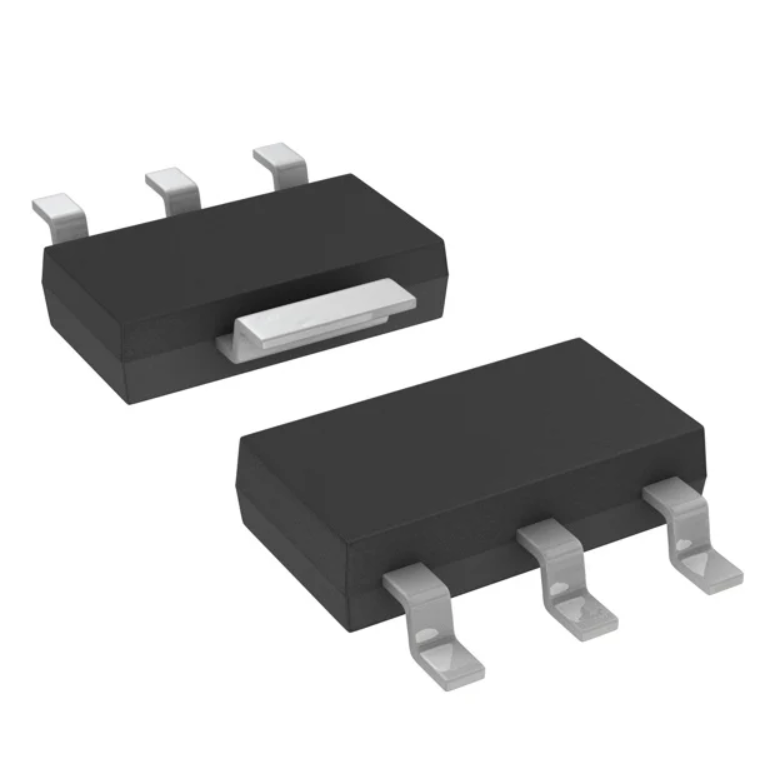
The LM 1117 is a popular low dropout (LDO) linear voltage regulator designed to provide a stable and regulated DC output voltage from a higher input voltage. Compared with traditional linear regulators, the component features a low dropout voltage of only 1.2V at 800mA, making it suitable for systems where the input voltage is only slightly higher than the desired output.
The device is available in both fixed-output and adjustable-output versions. The adjustable version allows users to set the output voltage anywhere between 1.25V and 13.8V using only two external resistors. Fixed-output versions are available in 1.8V, 2.5V, 3.3V, and 5V, eliminating the need for additional resistor networks.
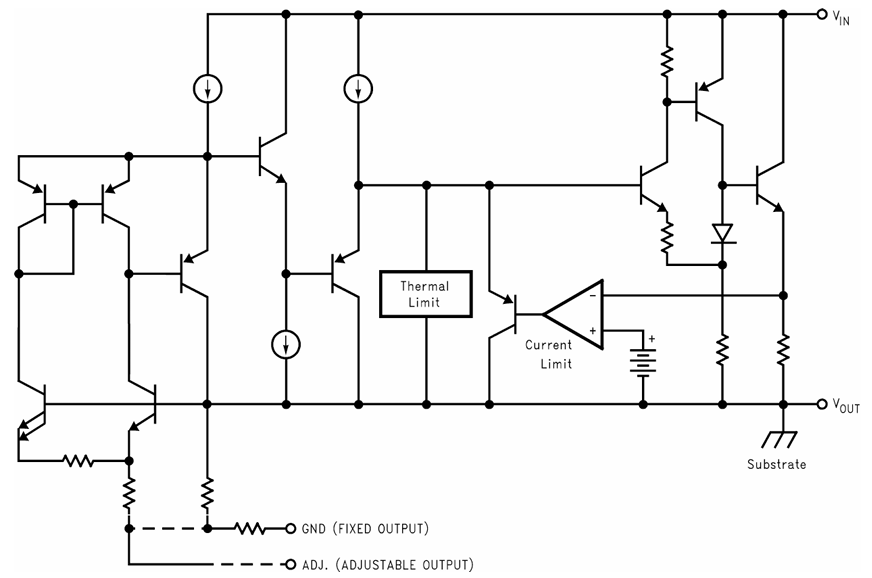
To ensure reliable operation, the LM1117 incorporates current limiting, thermal shutdown protection, and a Zener-trimmed bandgap voltage reference, providing output voltage accuracy within ±1%. A minimum 10µF tantalum output capacitor is recommended to maintain stability and improve transient response.
Thanks to its simple design, low cost, and dependable performance, the LM 1117 has become one of the most widely used LDO regulators in embedded systems, industrial electronics, communication equipment, and consumer products.
LM1117 Pinout
The LM 1117 is commonly available in the SOT-223 and TO-252 package.
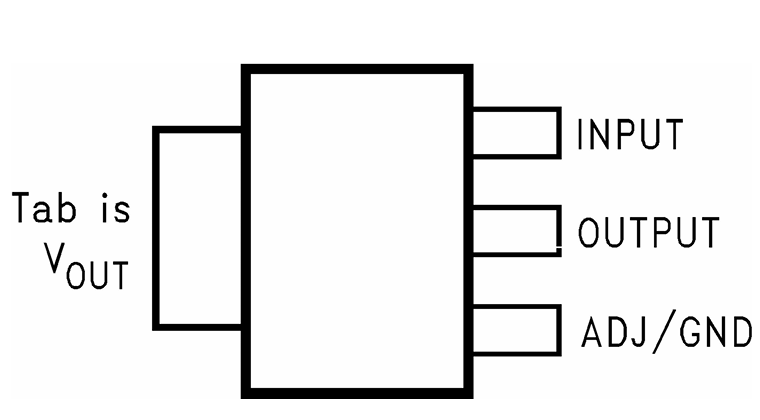
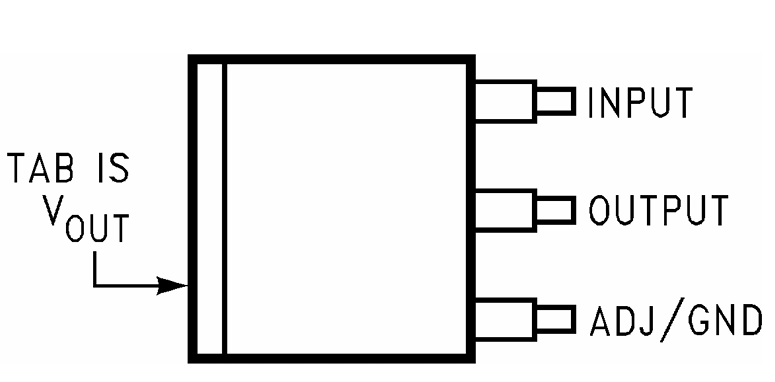
Pin 1 – Adjust/Ground
For the adjustable version, this pin connects to a resistor divider to determine the output voltage. For fixed-voltage versions, it serves as the ground connection.
Pin 2 – Output Voltage (VOUT)
The regulated voltage appears at this pin. Should connect a 10µF output capacitor close to this pin for stability.
Pin 3 – Input Voltage (VIN)
Connect the unregulated input voltage here. The input voltage should always be higher than the output voltage by at least the dropout voltage.
LM1117 Functional Block Diagram
LM1117 Features
Multiple Output Voltage Options
The LM1117 is available in fixed output versions of 1.8V, 2.5V, 3.3V, and 5V, as well as an adjustable version that allows the output voltage to set using two external resistors.
Low Dropout Performance
With a low dropout voltage, the LM1117 can maintain a stable output even when the input voltage is only slightly higher than the output, making it suitable for low-voltage power supply designs.
High Output Current
The regulator can deliver up to 800mA of continuous output current, making it suitable for powering microcontrollers, communication modules, sensors, and other electronic circuits.
Built-In Protection
The LM 1117 includes current limiting and thermal shutdown protection to safeguard both the regulator and the connected circuit from overload and overheating conditions.
Excellent Line Regulation
With a maximum line regulation of 0.2%, the LM 1117 maintains a stable output voltage even when the input voltage fluctuates.
Good Load Regulation
The device offers a maximum load regulation of 0.4%, ensuring consistent output voltage as the load current changes.
Compact Package Options
The LM 1117 is available in compact SOT-223 and WSON packages, allowing designers to save PCB space while providing effective heat dissipation.
Wide Operating Temperature Range
The standard LM 1117 operates from 0°C to +125°C, while the LM1117I version supports an extended industrial temperature range of −40°C to +125°C, making it suitable for demanding environments.
LM1117 Specifications
Table
Parameter | Value |
Manufacturer | Texas Instruments |
Output Current | 800mA |
Input Voltage (Maximum) | 15V |
Output Voltage | 5V (Fixed Version) |
Adjustable Output | 1.25V–13.8V |
Dropout Voltage | 1.2V @ 800mA |
Quiescent Current | 5mA |
Supply Current (Max) | 10mA |
PSRR | 75dB @120Hz |
Output Configuration | Positive |
Number of Regulators | 1 |
Output Type | Fixed / Adjustable |
Line Regulation | 0.2% Max |
Load Regulation | 0.4% Max |
Protection | Over Current, Thermal Shutdown |
Operating Temperature | -40°C to +125°C |
Mounting | Surface Mount |
Package | SOT-223-4, TO-252 |
LM1117 Manufacturer
The LM1117 is manufactured by Texas Instruments (TI), one of the world's leading semiconductor companies. Texas Instruments offers the LM 1117 in multiple package options with long-term product availability, making it a reliable choice for industrial, commercial, and consumer electronics.
LM1117 Equivalent and Alternative
Several voltage regulators can replace depending on the required voltage, package, and current capability.
LM7805
A fixed 5V linear regulator with a higher dropout voltage. It is suitable when efficiency is less important and sufficient input voltage is available.
LM7806
Provides a regulated 6V output and is commonly used in industrial power supplies.
LM7809
Offers a fixed 9V output for higher-voltage analog and industrial circuits.
LM7812
Supplies a regulated 12V output and widely use in power supply designs.
LD1117S25CTR
An STMicroelectronics LDO regulator offering similar electrical characteristics to the LM1117.
NCV1117ST25T3G
An automotive-grade regulator from onsemi with improved reliability for harsh environments.
SPX1117M3-L-2-5/TR
A MaxLinear low-dropout regulator designed for low-noise applications.
REG1117-3.3
A Texas Instruments regulator with a fixed 3.3V output.
TLV1117-33CDCY
An improved drop-in replacement from Texas Instruments with enhanced performance and lower quiescent current.
LM317
A classic adjustable linear regulator capable of higher output voltages but requiring a larger dropout voltage than the LM1117.
Where to Use LM1117
The LM1117 is ideal whenever a stable, required low-noise DC supply from a slightly higher input voltage.
Typical uses include:
· Microcontroller power supplies
· Raspberry Pi projects
· Arduino expansion boards
· FPGA and CPLD boards
· Communication equipment
· Embedded systems
· LCD display modules
· Wi-Fi and Bluetooth modules
· Industrial control boards
· Battery-powered electronics
· Sensor interface circuits
· Medical electronics
Its low dropout voltage makes it especially useful for converting 5V to 3.3V, one of the most common voltage conversions in digital electronics.
How to Use LM1117
Using the LM1117 requires only a few external components.
Step 1
Apply an input voltage that is at least 1.2V higher than the desired output voltage.
Step 2
Connect the input pin to the power source.
Step 3
Connect the ground pin (or Adjust pin for fixed versions) appropriately.
Step 4
Place a 10µF input capacitor near VIN if the input supply is far from the regulator.
Step 5
Place a 10µF tantalum or low-ESR output capacitor close to the output pin for stability.
Step 6
For the adjustable version, connect two resistors between VOUT, ADJ, and Ground to set the required output voltage.
Step 7
Verify that the power dissipation remains within the package's thermal limits. If necessary, use a larger copper area or heatsink to improve heat dissipation.
LM1117 Application
Use in numerous electronic products where require stable voltage regulation.
AC Drive Power Stage Modules
Provides regulated supply rails for gate drivers and control circuits.
Merchant Network and Server Power Supplies
Supplies clean voltage for networking processors and communication interfaces.
Industrial AC/DC Power Supplies
Regulates intermediate voltages used in industrial automation equipment.
Ultrasound Scanners
Provides stable analog and digital supply voltages for imaging electronics.
Servo Drive Control Modules
Delivers reliable power for microcontrollers, encoders, and feedback circuits.
Consumer Electronics
Used in routers, set-top boxes, development boards, and smart home products.
Embedded Systems
Powers microcontrollers, sensors, memory devices, and communication ICs.
Battery-Powered Devices
Its low dropout voltage helps maximize battery utilization.
LM1117 Datasheet PDF
The official data sheet provides detailed electrical characteristics, application circuits, thermal information, package dimensions, and recommended operating conditions. Designers should always consult the datasheet before integrating the regulator into a circuit.
Frequently Asked Questions [FAQ]
How to distinguish the LM1117 with the AMS1117?
Both are pin-compatible LDO regulators with similar functions, but they are produced by different manufacturers. Their electrical characteristics, dropout voltage, thermal performance, accuracy, and reliability may vary slightly. Always compare the datasheets before using one as a direct replacement.
How to connect LM1117?
Connect the input voltage to VIN, connect GND/ADJ appropriately, and take the regulated voltage from VOUT. Install a 10µF output capacitor close to the regulator. For the adjustable version, use two external resistors to set the desired output voltage.
What is a voltage regulator?
A voltage regulator is an electronic device that maintains a constant output voltage regardless of changes in input voltage or load current. It protects electronic circuits from voltage fluctuations and ensures stable operation.
What is the use of LM1117?
The LM1117 is used to generate stable regulated voltages such as 1.8V, 2.5V, 3.3V, and 5V for microcontrollers, communication modules, embedded systems, industrial controllers, sensors, and consumer electronic devices.
What is the difference between LM1117 and LM317?
The LM1117 is a low-dropout regulator with up to 800mA output current, while the LM317 is a standard adjustable regulator capable of up to 1.5A. The LM317 supports higher voltages but requires a larger input-to-output voltage difference.
What is the difference between LM1117 and LD1117?
Both regulators operate similarly and are largely compatible. The LD1117, manufactured by STMicroelectronics, offer slightly different electrical specifications, package options, and thermal characteristics. Designers should verify the datasheets before substitution.
What is the current of LM1117?
The LM1117 can supply up to 800mA of continuous output current when adequate input voltage and proper thermal management are provided.
What does a 3.3 V regulator do?
A 3.3V regulator converts a higher DC voltage, such as 5V or 12V, into a stable 3.3V output. It powers modern digital ICs including microcontrollers, Wi-Fi modules, flash memory, sensors, and communication devices that require a reliable 3.3V supply.
Conclusion
The LM1117 is one of the most widely used low-dropout linear voltage regulators for modern electronic designs. Its low dropout voltage, adjustable and fixed-output options, built-in protection features, and straightforward implementation make it suitable for a wide range of applications, from embedded development boards and industrial controllers to communication equipment and medical devices. Although newer regulators may offer lower quiescent current or improved efficiency, the LM 1117 remains a dependable, cost-effective solution for delivering clean and stable regulated power in countless electronic systems.
Read More:
1. Guide To The AMS1117 Voltage Regulator
2. Guide To The XL6009 Boost Converter
3. LM317T Voltage Regulator: Pinout, Datasheet and Equivalent
HOT NEWS
TP4056 Charging Module Pinout, Working, and Applications
TP4056 Charging Module Pinout, Working, and Applications
2026-01-23
LR41 Battery Guide: Specifications, Equivalents, and Uses
LR41 Battery Specifications, Equivalents, and Uses
2025-12-14
Understanding A 0603 Resistor
0603 resistor,dimensions,marking code, values
2025-05-29
MT3608 Boost Converter - An In-Depth Guide
MT3608 Boost Converter
2025-09-04
The 0402 Resistor: A Comprehensive Guide
0402 Resistor
2025-05-06
Complete Guide to the 220 Ohm Resistor
220 Ohm Resistor
2025-07-28
What Is A 1206 Resistor?
1206 resistor dimensions,footprint,value
2025-06-05
Guide To The XL6009 Boost Converter
XL6009 Boost Converter
2025-09-05
Understanding The CD4051 Analog Multiplexer
CD4051 analog multiplexer
2025-06-30
120 Ohm Resistor- Specifications, Applications, and Features
2025-05-12