




 BOM
BOM Cart
Cart Product Catalog
The MAX30102, developed by Maxim Integrated. In today’s rapidly evolving world of wearable health technology, compact and accurate biosensors play a key role in monitoring vital signs in real time. This tiny yet powerful module enables reliable heart-rate and blood oxygen (SpO₂) measurement, making it a preferred choice for engineers and developers building smart health devices.
From fitness trackers to advanced medical monitoring systems, the MAX 30102 simplifies design by integrating optical sensing, signal processing, and low-power operation into a single package. Its ability to deliver precise data while maintaining minimal power consumption makes it especially suitable for portable and battery-operated applications.
In this guide, we’ll explore the MAX30102’s features, working principle, pin configuration, applications, and how it compares with earlier sensor generations.
6. Comparison of MAX30100 and MAX30102
7. Working Principle of MAX30102 Pulse Sensor
8. Heart Rate Sensor Module MAX30102 Board
9. Frequently Asked Questions [FAQ]
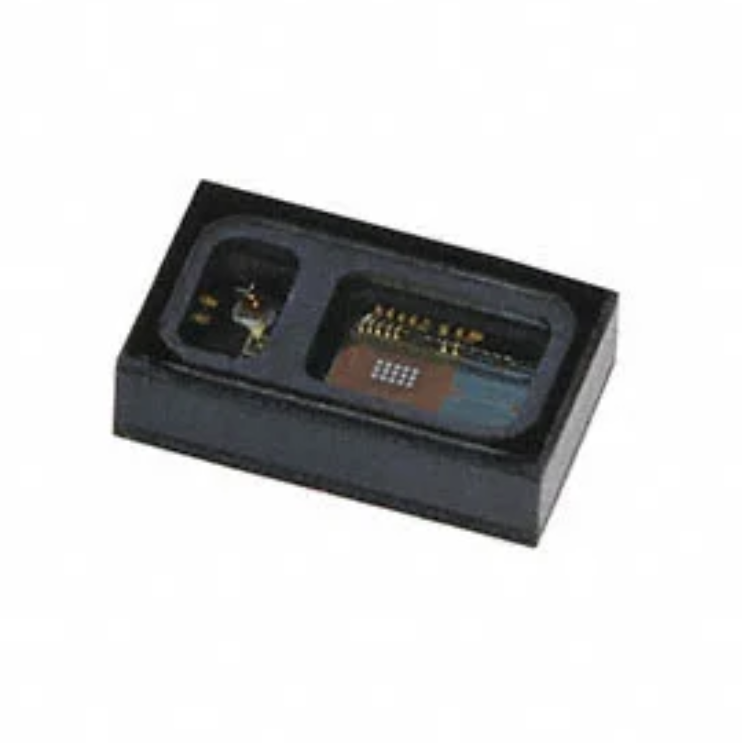
What is MAX30102?
The MAX 30102 is an integrated pulse oximetry and heart-rate monitoring module developed by Maxim Integrated. It combines internal LEDs, a photodetector, optical components, and low-noise electronics with ambient light rejection for accurate physiological measurements.
Designed as a complete solution for wearable and mobile devices, the sensor simplifies system integration. It operates with a 1.8V logic supply and a separate 3.3V LED supply, and communicates via a standard I²C interface. The module also supports software shutdown with near-zero standby current, enabling efficient power management.
MAX30102 Pinout
The circuit comes in a compact 14-pin package. Below is a clear description of each pin:
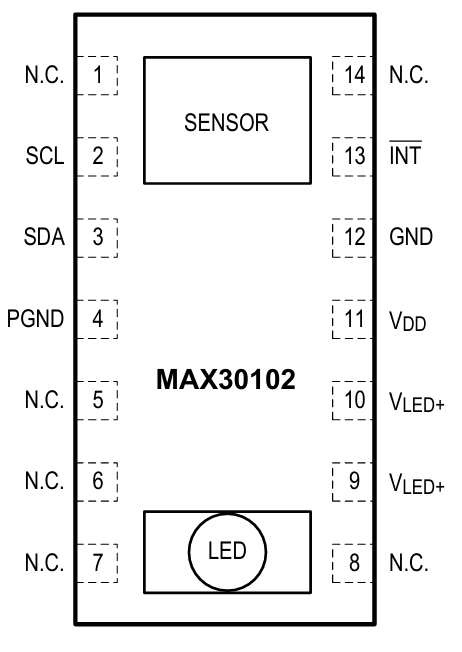
PIN | NAME | FUNCTION |
1, 5, 6, 7, 8, 14 | N.C. | No Connection. Connect to PCB pad for mechanical stability |
2 | SCL | I²C Clock Input |
3 | SDA | I²C Data, Bidirectional (Open-Drain) |
4 | PGND | Power Ground of the LED Driver Blocks |
9 | VLED | LED Power Supply (anode connection); use bypass capacitor to PGND |
10 | VLED | LED Power Supply (anode connection); use bypass capacitor to PGND |
11 | VDD | Analog Power Supply Input; use bypass capacitor to GND |
12 | GND | Analog Ground |
13 | INT | Active-Low Interrupt (Open-Drain); requires pull-up resistor |
MAX30102 CAD Model
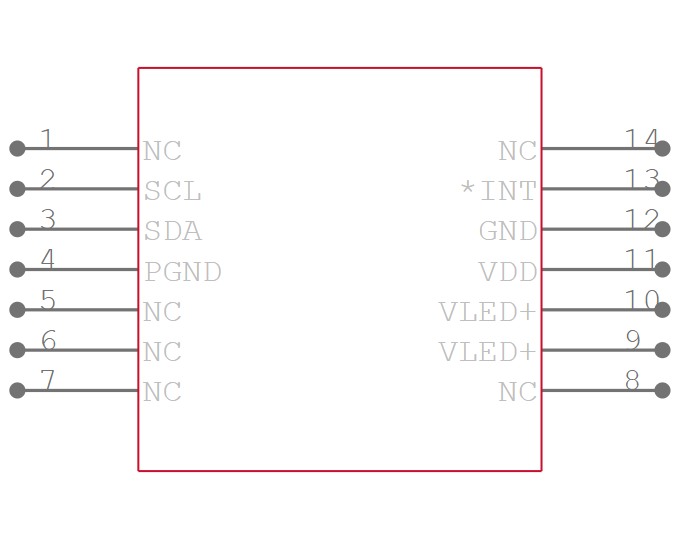
Footprint
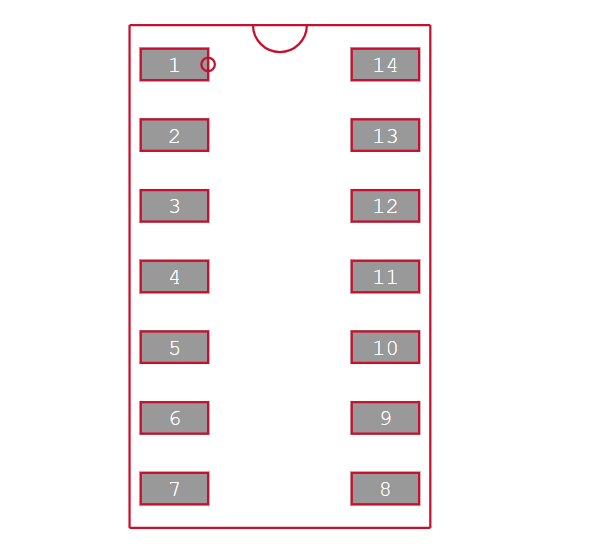
3D Model

MAX30102 Block Diagram
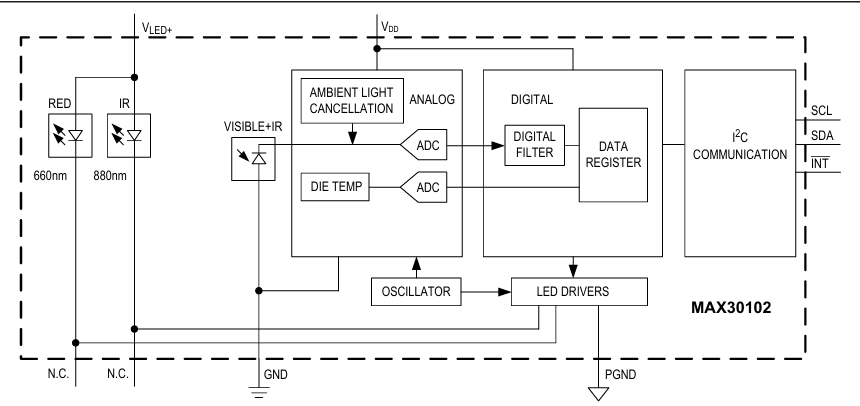
Mechanical Dimensions: 5.6mm × 3.3mm × 1.55mm
MAX30102 Features
Heart-Rate & Pulse Oximeter Integration
The sensor from Maxim Integrated combines heart-rate monitoring and pulse oximetry in a single module using an LED reflective sensing solution, simplifying wearable device design.
Compact Size
With dimensions of 5.6mm × 3.3mm × 1.55mm, this 14-pin optical module is extremely small, making it suitable for compact and space-limited applications.
Integrated Cover Glass
Built-in cover glass enhances optical performance and provides robust protection, effectively reducing interference from ambient and internal light sources.
Ultra-Low Power Operation
Designed for mobile and battery-powered devices, it supports programmable sample rates and LED current for power optimization, consumes less than 1mW in heart-rate mode, and features an ultra-low shutdown current of 0.7µA (typical).
Fast Data Output
Supports high sample rates, enabling quick and accurate data acquisition for real-time monitoring applications.
Motion Artifact Resistance
Offers strong resistance to motion interference with a high signal-to-noise ratio (SNR), ensuring reliable readings during movement.
Wide Operating Temperature Range
Operates reliably in harsh environments with a temperature range of -40°C to +85°C.
Technical Specifications
Parameter | Value |
Manufacturer | Maxim Integrated |
Sensor Type | Optical (PPG – Pulse Oximeter & Heart-Rate) |
Core Supply Voltage | 1.8V |
LED Supply Voltage | 3.3V – 5V |
Interface | I²C Compatible |
LED Wavelengths | Red (~660nm) & Infrared (~880nm) |
Power Consumption | < 1mW (Heart-rate mode) |
Shutdown Current | 0.7µA (typical) |
Operating Temperature | -40°C to +85°C |
Package Type | 14-pin Optical Module |
Dimensions | 5.6mm × 3.3mm × 1.55mm |
MAX30102 Manufacturer
The MAX 30102 manufacture by Maxim Integrated, a leading semiconductor company specializing in analog and mixed-signal integrated circuits. Maxim Integrated designed the MAX-30102 as a compact, low-power optical sensor for heart-rate and pulse oximetry applications, widely used in wearable and mobile health devices.
MAX30102 Sensor Uses
Wearable Devices
Widely use in wearable health devices such as smartwatches and fitness bands, providing real-time heart-rate and blood oxygen (SpO₂) monitoring.
Fitness Assistant Devices
Fitness trackers and health assistants integrate the MAX 30102 to measure pulse rate during workouts and daily activity, helping users track fitness goals accurately.
Smartphones
Some smartphones use the MAX 30102 for health-related apps, enabling on-device heart-rate and SpO₂ monitoring without additional hardware.
Tablets
Tablets with health and wellness applications can incorporate the MAX 30102 to support health monitoring, telemedicine, or fitness tracking functionalities.
Comparison of MAX30100 and MAX30102
The MAX30100 is the predecessor of the MAX30102 and shares similar functionality, combining LEDs, photodetector, and signal processing.
Key Differences
Feature | MAX30100 | MAX30102 |
Optical Design | Basic | Improved with cover glass |
Noise Immunity | Moderate | Better ambient light rejection |
Accuracy | Good | Higher accuracy |
Integration | Standard | Enhanced integration |
Application | Early wearables | Modern wearables |
MAX30100 Overview
The MAX 30100 is an integrated pulse oximetry and heart-rate monitoring sensor. It combines two LEDs (red and infrared), a photodetector, optimized optics, and low-noise analog signal processing to detect pulse oximetry and heart-rate signals. It operates on 1.8V and 3.3V power supplies and supports software shutdown with negligible standby current.
MAX30102 Improvements
Compared to the MAX30100, the MAX-30102 offers several enhancements:
Improved Optics: Integrated cover glass reduces ambient light interference.
Better Signal Quality: Higher signal-to-noise ratio (SNR) and motion artifact resistance.
Lower Power Consumption: Ultra-low power operation and minimal shutdown current.
Compact Design: Smaller, more robust 14-pin module for wearable integration.
Overall, the MAX30102 provides higher accuracy, enhanced reliability, and better suitability for modern wearable and mobile health devices than its predecessor, the MAX30100.
Working Principle of MAX30102 Pulse Sensor
The sensor operates based on Photoplethysmography (PPG), a non-invasive optical technique used to measure blood volume changes in microvascular tissue.
Step 1: Light Emission
The sensor emits red (~660 nm) and infrared (~880 nm) light into the skin using its integrated LEDs.
Step 2: Light Absorption
Oxygenated hemoglobin (HbO₂) and deoxygenated hemoglobin (Hb) absorb light differently. Variations in blood volume during heartbeats change the amount of light absorbed.
Step 3: Reflection Detection
A photodetector inside the MAX 30102 measures the reflected light intensity from the tissue.
Step 4: Signal Conversion
The reflected light is converted into an electrical signal, which corresponds to blood volume pulsations in real time.
Step 5: Data Processing
The module sends the electrical signal to a microcontroller via I²C, which calculates:
Heart rate (BPM) by analyzing the pulse waveform
Blood oxygen saturation (SpO₂) by comparing red and infrared light absorption
This optical principle enables the MAX30102 to provide accurate, continuous heart-rate and SpO₂ measurements for wearable and mobile health devices.
Heart Rate Sensor Module MAX30102 Board
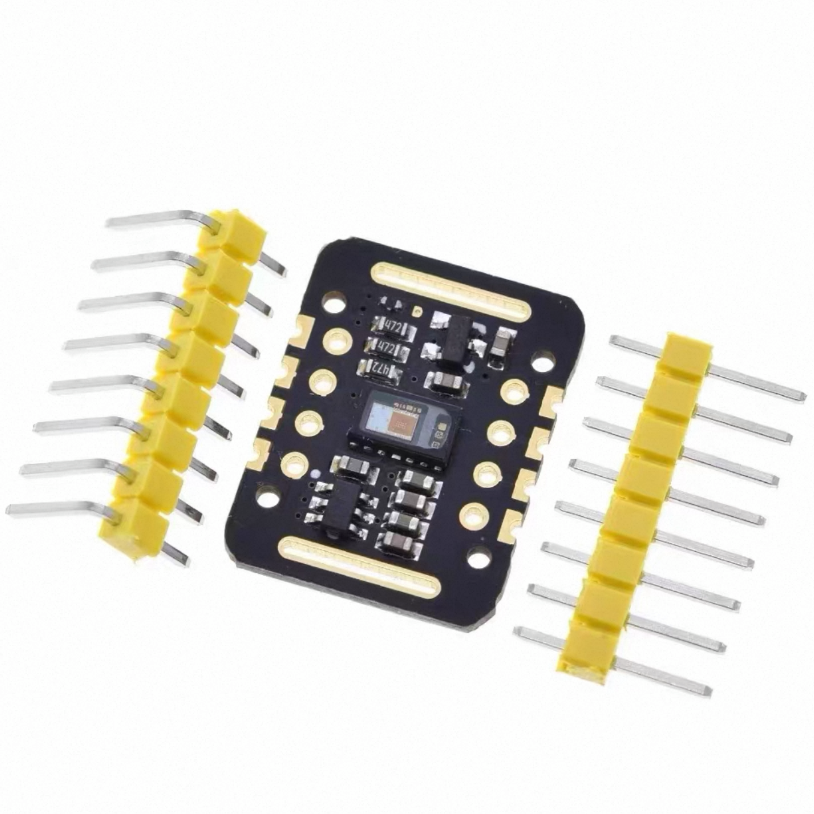
The MAX 30102 is an integrated pulse oximeter and heart-rate monitoring sensor module. It combines a red LED and an infrared LED, a photodetector, optical elements, and low-noise electronics with ambient light suppression.
The module operates with a 1.8V logic supply and a separate 5V supply for the internal LEDs, making it suitable for wearable devices to measure heart rate and blood oxygen (SpO₂). Can place on the finger, earlobe, or wrist for accurate physiological readings.
A standard I²C-compatible interface allows the sensor to transmit data to microcontrollers like Arduino or KL25Z, where heart rate and can calculate SpO₂. The module also supports software shutdown, reducing standby current to nearly zero while keeping power rails active.
Thanks to its compact size and performance, the sensor module has widely use in devices such as the Samsung Galaxy S series smartphones. Compared to its predecessor, the MAX30100, it features an integrated cover glass, which significantly reduces both external and internal light interference.
Key Specifications of Sensor Module:
Specification | Details |
LED Wavelengths | Red (~660 nm) and Infrared (~880 nm) |
LED Supply Voltage | 3.3–5V |
Signal Type | Reflective PPG (Photoplethysmography) |
Output Interface | I²C |
Communication Voltage | 1.8–3.3V or 5V selectable |
Module Mounting Hole | 0.5 × 8.5 mm |
Module Working Principle:
The MAX 30102 uses photoplethysmography to measure pulse and blood oxygen saturation. Light from the LEDs passes through or reflects off tissue. Changes in arterial blood volume during heartbeats alter the light intensity, which the photodetector converts into electrical signals. These signals are then amplified and transmitted for processing, providing real-time heart rate and SpO₂ readings.
MAX30102 Datasheet
The Analog Devices datasheet provides full technical details including: electrical characteristics, timing diagrams, register configuration, application circuits
Frequently Asked Questions [FAQ]
What is the use of MAX30102?
Use for non-invasive health monitoring, primarily measuring heart rate and blood oxygen saturation (SpO₂). It is integrated into wearable devices, fitness trackers, smartphones, and tablets, providing real-time physiological data through its optical sensing and I²C communication interface.
Is MAX30102 good for heart rate monitoring?
Yes, the snesor is highly suitable for heart rate monitoring. Its integrated LEDs, photodetector, and low-noise electronics ensure accurate pulse detection, even during movement. Its high signal-to-noise ratio and motion artifact resilience make it reliable for wearable and mobile health devices.
Does MAX30102 work on wrists?
Yes, the MAX 30102 can function on the wrist, though readings are most accurate on fingers or earlobes because stronger blood flow. Wrist placement works for smartwatches and fitness bands, but care must take to maintain proper contact and minimize motion interference for precise heart rate and SpO₂ measurements.
Is MAX30102 a PPG sensor?
Yes, the MAX 30102 operates based on Photoplethysmography (PPG). It measures changes in blood volume by detecting light absorption and reflection from the skin using red and infrared LEDs. The photodetector converts these changes into electrical signals for heart rate and SpO₂ calculation.
Can MAX30102 measure blood pressure?
No, the MAX 30102 cannot directly measure blood pressure. It limites to heart rate and SpO₂ measurement. However, some devices use PPG data from the MAX 30102 combined with algorithms and additional sensors to estimate blood pressure indirectly, but this requires calibration and additional hardware.
Can MAX30102 measure temperature?
No, the MAX 30102 does not include a temperature sensor. Specifically design for pulse oximetry and heart-rate monitoring. To measure temperature, need an additional dedicated temperature sensor in the device.
What is MAX30102 price and where to buy?
The MAX30102 typically costs $1–$3 per module, depending on quantity and supplier. It is available from Orwintech Electronics, and online marketplaces like Amazon and eBay, often sold as standalone breakout boards for microcontroller integration.
What are the key features of the MAX30102 sensor?
Key features include heart-rate and SpO₂ monitoring, red and infrared LEDs, I²C interface, ultra-low power operation, motion artifact resistance, high signal-to-noise ratio, small 5.6×3.3×1.55 mm package, and wide operating temperature range (-40°C to +85°C) for wearable and mobile applications.
How does the MAX30102 measure heart rate?
The MAX-30102 uses PPG: red and infrared LEDs shine light into the skin, and a photodetector measures reflected light variations caused by blood pulsations. These signals convert to electrical data, transmitted via I²C, and processed by a microcontroller to calculate heart rate in beats per minute (BPM).
What are the differences between the MAX30100 and MAX30102 sensors?
The MAX 30102 improves on the MAX30100 with integrated cover glass to reduce light interference, higher signal-to-noise ratio, better motion artifact resistance, lower power consumption, and a smaller, more robust 14-pin module. Both measure heart rate and SpO₂, but the MAX 30102 offers enhanced accuracy and reliability.
Conclusion
The MAX30102 is a compact, low-power, and highly accurate sensor module for heart-rate and blood oxygen (SpO₂) monitoring. Its integrated LEDs, photodetector, and low-noise electronics make it ideal for wearable devices, fitness trackers, and mobile health applications. With superior motion resilience, fast data output, and a small footprint, it offers reliable performance compared to its predecessor, the MAX30100. Whether used on fingers, earlobes, or wrists, the sensor provides developers with an efficient, easy-to-integrate solution for real-time physiological monitoring in modern health and fitness technology.
Read More:
1. DRV8833 Dual H-Bridge Motor Driver Module: Complete Guide
2. Mini MP1584 DC-DC 3A Buck Converter Module: Complete Guide
HOT NEWS
TP4056 Charging Module Pinout, Working, and Applications
TP4056 Charging Module Pinout, Working, and Applications
2026-01-23
LR41 Battery Guide: Specifications, Equivalents, and Uses
LR41 Battery Specifications, Equivalents, and Uses
2025-12-14
Understanding A 0603 Resistor
0603 resistor,dimensions,marking code, values
2025-05-29
Understanding The CD4051 Analog Multiplexer
CD4051 analog multiplexer
2025-06-30
MT3608 Boost Converter - An In-Depth Guide
MT3608 Boost Converter
2025-09-04
Complete Guide to the 220 Ohm Resistor
220 Ohm Resistor
2025-07-28
The 0402 Resistor: A Comprehensive Guide
0402 Resistor
2025-05-06
Guide To The XL6009 Boost Converter
XL6009 Boost Converter
2025-09-05
Mini MP1584 DC-DC 3A Buck Converter Module: Complete Guide
Mini MP1584 DC-DC 3A Buck Converter Module: Complete Guide
2026-03-26
What Is A 1206 Resistor?
1206 resistor dimensions,footprint,value
2025-06-05