




 BOM
BOM Cart
Cart Product Catalog
The MPU6050 is a popular motion tracking sensor developed by InvenSense. It combines a 3-axis accelerometer and a 3-axis gyroscope in a single compact chip, allowing accurate measurement of motion and orientation.
With its built-in Digital Motion Processor (DMP), the MPU-6050 can process motion data internally, reducing the workload on the microcontroller. This makes it a widely used choice for applications like drones, robotics, and motion-controlled systems.
1. MPU6050 Module Introduction
3. Specification of MPU6050 Sensor
6. MPU6050 Accelerometer Features
7. Where and How to Use MPU6050
8. MPU6050 Interfacing with Arduino
9. MPU6050 Code for Arduino Uno
10. Frequently Asked Questions
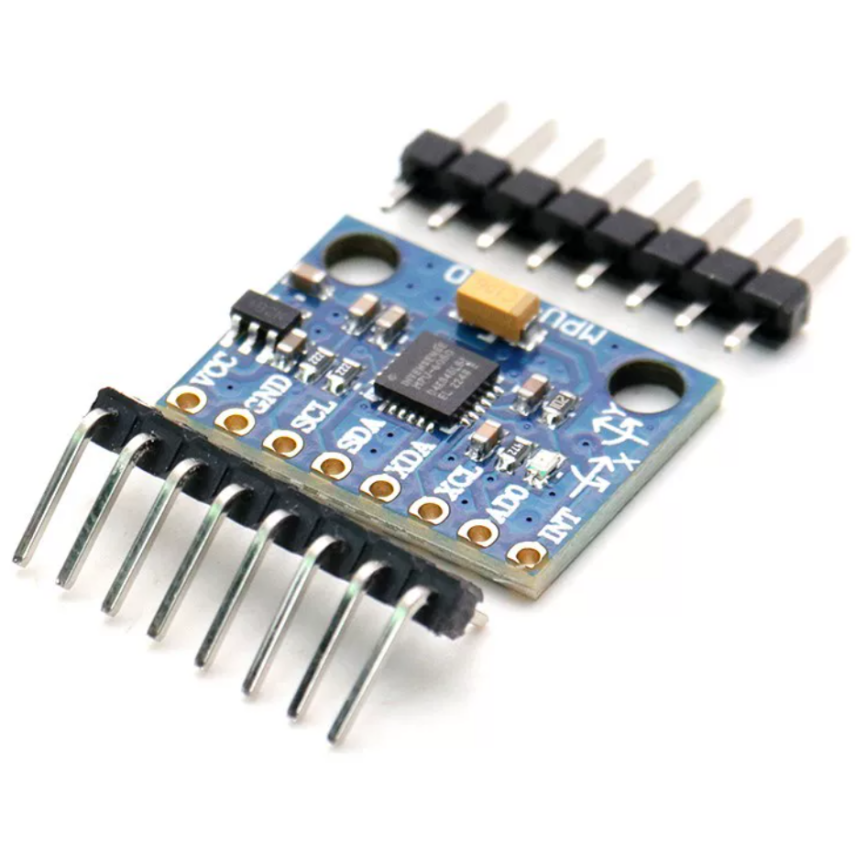
MPU6050 Module Introduction
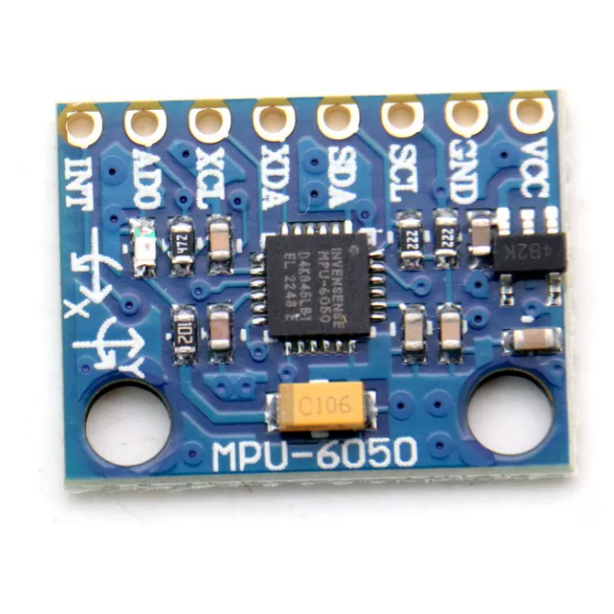
The MPU 6050 module is a high-performance 6-axis motion sensing device that integrates a 3-axis accelerometer and gyroscope in a single compact unit. Built around the MPU-6050 chip from InvenSense, widely use for motion tracking and orientation detection.
The module includes a 3-axis MEMS gyroscope, MEMS accelerometer, and an embedded Digital Motion Processor (DMP). Its primary function is to measure the tilt and orientation of an object along the X, Y, and Z axes, including Pitch, Roll, and Yaw angles. This makes it ideal for applications such as quadcopters, self-balancing robots, and motion-controlled systems.
Using the I2C interface, the MPU6050 outputs six raw data values: three from the accelerometer and three from the gyroscope. Can process these values using sensor fusion algorithms to calculate accurate orientation angles. Additionally, the built-in DMP can perform this calculation internally and directly output processed motion data, reducing the computational load on the microcontroller.
MPU6050 Module Pinout
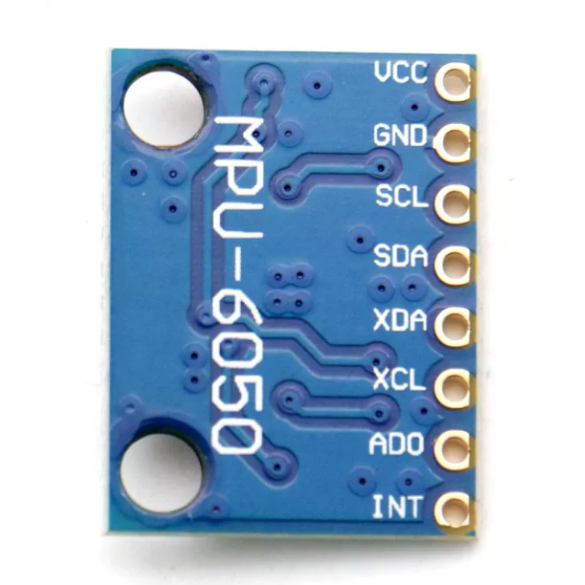
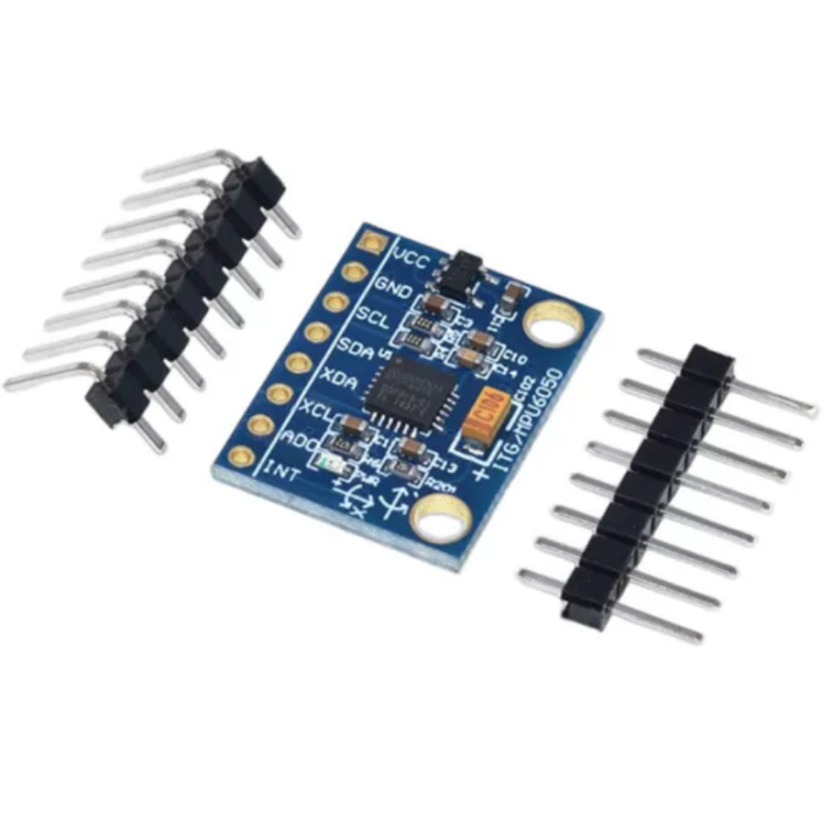
The MPU 6050 module uses a simple 8-pin interface, making it easy to connect with microcontrollers such as Arduino, ESP32, or STM32. It primarily communicates through the I2C protocol, requiring only two signal lines (SCL and SDA) for data exchange.
MPU6050 Pin Description
Pin No. | Pin Name | Description |
1 | Vcc | Supplies power to the module. Typically +3V to +5V (most commonly +5V). |
2 | GND | Ground connection of the system. |
3 | SCL | Serial Clock Line for I2C communication. Synchronizes data transfer. |
4 | SDA | Serial Data Line for I2C communication. Transfers data between MCU and sensor. |
5 | XDA | Auxiliary I2C Data line. Used to connect external I2C sensors (optional). |
6 | XCL | Auxiliary I2C Clock line. Works with XDA for external sensor communication (optional). |
7 | AD0 | Address selection pin. Used to change the I2C address when multiple MPU 6050 modules are connected. |
8 | INT | Interrupt pin. Signals the microcontroller when new data is available. |
Additional Notes
The default I2C address of the MPU-6050 is 0x68. When the AD0 pin is set HIGH, the address changes to 0x69, allowing multiple sensors on the same I2C bus.
The INT pin is particularly useful in real-time applications, as it notifies the microcontroller when fresh data is ready, avoiding constant polling.
The XDA and XCL pins enable the MPU 6050 to act as an I2C master for additional sensors, such as magnetometers, expanding system functionality.
This flexible pin configuration makes the MPU 6050 easy to integrate into a wide range of embedded and motion-sensing projects.
Specification of MPU6050 Sensor
The key specifications of the module are summarized in the table below:
Parameter | Description |
Product Name | MPU6050 Module (with XH2.54 header pins, cable, and enclosure) |
Communication Method | Standard I2C (IIC) communication protocol |
Operating Voltage | 5V DC |
Gyroscope Operating Current | 5 mA |
Gyroscope Standby Current | 5 µA |
Gyroscope Range | ±250, ±500, ±1000, ±2000 °/s |
Accelerometer Range | ±2g, ±4g, ±8g, ±16g |
Accelerometer Operating Current | 350 µA |
ADC Resolution | Built-in 16-bit ADC, 16-bit digital output |
These specifications make the MPU6050 suitable for accurate motion sensing, orientation detection, and real-time embedded applications.
Alternative for MPU6050
While widely use the MPU 6050, several alternative sensors offer different features, performance levels, or additional capabilities depending on your application.
ADXL335
A simple analog-output accelerometer. It is easy to use but lacks a gyroscope, making it suitable for basic tilt and motion detection only.
ADXL345
A digital accelerometer with I2C/SPI support, offering better precision and features like free-fall detection and activity monitoring.
MPU9250
An upgraded version of MPU-6050 that includes a magnetometer, enabling full 9-axis motion tracking and more accurate heading (yaw) measurement.
LSM6DS3
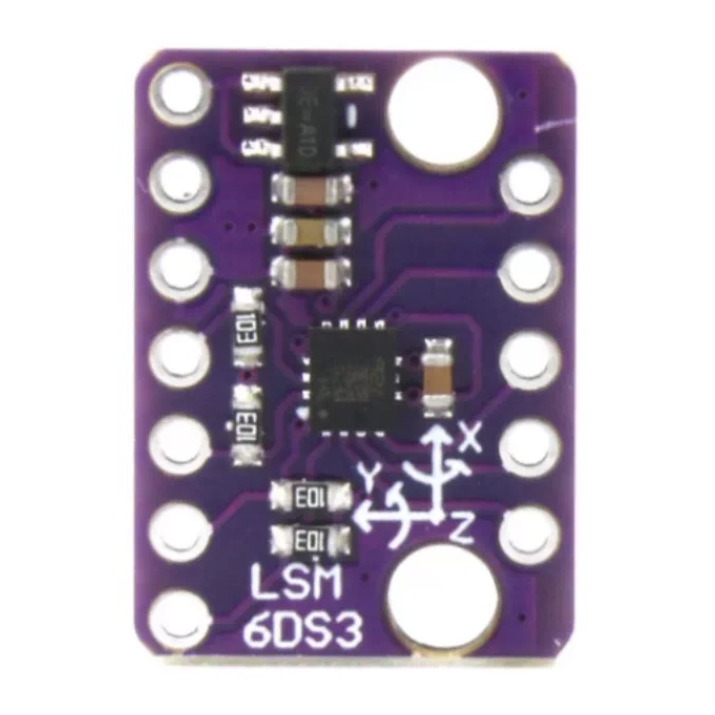
This sensor integrates a 3-axis accelerometer and a 3-axis gyroscope with a large 8KB FIFO buffer and embedded interrupt functions. Designed for mobile devices, it supports motion detection, tilt sensing, tap recognition, step counting, and temperature measurement. Its flexibility and low cost make it suitable for a wide range of applications.
BNO055
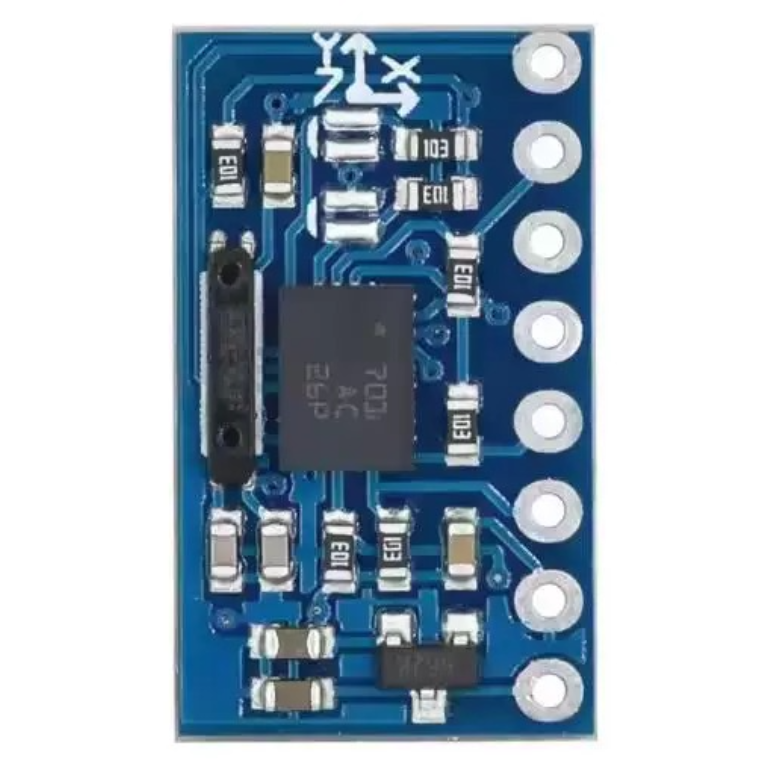
A highly integrated sensor that combines a 3-axis accelerometer, 3-axis gyroscope, and 3-axis magnetometer, along with a built-in 32-bit microcontroller for sensor fusion. It can output processed orientation data directly, reducing development complexity. Ideal for smartphones, wearables, and advanced navigation systems.
LIS3DSH
A low-power, high-performance accelerometer with embedded state machines for autonomous operation. It supports programmable motion detection, selectable ranges (±2g to ±16g), and data rates from 3.125 Hz to 1.6 kHz. It also includes a FIFO buffer to reduce processor load and operates reliably from -40°C to +85°C.
Summary
Choosing an alternative depends on your project needs:
Use ADXL335/ADXL345 for simple acceleration sensing
Choose MPU9250 for full 9-axis tracking
Select BNO055 if require built-in sensor fusion
Consider LSM6DS3 or LIS3DSH for low-power, high-performance embedded applications
Each of these sensors provides unique advantages, allowing you to select the most suitable option for your design.
MPU 6050 Applications
Motion-Sensing Games:
Widely use in motion-controlled gaming systems, where it detects user movements and translates them into real-time game actions, creating a more immersive and interactive experience.
Augmented Reality (AR):
In AR applications, the MPU 6050 helps track device orientation and motion, allowing virtual objects to align accurately with the real-world environment.
Electronic Image Stabilization (EIS):
Used to detect unwanted camera movements and assist in stabilizing images digitally, improving video and photo quality.
Optical Image Stabilization (OIS):
It supports optical stabilization systems by measuring motion and helping adjust lens positioning to reduce blur caused by hand movement.
Pedestrian Navigation:
The MPU-6050 enhances navigation systems by tracking user motion and direction, especially in environments where GPS signals are weak or unavailable.
Touchless Gesture Interface:
It enables gesture-based control systems, allowing users to interact with devices without physical contact through motion detection.
Gesture Shortcuts:
The sensor can recognize specific motion patterns to trigger predefined actions, improving user convenience and interaction speed.
Authentication Systems:
Can use in motion-based authentication, where unique movement patterns act as a form of user verification.
Market Applications
Smartphones:
Widely used for screen rotation, motion sensing, and gaming features in modern smartphones.
Tablet Devices:
Provides orientation detection and motion-based interaction in tablets.
Handheld Gaming Devices:
Enhances gaming experience through motion control and real-time feedback.
3D Remote Controllers:
Used in advanced remote systems to detect movement and control devices in three-dimensional space.
Portable Navigation Devices:
Improves motion tracking and positioning accuracy in compact navigation systems.
MPU6050 Accelerometer Features
Sensor Fusion Output:
The MPU 6050 can provide processed motion data in multiple formats, including rotation matrices, quaternions, and Euler angles. These outputs are generated through internal sensor fusion, making orientation calculations more convenient.
High-Precision Gyroscope:
It features a 3-axis gyroscope with a sensitivity of 131 LSB/°/s and selectable full-scale ranges of ±250, ±500, ±1000, and ±2000 °/s, enabling accurate angular velocity measurement.
Programmable Accelerometer:
The integrated 3-axis accelerometer offers programmable ranges of ±2g, ±4g, ±8g, and ±16g, allowing flexibility for different motion detection requirements.
Reduced Drift and Cross-Axis Sensitivity:
The device minimizes sensitivity differences between axes, reducing drift and improving overall measurement stability and accuracy.
Digital Motion Processor (DMP):
The built-in DMP engine handles complex motion processing tasks such as sensor fusion, synchronization, and gesture recognition, significantly reducing the computational load on the host microcontroller.
Platform Support:
The motion processing library is compatible with major platforms, including Android, Linux, and Windows, simplifying development across different systems.
Automatic Calibration Support:
It includes internal timing bias and sensor calibration features, reducing the need for complex external calibration procedures.
Integrated Temperature Sensor:
A built-in digital temperature sensor allows monitoring of environmental and device temperature conditions.
Synchronization Support:
A digital sync pin enables synchronization with external signals, which is useful in applications such as video electronic image stabilization.
Programmable Interrupts:
The sensor supports configurable interrupt functions for motion-based events such as gesture recognition, tap detection, free-fall detection, high-G events, zero-motion detection, and shake detection.
Low Power Consumption:
The MPU 6050 operates efficiently with low current consumption:
Gyroscope: ~5 mA (active), ~5 µA (standby)
Accelerometer: ~350 µA (active), ultra-low power in sleep mode
Flexible Power Supply:
Supports supply voltages of 2.5V, 3.0V, and 3.3V, with an interface voltage (VDDIO) of 1.8V.
High-Speed Communication:
Supports I2C communication up to 400 kHz, and in some configurations, SPI interface up to 20 MHz for faster data transfer.
Stable Internal Oscillator:
Includes an internal clock generator with only ±1% variation across the full temperature range, ensuring reliable performance.
High Shock Tolerance:
Designed to withstand mechanical shocks up to 10,000g, making it suitable for rugged applications.
Compact Package:
Housed in a small 4×4×0.9 mm QFN package, ideal for space-constrained and portable devices.
Environmental Compliance:
Fully compliant with RoHS standards, ensuring environmental safety and regulatory compliance.
Where and How to Use MPU6050
Use the MPU-6050 when your project requires motion detection, tilt sensing, or orientation tracking.
Typical Use Cases
· Self-balancing robots
· Drone flight stabilization
· Gesture-controlled systems
· Camera stabilization systems
Basic Usage Steps
1. Connect the sensor via I2C (SCL, SDA)
2. Power the module (3.3V or 5V depending on board)
3. Initialize the sensor registers
4. Read accelerometer and gyroscope data
5. Apply filtering (Complementary or Kalman filter)
6. Compute orientation (Pitch, Roll, Yaw)
MPU6050 Interfacing with Arduino
The MPU-6050 can be easily interfaced with an Arduino board like Arduino Uno.
Connections
MPU 6050 | Arduino Uno |
Vcc | 5V |
GND | GND |
SCL | A5 |
SDA | A4 |
INT | D2 (optional) |
Use the Wire library for I2C communication.
MPU6050 Code for Arduino Uno
#include <Wire.h>
#include <MPU6050.h>
MPU6050 mpu;
void setup() {
Serial.begin(9600);
Wire.begin();
mpu.initialize();
if (mpu.testConnection()) {
Serial.println("MPU6050 connected successfully");
} else {
Serial.println("Connection failed");
}
}
void loop() {
int16_t ax, ay, az;
int16_t gx, gy, gz;
mpu.getMotion6(&ax, &ay, &az, &gx, &gy, &gz);
Serial.print("Accel: ");
Serial.print(ax); Serial.print(" ");
Serial.print(ay); Serial.print(" ");
Serial.print(az); Serial.print(" | ");
Serial.print("Gyro: ");
Serial.print(gx); Serial.print(" ");
Serial.print(gy); Serial.print(" ");
Serial.println(gz);
delay(500);
}
Frequently Asked Questions
What is the MPU6050 sensor used for?
Use for motion tracking and orientation detection. It measures acceleration and angular velocity, making it ideal for drones, robotics, gaming controllers, and wearable devices that require precise movement detection.
Is the MPU6050 discontinued?
Yes, the MPU6050 has been officially discontinued by TDK InvenSense, but it is still widely available in the market because high demand and compatibility with existing designs.
What are the MPU6050's limitations?
It lacks a magnetometer, so it cannot provide absolute heading (yaw drift occurs over time). It also requires external filtering algorithms for accurate orientation and may experience drift and noise in long-term measurements.
What does MPU stand for in MPU6050?
MPU stands for Motion Processing Unit. It refers to the sensor’s ability to process motion data internally using its built-in Digital Motion Processor (DMP).
How to use MPU6050?
Connect it via I2C to a microcontroller, initialize it through code, read accelerometer and gyroscope data, and apply sensor fusion algorithms to calculate orientation angles such as pitch, roll, and yaw.
What are the advantages of using MPU6050?
It combines multiple sensors in one compact module, reduces system complexity, supports onboard processing (DMP), offers good accuracy, and is cost-effective for a wide range of motion-sensing applications.
How accurate is the MPU6050 sensor?
The MPU6050 provides good accuracy for general applications, with 16-bit resolution. However, accuracy depends on calibration and filtering. For high-precision applications, prefer more advanced IMUs like BNO055.
Conclusion
The MPU6050 remains one of the most popular motion sensors for embedded systems because its integration, affordability, and versatility. Whether you're building a drone, robot, or gesture-controlled device, it provides a reliable foundation for motion tracking and orientation sensing.
Read More:
1. MAX30102 Pulse Oximeter and Heart-Rate Sensor Complete Guide
2. ACS712 Current Sensor: An Overview and Guide
3. Mini MP1584 DC-DC 3A Buck Converter Module: Complete Guide
HOT NEWS
TP4056 Charging Module Pinout, Working, and Applications
TP4056 Charging Module Pinout, Working, and Applications
2026-01-23
LR41 Battery Guide: Specifications, Equivalents, and Uses
LR41 Battery Specifications, Equivalents, and Uses
2025-12-14
Understanding A 0603 Resistor
0603 resistor,dimensions,marking code, values
2025-05-29
MT3608 Boost Converter - An In-Depth Guide
MT3608 Boost Converter
2025-09-04
The 0402 Resistor: A Comprehensive Guide
0402 Resistor
2025-05-06
Complete Guide to the 220 Ohm Resistor
220 Ohm Resistor
2025-07-28
What Is A 1206 Resistor?
1206 resistor dimensions,footprint,value
2025-06-05
Guide To The XL6009 Boost Converter
XL6009 Boost Converter
2025-09-05
Understanding The CD4051 Analog Multiplexer
CD4051 analog multiplexer
2025-06-30
120 Ohm Resistor- Specifications, Applications, and Features
2025-05-12