




 BOM
 Cart
 Product Catalog
The SGP30 air quality sensor is a digital multi-pixel gas sensor designed for indoor air quality monitoring. Based on Sensirion's CMOSens® technology, it integrates multiple sensing elements, a temperature-controlled microhotplate, and an I²C interface into a compact DFN package. It provides TVOC and equivalent CO2 (CO2eq) output signals, making it suitable for air purifiers, smart home devices, ventilation systems, and IoT applications. In this article, we will introduce the SGP30's working principle, pinout, specifications, features, applications, GY-SGP30 module, and comparison with the CCS811 air quality sensor.
1. Description of the SGP30 Air Quality Sensor
6. GY-SGP30 CO2 Gas Sensor Module
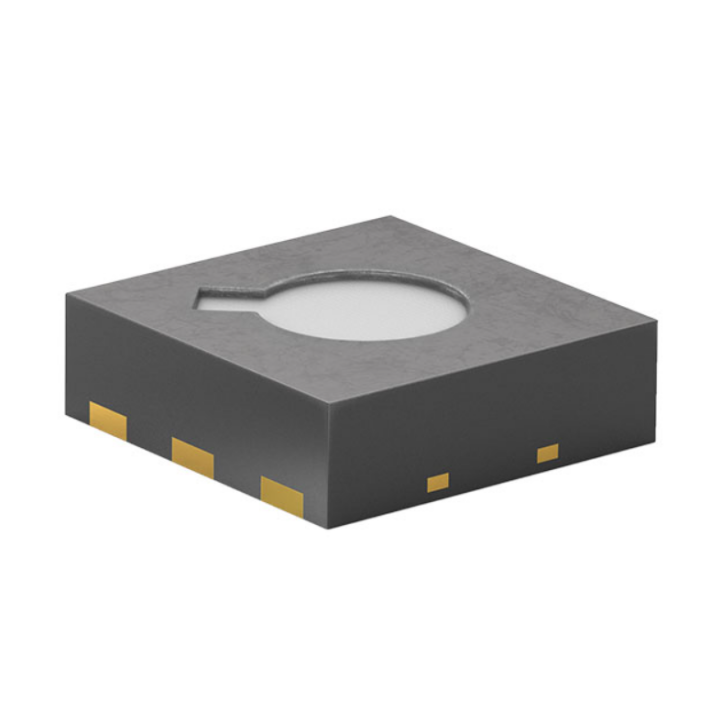
Description of the SGP30 Air Quality Sensor
The SGP30 air quality sensor is a digital multi-pixel gas sensor developed by Sensirion for indoor air quality monitoring. Based on the company's CMOSens® technology, it integrates multiple sensing elements, a temperature-controlled micro hotplate, signal processing, and an I²C digital interface into a single compact chip. It provides two preprocessed indoor air quality signals: Total Volatile Organic Compounds (TVOC) and equivalent carbon dioxide (CO2eq).
Unlike conventional single-element metal-oxide gas sensors, this device uses multiple sensing elements on one chip to provide more detailed information about indoor air conditions. Its sensing technology offers strong resistance to contaminating gases commonly found in real-world environments, helping maintain long-term stability and minimize measurement drift.
The SGP30 is housed in a small 2.45 × 2.45 × 0.9 mm DFN package, making it suitable for space-constrained electronic designs. Its high manufacturing reproducibility, reliability, and compatibility with standard surface-mount assembly processes also make it a practical choice for high-volume consumer electronics and industrial applications.
SGP30 Pinout
The SGP 30 comes in a compact 6-pin DFN package. It communicates with a microcontroller through an I²C interface, using SDA for serial data transmission and SCL for the clock signal.
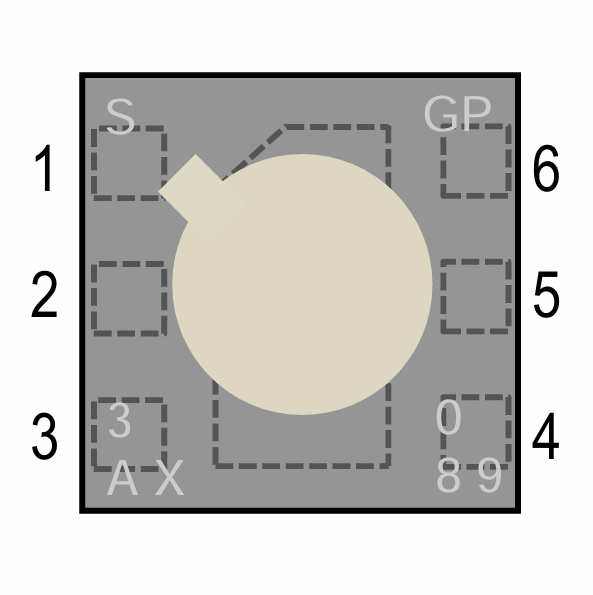
Pin | Name | Description |
1 | VDD | Supply voltage |
2 | VSS | Ground |
3 | SDA | Bidirectional serial data |
4 | R | Connect to ground; no electrical function |
5 | VDDH | Hotplate supply voltage |
6 | SCL | Bidirectional serial clock |
Pinout Notes:
VDD: Supplies power to the sensor's internal electronics.
VSS: Provides the ground connection.
SDA and SCL: Form the I²C communication interface for connecting to microcontrollers such as Arduino, ESP32, and STM32.
R: Should connect to ground according to the pin configuration.
VDDH: Supplies power to the integrated microhotplate.
When designing a circuit, follow the recommended power supply and decoupling arrangements in the manufacturer's datasheet.
Functional Block Diagram
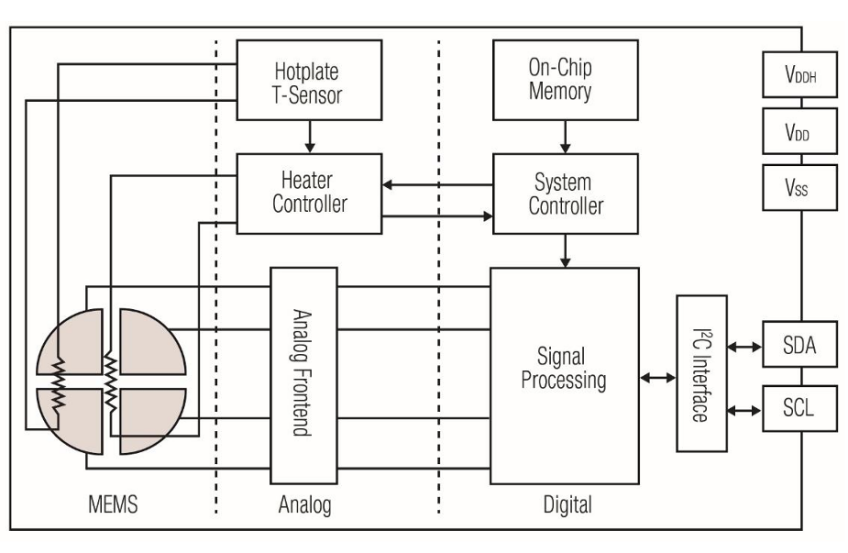
Sensirion SGP30 Specifications
The following table summarizes the main technical specifications of the SGP 30 air quality sensor.
Parameter | Value |
Manufacturer | Sensirion AG |
Sensor Type | Air Quality Sensor |
Packaging | Tape & Reel (TR) |
Package | 6-pin DFN |
Package Dimensions | 2.45 × 2.45 × 0.9 mm |
Accuracy | ±10% |
Output Interface | I²C |
Supply Voltage | 1.62V~1.98V |
Supply Current | 48mA |
Operating Temperature | -40°C~85°C |
Output Signals | TVOC and CO2eq |
Note: The 48 mA supply current is an important consideration when designing battery-powered equipment. The sensor's supply requirements should also check carefully when connecting it to a 3.3 V or 5 V development board.
SGP30 Features
The SGP 30 combines multiple sensing elements and digital signal processing in a compact package, providing several useful features for indoor air quality applications.
Multi-Pixel Gas Sensing: Integrates multiple metal-oxide sensing elements on a single chip to monitor indoor air quality.
Long-Term Stability: Offers strong resistance to contaminating gases, helping reduce measurement drift during extended operation.
Digital I²C Interface: Supports straightforward communication with microcontrollers and embedded control systems.
TVOC and CO2eq Outputs: Provides processed signals for monitoring total volatile organic compounds and equivalent carbon dioxide levels.
Compact Package: Uses a small 6-pin DFN package measuring only 2.45 × 2.45 × 0.9 mm.
SMD Assembly Compatibility: Supports standard reflow soldering and tape-and-reel packaging for automated manufacturing.
Integrated Microhotplate: Uses a temperature-controlled microhotplate to support the operation of its gas-sensing elements.
SGP30 Applications
The SGP 30 is designed for indoor air quality monitoring and can integrate into various electronic products that require continuous gas detection and environmental assessment.
Air Purifiers: The sensor can monitor indoor air quality by measuring TVOC and CO2eq signals. An air purifier can use this information to adjust its fan speed or purification mode according to changing indoor conditions.
Demand-Controlled Ventilation: In smart ventilation systems, the device provides air quality information to help control ventilation operation. This allows the system to respond to changes in indoor air conditions instead of running continuously at a fixed setting.
Smart Home Devices: The compact package and digital interface make it suitable for smart home products, including indoor air quality monitors, environmental control systems, and connected household appliances.
IoT Applications: The I²C interface allows easy integration with embedded controllers and wireless communication modules. Combined with an ESP32 or other microcontroller, it can be used to build connected air quality monitoring devices.
Consumer Electronics: Its small size and surface-mount compatibility make it suitable for portable air quality detectors and other compact electronic equipment.
GY-SGP30 CO2 Gas Sensor Module
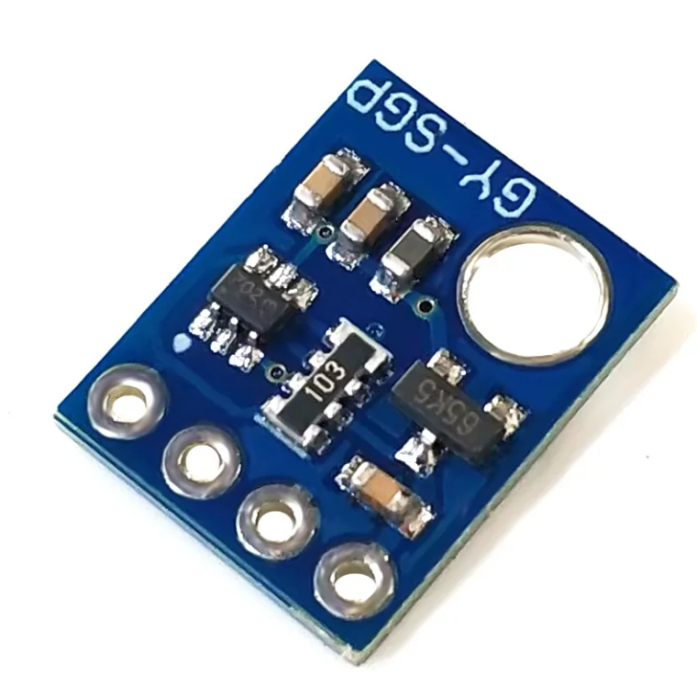
The GY-SGP30 module is a breakout board based on the Sensirion SGP 30 digital multi-pixel gas sensor chip. Designed to simplify the integration of indoor air quality monitoring into development boards and embedded electronic projects.
This module is commonly used to monitor TVOC and equivalent CO2 (eCO2) levels. Through its I²C interface, it can communicate with popular development platforms such as Arduino, ESP32, and Raspberry Pi.
The main functions include:
TVOC Monitoring: Provides information about total volatile organic compound levels in indoor environments.
eCO2 Monitoring: Outputs an equivalent CO2 estimate based on the sensor's gas measurements. It is not a direct CO2 measurement.
I²C Communication: Uses SDA and SCL signals to exchange measurement data with a host controller.
Easy Integration: The breakout-board format simplifies wiring and prototyping.
Indoor Air Quality Applications: Suitable for smart home monitors, air purifiers, and IoT environmental monitoring projects.
When using this module, check its specific supply voltage and logic-level requirements. Breakout boards may include additional voltage regulation or other supporting components that are not present on the bare sensor.
CCS811 vs SGP30
The CCS811 and SGP30 are both metal-oxide (MOX) gas sensors designed for indoor air quality monitoring. They provide digital outputs and communicate with external controllers through an I²C interface. However, their internal architectures, processing methods, and output characteristics are different.
CCS811 Features
The CCS811 is a low-power digital gas sensor designed for detecting indoor air quality changes. Its main characteristics include:
Low-power operation, making it suitable for battery-powered devices.
Fast sensor heating and high sensitivity.
Integrated intelligent algorithms for calculating TVOC and equivalent CO2 values.
I²C digital output for direct communication with a host microcontroller.
Integrated 8-bit MCU for running the first-level processing algorithms.
Integrated 12-bit ADC for sensor signal acquisition and conversion.
Reset and interrupt control functions for system integration.
CCS811 vs SGP30 Comparison Table
Parameter | SGP30 | CCS811 |
Manufacturer | Sensirion | ams |
Sensor Technology | Metal-Oxide (MOX) | Metal-Oxide (MOX) |
Sensing Structure | Multi-pixel sensing elements | MOX gas sensor |
Interface | I²C | I²C |
Output | TVOC and CO2eq | TVOC and eCO2 |
Signal Processing | Integrated processing | Integrated MCU and algorithms |
Main Application | Indoor air quality monitoring | Indoor air quality monitoring |
Package | 6-pin DFN | 10-lead LCC |
Which Sensor Should You Choose?
The SGP30 is a suitable choice for projects that require a compact multi-pixel sensing solution, long-term stability, and digital TVOC and CO2eq outputs. Its small DFN package is particularly useful for space-constrained products and high-volume electronic manufacturing.
The CCS811 is another practical option for indoor air quality monitoring, especially when its integrated processing functions and interrupt features match the system requirements.
Both devices provide estimated CO2 values rather than direct measurements of actual carbon dioxide concentration. If an application requires accurate CO2 measurement, an NDIR-based CO2 sensor may be more appropriate.
Frequently Asked Questions
What does the SGP30 sensor measure?
The SGP30 measures indoor air quality using multiple metal-oxide sensing elements. It provides two processed output signals: Total Volatile Organic Compounds (TVOC) and equivalent carbon dioxide (CO2eq). These values help electronic systems evaluate changes in indoor air conditions and control ventilation or air purification equipment.
Is the SGP30 a real CO2 sensor?
No. The SGP30 does not directly measure carbon dioxide concentration. Instead, it calculates an equivalent CO2 value based on detected gas patterns. This output can indicate changes in indoor air quality, but it should not replace an NDIR CO2 sensor when accurate carbon dioxide measurements are required.
How does the SGP30 communicate with Arduino?
The SGP30 communicates with Arduino through the I²C interface. Connect SDA and SCL to the corresponding I²C pins, provide the required supply voltage, and connect ground. An appropriate SGP30 library can initialize the sensor, retrieve TVOC and CO2eq readings, and display the results.
What is the difference between SGP30 and CCS811?
Both sensors are digital MOX devices designed for indoor air quality monitoring. The SGP 30 features multiple sensing elements on one chip and provides TVOC and CO2eq outputs. The CCS811 integrates an MCU and ADC for signal processing. Selection depends on package requirements, power consumption, software support, and application needs.
What are the main applications of the SGP30?
The SGP 30 is commonly used in indoor air quality monitors, air purifiers, demand-controlled ventilation systems, smart home devices, and IoT environmental monitoring equipment. Its compact package and I²C interface make integration relatively straightforward, especially in products that need continuous monitoring of indoor TVOC and equivalent CO2 levels.
What is the GY-SGP30 module used for?
The GY-SGP30 is a breakout module designed to simplify the use of the SGP30 sensor in electronic projects. It provides access to TVOC and equivalent CO2 readings through an I²C interface. It can be connected to compatible microcontrollers such as Arduino, ESP32, and Raspberry Pi for indoor air quality monitoring.
Conclusion
The SGP30 is a compact digital air quality sensor that combines multi-pixel metal-oxide sensing technology, integrated signal processing, and an I²C communication interface. Its TVOC and CO2eq outputs, long-term stability, and small DFN package make it suitable for air purifiers, smart home equipment, ventilation systems, and IoT monitoring devices.
When selecting an indoor air quality sensor, the SGP30 and CCS811 are both useful options. However, designers should consider their sensing architectures, power requirements, and output characteristics before choosing a component. For applications requiring direct CO2 measurement, a dedicated CO2 sensor should be considered instead.
Read More:
1. SHT31 Temperature & Humidity Sensor Module & Compare BME280
2. SCD30 CO2 Sensor Module: Pinout, Arduino Guide & Datasheet
3. DS3231 RTC Module – High Precision Real Time Clock
SGP30 Datasheet:
HOT NEWS
TP4056 Charging Module Pinout, Working, and Applications
TP4056 Charging Module Pinout, Working, and Applications
2026-01-23
Understanding The CD4051 Analog Multiplexer
CD4051 analog multiplexer
2025-06-30
LR41 Battery Guide: Specifications, Equivalents, and Uses
LR41 Battery Specifications, Equivalents, and Uses
2025-12-14
Understanding A 0603 Resistor
0603 resistor,dimensions,marking code, values
2025-05-29
MT3608 Boost Converter - An In-Depth Guide
MT3608 Boost Converter
2025-09-04
Mini MP1584 DC-DC 3A Buck Converter Module: Complete Guide
Mini MP1584 DC-DC 3A Buck Converter Module: Complete Guide
2026-03-26
The 0402 Resistor: A Comprehensive Guide
0402 Resistor
2025-05-06
Complete Guide to the 220 Ohm Resistor
220 Ohm Resistor
2025-07-28
Guide To The XL6009 Boost Converter
XL6009 Boost Converter
2025-09-05
What Is A 1206 Resistor?
1206 resistor dimensions,footprint,value
2025-06-05