




 BOM
BOM Cart
Cart Product Catalog
The CC1101 wireless transceiver module is a popular low-power RF communication solution designed for sub-1GHz wireless data transmission applications. Operating mainly at 433MHz, the module provides reliable long-range communication, low power consumption, and strong signal sensitivity, making it suitable for embedded systems, IoT devices, wireless sensors, and industrial automation projects.
Based on the Texas Instruments CC 1101 RF chip, the module supports programmable frequencies, multiple data rates, RSSI signal monitoring, and SPI communication. Widely used in smart home products, remote control systems, telemetry equipment, and wireless monitoring applications.
Thanks to its compact size, stable performance, and compatibility with platforms such as Arduino, ESP32, STM32, and Raspberry Pi Pico, the CC 1101 has become a common choice for developers seeking efficient wireless communication in the 433MHz frequency band.
2. Features and Specifications
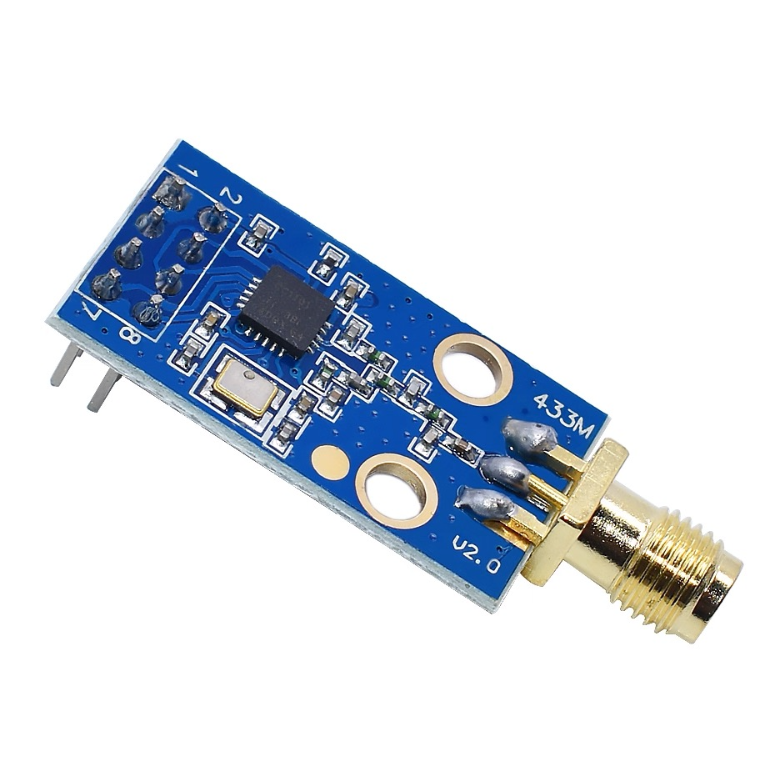
What is CC1101 Module?
The CC 1101 board is a low-power wireless RF transceiver module used for short-range and long-range data communication in the sub-1GHz frequency band. Based on the Texas Instruments CC1101RGPR chip and commonly design for 433MHz wireless applications.
This module can both transmit and receive digital data, making it suitable for two-way wireless communication systems. It supports stable RF performance, programmable frequency settings, high receiver sensitivity, and low power consumption, which makes it ideal for battery-powered devices and embedded electronics projects.
The module communicates with microcontrollers through a standard SPI interface and is compatible with platforms such as Arduino, ESP32, STM32, and Raspberry Pi Pico. Widely used in wireless sensors, smart home systems, remote controls, industrial automation, telemetry devices, and IoT applications.
Because its long communication range, compact size, and flexible configuration options, the module board remains one of the most popular sub-1GHz RF modules for wireless communication projects.
Features and Specifications
Feature
Low Power Consumption
Designed for low-power wireless communication applications. Its low operating current makes it suitable for battery-powered devices such as wireless sensors, remote controls, smart meters, and portable embedded systems.
Long Communication Range
The module supports wireless communication distances of more than 380 meters under suitable environmental conditions. The actual transmission range depends on antenna quality, data rate, power settings, and surrounding obstacles.
Sub-1GHz RF Communication
The CC 1101 operates in the 387MHz to 464MHz frequency range and is commonly configured for 433MHz communication. Sub-1GHz frequencies provide better signal penetration and longer transmission distance compared to higher-frequency RF modules.
Adjustable Frequency
The operating frequency can be configured through software, allowing developers to adjust the RF frequency according to regional requirements and project needs.
High Receiver Sensitivity
The module features excellent receiver sensitivity of up to -117dBm, enabling stable communication even in weak signal environments and improving long-distance wireless performance.
SPI Communication Interface
The CC 1101 uses a standard SPI communication interface with support for SPI Mode 0 and communication speeds up to 10Mbps. This allows fast and reliable communication with microcontrollers.
RSSI Signal Detection
The module supports RSSI (Received Signal Strength Indicator) functionality, which helps measure signal quality and optimize wireless communication performance.
Multiple Data Rates
The module supports adjustable air data rates from 1.2kbps to 500kbps. For stable 433MHz communication, lower data rates are generally recommended.
FIFO Data Buffer
The built-in FIFO buffer supports packet-based communication and improves data handling efficiency. The module supports packet lengths from 1 to 32 bytes.
Compact PCB Design
With a PCB size of only 28mm × 15mm, the module is compact and suitable for space-constrained electronic projects and embedded systems.
Wide Operating Voltage
The module supports an operating voltage range from 1.8V to 3.6V DC, making it compatible with many low-voltage microcontrollers and battery-powered devices.
Industrial Manufacturing Process
Produce the module using SMT machine assembly and industrial-grade components, providing stable performance and reliable operation in various applications.
Strong Compatibility
The module can be easily connected to development platforms such as Arduino, ESP32, STM32, Raspberry Pi Pico, and other SPI-compatible microcontrollers.
Wide Application Support
Widely used in smart home systems, wireless sensor networks, telemetry devices, industrial automation, remote controls, IoT products, and security systems.
Technical Specifications
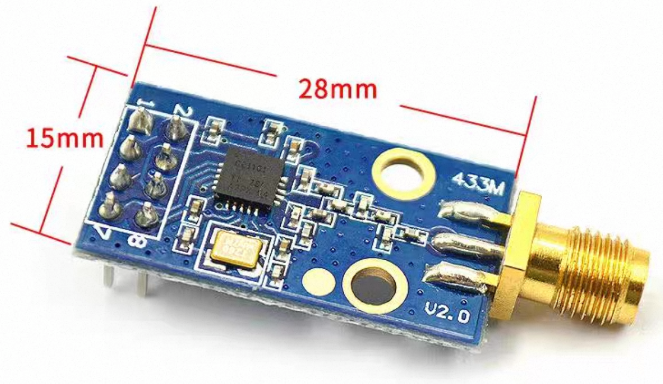
Parameter | Specification |
Product Name | CC1101 Wireless Module |
RF Chip | CC1101RGPR |
Recommended Frequency | 433MHz |
Frequency Range | 387MHz – 464MHz |
RF Output Power | 10dBm (about 10mW) |
Communication Distance | More than 380 meters |
Operating Voltage | 1.8V – 3.6V DC |
Communication Level | 0.7VDD – 3.6VDC |
PCB Size | 28mm × 15mm |
Module Size | 15mm × 28mm |
Manufacturing Process | SMT Machine Assembly |
Interface Type | 2×4×2.54mm Header |
Air Data Rate | 1.2kbps – 500kbps |
Recommended Data Rate | Below 20kbps at 433MHz |
Transmit Current | 29.2mA Peak |
Receive Current | 14.7mA |
Communication Interface | Standard SPI Interface |
SPI Mode | Mode 0 |
SPI Speed | Up to 10Mbps |
Packet Length | 1–32 Bytes |
FIFO Buffer | 3-Level FIFO Buffer |
RSSI Support | Yes |
Receiver Sensitivity | -117dBm @ 250kbps |
Operating Temperature | -30°C to 85°C |
Operating Humidity | 10% – 90% |
Storage Temperature | -40°C to 125°C |
CC1101 Module Pinout
Pin Description
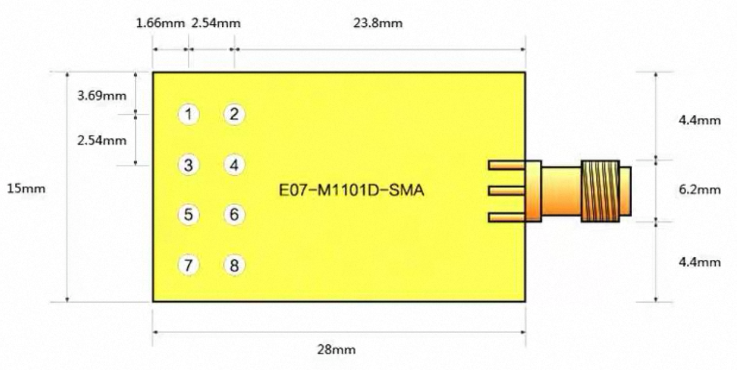
Pin | Name | Description |
1 | GND | Ground pin used for the common electrical ground connection. |
2 | VCC | Power supply input pin. The module typically operates at 3.3V DC. |
3 | GDO0 | General digital output pin used for interrupts, packet transmission, and status signaling. |
4 | CSN | Chip Select pin for SPI communication. Used to enable or disable communication with the module. |
5 | SCK | SPI clock line used to synchronize SPI data transmission between the microcontroller and the CC 1101 module. |
6 | MOSI | Master Out Slave In pin. Used for sending data from the microcontroller to the CC 1101 module. |
7 | MISO | Master In Slave Out pin. Used for sending data from the CC 1101 module to the microcontroller. |
8 | GDO2 | Second general digital output pin used for programmable RF status and interrupt functions. |
Packet Structure Basics
The 1101 RF module uses packet-based wireless communication to send and receive digital data. Each RF packet contains several sections that help ensure stable and reliable communication.
Preamble
The preamble is a sequence of bits used to synchronize the receiver with the incoming signal before data transmission starts.
Sync Word
The sync word identifies the beginning of a valid data packet. Both transmitter and receiver must use the same sync word.
Packet Length
This field defines the size of the transmitted payload data. The CC 1101 supports both fixed and variable packet lengths.
Payload Data
The payload contains the actual transmitted information such as sensor data, commands, or status signals.
CRC Check
CRC (Cyclic Redundancy Check) is used for error detection. The CC 1101 can automatically generate and verify CRC data.
FIFO Buffer
The module includes internal FIFO buffers for efficient packet transmission and reception.
RSSI Support
RSSI measures the received signal strength and helps monitor wireless communication quality.
Libraries & Setup
The CC 1101 module requires a software library and proper SPI configuration to work with microcontrollers such as Arduino, ESP32, and others. Most setups are simple and use existing open-source drivers.
Common Libraries
· ELECHOUSE CC1101 Library (Arduino)
· RadioLib (multi-protocol RF library)
· SmartRC CC1101 Driver Library
These libraries handle register configuration, frequency setup, packet transmission, and reception.
Basic Setup Steps
1. Hardware Connection
Connect the module board to your microcontroller using SPI pins (SCK, MOSI, MISO, CSN) and power it with 3.3V.
2. Install Library
Install a CC1101 library through the Arduino Library Manager or download it from GitHub.
3. Initialize Module
Initialize the module in your code by setting frequency (e.g., 433MHz), power level, and data rate.
4. Configure Settings
Set parameters such as channel, sync word, and packet length depending on your application.
5. Send or Receive Data
Use library functions to transmit or receive packets through the RF link.
Important Notes
· Always use 3.3V power (not 5V)
· Ensure correct SPI wiring
· Match frequency on both transmitter and receiver
· Use a proper antenna for stable communication
CC1101 Wiring
Wiring Table
Pin | Arduino Nano | Arduino Pro Micro | ESP32 | Raspberry Pi Pico |
VCC | 3.3V | 3.3V | 3.3V | 3.3V |
GND | GND | GND | GND | GND |
SCK | D13 | D15 | GPIO18 | GP18 |
MOSI | D11 | D16 | GPIO23 | GP19 |
MISO | D12 | D14 | GPIO19 | GP16 |
CSN (SS) | D10 | D10 | GPIO5 | GP17 |
GDO0 (Optional) | D2 | D2 | GPIO4 | GP20 |
GDO2 (Optional) | D3 | D3 | GPIO2 | GP21 |
Arduino Nano CC1101 Wiring Example
The CC1101 module communicates with the Arduino Nano using the SPI interface. Proper wiring is important for stable wireless performance and safe operation, since the module works only at 3.3V logic levels.
Basic Wiring (Arduino Nano)
CC1101 Pin | Arduino Nano Pin | Description |
VCC | 3.3V | Power supply (do not use 5V) |
GND | GND | Ground connection |
SCK | D13 | SPI clock signal |
MOSI | D11 | SPI data from Arduino to CC1101 |
MISO | D12 | SPI data from CC1101 to Arduino |
CSN | D10 | SPI chip select pin |
GDO0 | D2 | Optional interrupt / packet status |
GDO2 | D3 | Optional secondary output |
Important Wiring Notes
· Always power the CC1101 with 3.3V only
· Do not connect directly to 5V signals
· Keep SPI wires short for stable communication
· Use GDO0 if you need packet receive interrupts
· Add a proper antenna for better range and signal stability
Typical Connection Overview
The Arduino Nano acts as the SPI master, while the CC1101 module works as the SPI slave device. Once connected correctly, the Arduino can configure frequency, send packets, and receive wireless data through the module.
Recommended Practice
For best performance:
Use a stable external 3.3V regulator if needed.
Add decoupling capacitor (10µF or 100µF) near VCC pin.
Avoid noisy power sources when transmitting RF signals.
CC1101 Board Application
Widely used in low-power wireless communication systems. Its long-range capability, low power consumption, and stable RF performance make it suitable for many embedded and IoT applications.
Smart Home Systems
Commonly used in smart home devices such as wireless switches, remote lighting control, smart plugs, and home automation systems. It enables stable 433MHz communication between controllers and appliances.
Wireless Sensor Networks
In sensor-based systems, used to transmit data such as temperature, humidity, pressure, and motion signals. It is suitable for environmental monitoring, agriculture systems, and industrial sensing applications.
Remote Control Systems
Widely used in RF remote controls for garage doors, fans, toys, and consumer electronics. Its reliable transmission makes it ideal for simple wireless command systems.
Industrial Automation
Used in factory automation, machine monitoring, wireless alarms, and telemetry systems. It supports stable communication in environments requiring low-power and long-distance RF links.
IoT Applications
In Internet of Things (IoT) projects, the CC1101 enables wireless communication between microcontrollers and cloud-connected gateways. Often use in DIY IoT prototypes and embedded smart devices.
Security Systems
Also used in wireless alarm systems, door sensors, and security monitoring devices. Its low power consumption makes it suitable for always-on security applications.
CC1101 Datasheet PDF
The official datasheet for the CC 1101 RF transceiver provides complete details about electrical characteristics, register settings, packet configuration, and RF design guidelines.
Frequently Asked Questions
What is CC1101 used for?
The CC1101 is used for low-power wireless communication in the sub-1GHz band. Applied in smart home devices, wireless sensors, remote controls, IoT systems, telemetry, and industrial automation. It enables reliable long-range data transmission using 433MHz or nearby frequencies.
What voltage does the CC1101 use?
The CC 1101 operates with a supply voltage range of 1.8V to 3.6V DC. The recommended operating voltage is 3.3V for stable performance. It is important not to connect it directly to 5V systems, as this may damage the RF transceiver module.
What is the maximum power of CC1101?
The CC1101 module typically supports a maximum RF output power of about 10dBm, which equals approximately 10mW. This power level is sufficient for short to medium-range wireless communication while maintaining low energy consumption for battery-powered embedded applications.
Which frequency should I choose?
The most common choice is 433MHz, which offers good range and penetration. However, the CC 1101 supports 387MHz to 464MHz. The final frequency should depend on local RF regulations and application requirements, ensuring compatibility and avoiding interference with other wireless systems.
How much range can I expect?
Under ideal conditions, the CC1101 can achieve over 380 meters of communication range. Actual distance depends on antenna quality, data rate, obstacles, and environment. Indoor usage typically reduces range, while outdoor line-of-sight conditions significantly improve transmission distance.
What does a CC1101 module do?
The CC1101 module sends and receives digital data using radio frequency signals. It acts as a wireless communication bridge between microcontrollers. It supports packet-based transmission, enabling devices to exchange information reliably over long distances using low-power sub-1GHz RF communication.
Which is better nRF24L01 or CC1101 module?
The nRF24L01 is better for high-speed, short-range communication at 2.4GHz. The CC1101 is better for long-range, low-power communication in the sub-1GHz band with better wall penetration. Choice depends on whether speed or range is more important.
Does CC1101 need an antenna?
Yes, the CC 1101 requires an antenna for proper operation. Without an antenna, range is greatly reduced and signal quality becomes unstable. A properly tuned 433MHz antenna ensures better transmission distance, improved sensitivity, and more reliable wireless communication performance.
Conclusion
The CC1101 wireless transceiver module is a powerful and flexible RF communication solution for embedded systems and wireless applications. With its low power consumption, long communication range, high receiver sensitivity, and SPI interface support, the module is suitable for a wide variety of IoT, industrial, smart home, and remote control projects.
Its compatibility with popular development boards such as Arduino, ESP32, and Raspberry Pi Pico makes it easy for both beginners and professional developers to integrate wireless communication into their projects. Whether you are building a wireless sensor network, remote monitoring system, or RF automation device, the CC1101 provides reliable sub-1GHz communication with excellent performance.
Read More:
1. SX1276 LoRa Transceiver: Pinout and Wireless Lora Module
2. TJA1050 Transceiver Pinout, Applications and Can Bus Module
HOT NEWS
TP4056 Charging Module Pinout, Working, and Applications
TP4056 Charging Module Pinout, Working, and Applications
2026-01-23
LR41 Battery Guide: Specifications, Equivalents, and Uses
LR41 Battery Specifications, Equivalents, and Uses
2025-12-14
Understanding A 0603 Resistor
0603 resistor,dimensions,marking code, values
2025-05-29
Understanding The CD4051 Analog Multiplexer
CD4051 analog multiplexer
2025-06-30
MT3608 Boost Converter - An In-Depth Guide
MT3608 Boost Converter
2025-09-04
Complete Guide to the 220 Ohm Resistor
220 Ohm Resistor
2025-07-28
The 0402 Resistor: A Comprehensive Guide
0402 Resistor
2025-05-06
What Is A 1206 Resistor?
1206 resistor dimensions,footprint,value
2025-06-05
Guide To The XL6009 Boost Converter
XL6009 Boost Converter
2025-09-05
Mini MP1584 DC-DC 3A Buck Converter Module: Complete Guide
Mini MP1584 DC-DC 3A Buck Converter Module: Complete Guide
2026-03-26