




 BOM
BOM Cart
Cart Product Catalog
HX711 load cell amplifier module is a high-precision 24-bit ADC board designed for electronic weighing and force measurement applications. Based on the HX711 A/D converter chip, this module integrates a programmable gain amplifier and provides a simple digital interface for connecting load cells, pressure sensors, and strain gauge sensors. With high resolution, low power consumption, and easy compatibility with Arduino, ESP32, STM32, and other microcontrollers, the HX 711 module widely use for building digital scales, kitchen scales, and industrial weighing systems. This guide introduces the HX711’s pinout, specifications, features, wiring connections, applications, and common questions to help you understand how this weight sensor amplifier works.
1. What is HX711 Load Cell Amplifier Module?
3. Features and Specifications
6. Frequently Asked Questions [FAQ]
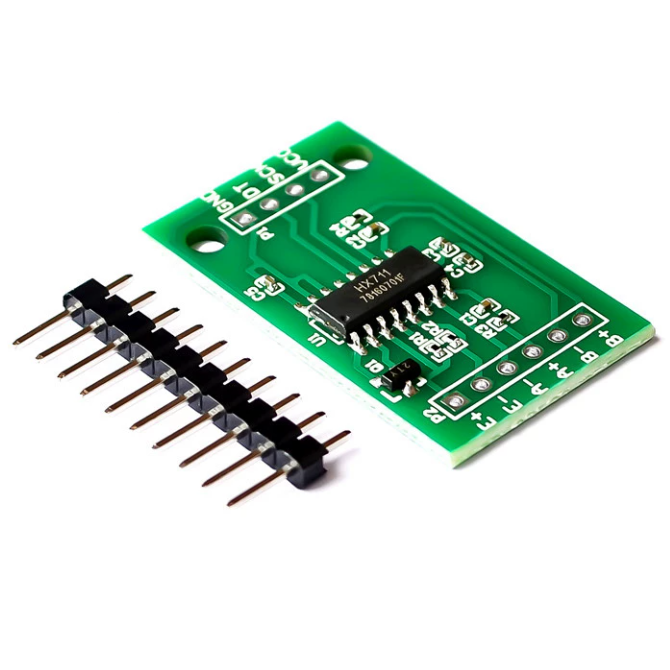
What is HX711 Load Cell Amplifier Module?
The HX711 module is a high-precision ADC conversion board designed for electronic weighing applications. It uses the HX711 24-bit A/D converter chip, which integrates a programmable gain amplifier and is specially developed for high-accuracy electronic scales.
The module is designed to work with bridge-type sensors such as load cells, pressure sensors, and strain gauges. Can configure its input circuit to provide excitation voltage and measure tiny differential voltage changes from the sensor bridge. With high resolution, low power consumption, and simple digital communication, the HX 711 provides an ideal low-cost front-end solution for precision weight measurement systems.
The module converts the small analog signal generated by a load cell into a digital output signal that can be directly read by microcontrollers such as Arduino, ESP32, STM32, and other embedded systems.
HX711 Sensor Module Pinout
The module provides sensor excitation connections, differential analog inputs, and a simple two-wire digital interface.
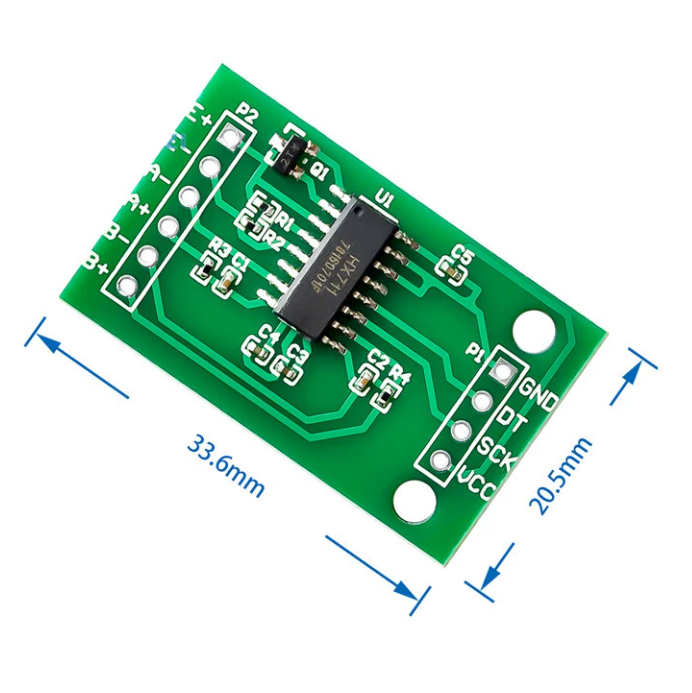
Pin | Function |
E+ | Analog power positive / Load cell excitation positive |
E- | Ground / Load cell excitation negative |
A- | Channel A negative analog input |
A+ | Channel A positive analog input |
B- | Channel B negative analog input |
B+ | Channel B positive analog input |
GND | Power ground |
DT | Digital serial data output |
SCK | Serial clock input and power-down control (high level active) |
VCC | Power supply positive |
Channel A is normally used for high-precision load cell measurement because it supports higher programmable gain options. Can use Channel B for applications requiring another analog input channel with lower sensitivity.
HX711 Features and Specifications
Module Feature
HX711 24-bit ADC conversion provides high-resolution measurement for small sensor signals. The integrated 24-bit analog-to-digital converter allows the module to detect tiny voltage changes from load cells and other bridge sensors.
Programmable gain amplifier allows different gain settings of 32, 64, and 128, making the HX711 suitable for different sensor output ranges and measurement requirements.
Dual-channel input design provides two differential analog input channels. Typically use channel A for weighing applications, while can use Channel B for secondary measurement purposes.
Simple digital serial communication allows the HX711 to connect easily with popular microcontrollers without requiring complex communication protocols. Only the DT and SCK pins are needed for data transmission.
Low power operation makes the HX711 suitable for battery-powered weighing devices and portable measurement systems.
Specification
Parameter | Value |
Input Voltage Range | 40 mV |
ADC Resolution | 24-bit A/D Converter Integrated |
Programmable Gain | 32, 64, or 128 |
Number of Channels | 2 |
Output Interface | Digital Serial Output |
Refresh Frequency | 80 Hz |
Operating Voltage | 2.6~5.5V DC |
Operating Current | <10mA |
Module Size | 38mm x 21mm x 10mm |
HX711 Load Cell Amplifiers Application
Load Cell Amplifier Module is widely used in weight measurement and force detection systems because it can accurately process the small electrical signals generated by strain gauge sensors. By combining a high-resolution ADC with a programmable gain amplifier, this module provides a simple and reliable solution for converting load cell output signals into digital data for microcontrollers.
Electronic weighing systems are one of the most common applications. The module is frequently used in digital scales, kitchen scales, and electronic balances, where require accurate weight measurement. It works with different types of load cells to detect tiny changes caused by applied force and provides stable measurement results after calibration.
Industrial measurement equipment can also benefit from this module in applications such as process control, material weighing, and load monitoring. Its low power consumption and compact size make it suitable for embedded measurement devices where space and energy efficiency are important considerations.
Microcontroller-based projects are another popular application area. The simple two-wire digital interface allows easy connection with Arduino, ESP32, STM32, and other development platforms, making it convenient for DIY electronic scales, smart devices, and sensor-based projects.
Force and pressure sensing systems can use this module together with compatible bridge-type sensors to measure mechanical changes. It provides a cost-effective front-end solution for applications that require precise analog signal conversion without using complex external circuits.
HX711 Wiring Connection
Load Cell Installation
When using a load cell, one side of the sensor should be fixed through the mounting holes, while the other side should remain in a suspended state. Apply force according to the direction marked on the sensor.
Avoid directly pressing the white coated area of the load cell, as excessive pressure may damage the internal strain gauge structure.
For a full-bridge four-wire load cell, the sensor is simple to connect. Apply a 5~10V excitation voltage, and the deformation of the strain gauge bridge produces a small voltage signal that can measure by the HX711 module.
Load Cell Wire Connection
A typical four-wire load cell connection is:
Load Cell Wire | HX711 Connection |
Red | E+ (Excitation Positive) |
Black | E- (Excitation Negative) |
Green | A+ (Signal Positive) |
White | A- (Signal Negative) |
The exact wire colors vary depending on the manufacturer, so always check the sensor specification before wiring.
Load Cell Usage Notes
1. Should normally install a parallel beam load cell in a cantilever beam configuration. Correct mechanical installation is important for measurement accuracy.
2. Load cells have small deformation ranges. During installation and operation, avoid overload conditions.
3. If the sensor does not return to its original shape after removing external force, permanent deformation may have occurred and the load cell may be damaged.
4. A four-wire load cell usually contains:
o Red wire: excitation positive
o Black wire: excitation negative
o White wire: signal output negative
o Green or blue wire: signal output positive
5. Do not randomly change the wire length because it affect measurement accuracy.
6. The full-scale output voltage can be calculated from excitation voltage and sensor sensitivity.
For example:
A 5V excitation voltage with a load cell sensitivity of 1.0mV/V produces:
5V × 1.0mV/V = 5mV full-scale output voltage
This small signal is why require a high-resolution ADC amplifier such as the HX711.
Frequently Asked Questions [FAQ]
What is HX711 used for?
The HX711 is mainly used for measuring weight and force signals from load cells. It converts the tiny analog voltage output of strain gauge sensors into a 24-bit digital signal. Commonly use in electronic scales, kitchen scales, industrial weighing equipment, and Arduino-based weight measurement projects.
What is an HX711 amplifier?
The HX 711 is a load cell amplifier and ADC module that combines a programmable gain amplifier with a 24-bit analog-to-digital converter. It amplifies the small differential voltage signal from a load cell and converts it into digital data that microcontrollers can process.
What are the common HX711 problems?
Common HX711 problems include unstable readings, incorrect wiring, poor mechanical installation, sensor overload, insufficient power supply, and incorrect calibration. Electrical noise and loose connections can also affect measurement accuracy. Checking load cell wiring, grounding, and performing proper calibration usually helps solve inaccurate readings.
What is the difference between a load cell and an HX711 module?
A load cell is a sensor that converts mechanical force or weight into a small electrical signal. The HX 711 module is an electronic interface that amplifies and converts this signal into digital data. A complete weighing system normally requires both a load cell and an HX711 module.
Does HX711 need 5V?
The HX711 can operate from a power supply range of 2.6V to 5.5V. It does not strictly require 5V and can work with 3.3V microcontrollers. However, the excitation voltage supplied to the load cell should match the sensor requirements to achieve stable measurement performance.
How to check if a load cell is working or not?
Can check a load cell by measuring resistance between its wires and observing whether the output voltage changes when apply force. A working load cell should show stable resistance values and produce a small differential voltage change when loaded. Can also use an HX 711 module to test sensor output changes.
Conclusion
The HX711 load cell amplifier module is a compact and reliable solution for building high-precision weighing systems. With an integrated 24-bit ADC, programmable gain amplifier, low power consumption, and simple serial interface, it can easily connect load cells with Arduino, ESP32, STM32, and other microcontrollers.
For electronic scales, force measurement devices, and industrial weighing applications, the HX711 provides an affordable and practical way to achieve accurate digital weight measurement.
Read More:
1. TP4056 Charging Module Pinout, Working, and Applications
2. BPW34 Photodiode: Datasheet, Pinout, and Alternative
3. CC1101 Wireless RF Transceiver Module Board Guide
HX711 Datasheet:
HOT NEWS
TP4056 Charging Module Pinout, Working, and Applications
TP4056 Charging Module Pinout, Working, and Applications
2026-01-23
LR41 Battery Guide: Specifications, Equivalents, and Uses
LR41 Battery Specifications, Equivalents, and Uses
2025-12-14
Understanding A 0603 Resistor
0603 resistor,dimensions,marking code, values
2025-05-29
MT3608 Boost Converter - An In-Depth Guide
MT3608 Boost Converter
2025-09-04
The 0402 Resistor: A Comprehensive Guide
0402 Resistor
2025-05-06
Complete Guide to the 220 Ohm Resistor
220 Ohm Resistor
2025-07-28
What Is A 1206 Resistor?
1206 resistor dimensions,footprint,value
2025-06-05
Understanding The CD4051 Analog Multiplexer
CD4051 analog multiplexer
2025-06-30
Guide To The XL6009 Boost Converter
XL6009 Boost Converter
2025-09-05
120 Ohm Resistor- Specifications, Applications, and Features
2025-05-12