




 BOM
BOM Cart
Cart Product Catalog
The TXS0108E is a high-speed, 8-channel bidirectional logic level converter designed to connect digital devices operating at different voltage levels. Commonly used when a 1.8V, 2.5V, 3.3V, or 5V system needs to communicate with another device using a different logic voltage.
This guide explains the TXS 0108E 8-channel level shifter, including its technical specifications, pinout, wiring, working principle, applications, and frequently asked questions.
1. What is TXS0108E 8 Channel Level Shifter?
8. Frequently Asked Questions [FAQ]
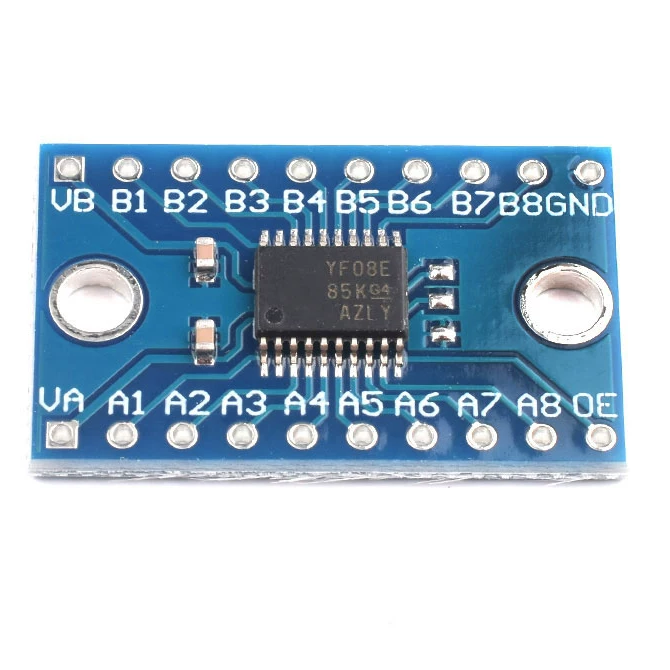
What is TXS0108E 8 Channel Level Shifter?
The TXS 0108E 8 Channel Level Shifter is a high-speed, full-duplex 8-channel voltage-level translation module based on the TXS0108EPWR IC from Texas Instruments. It provides bidirectional communication between two digital systems operating at different voltage levels.
The module has eight independent channels, allowing multiple digital signals to be translated simultaneously. Because automatically detect the signal direction, not normally require separate direction-control pins.
Connected the low-voltage side to VCCA, while connect the high-voltage side to VCCB. For example, can supply VCCA with 3.3V and VCCB with 5V to provide communication between 3.3V and 5V logic devices.
TXS0108E Technical Specifications
The TXS 0108E supports a wide range of supply voltages on its two sides, making it suitable for mixed-voltage digital systems.
Parameter | Specification |
IC | TXS0108EPWR |
Number of Channels | 8 |
VCCA Voltage | 1.2V–3.6V |
VCCB Voltage | 1.65V–5.5V |
Logic Conversion | 1.8V ↔ 3.3V, 3.3V ↔ 5V, etc. |
Communication | Bidirectional |
Direction Control | Automatic |
Enable Control | OE |
Ground | Common GND |
The VCCA side supports 1.2V to 3.6V, while the VCCB side supports 1.65V to 5.5V. This allows the module to handle common conversions such as 1.8V to 3.3V and 3.3V to 5V.
The module does not generate these supply voltages itself. Must supply the appropriate voltage to VCCA and VCCB by the connected circuits.
TXS0108E Logic Level Converter Pinout
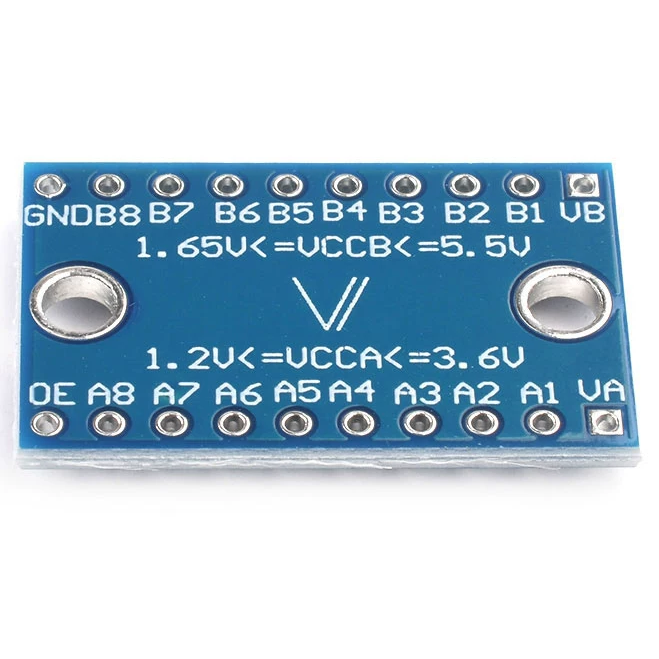
The module typically provides 20 pins, including power, enable, and eight channels on each side.
Pin | Function |
VCCB | High-voltage-side power input, 1.65V–5.5V |
GND | Ground |
B1–B8 | High-voltage logic ports |
A1–A8 | Low-voltage logic ports |
VCCA | Low-voltage-side power input, 1.2V–3.6V |
OE | Output-enable control |
VCCA
VCCA supplies the low-voltage side of the translator. It can operate from 1.2V to 3.6V. For a typical 3.3V system, connect VCCA to 3.3V.
VCCB
VCCB supplies the high-voltage side and supports 1.65V to 5.5V. For 5V logic, connect VCCB to a regulated 5V supply.
A1–A8
The A1–A8 pins are the low-voltage-side logic channels. They can connect to devices using lower logic levels such as 1.8V or 3.3V.
B1–B8
The B1–B8 pins are the high-voltage-side logic channels. They can interface with systems using higher logic levels, such as 5V.
OE
OE controls whether the level translator is enabled. A high level enables the device, while a low level places the outputs into a high-impedance state.
For typical applications, OE can connect to the appropriate logic supply so that the translator remains enabled.
TXS0108E Module Wiring
The TXS0108E can connect a 5V Arduino to a 3.3V device. Connect the Arduino side to the B pins and the lower-voltage device to the A pins.
TXS0108E | Arduino / Device |
VCCA | 3.3V |
VCCB | 5V |
GND | Common GND |
A1–A8 | 3.3V device signals |
B1–B8 | Arduino signals |
OE | 3.3V or logic HIGH |
For example, Arduino D2 → B1 → A1 → 3.3V device. Connect the grounds together and make sure VCCA and VCCB connect to the correct voltage levels.
TXS0108E Key Features
The TXS 0108E module provides several useful features for mixed-voltage digital electronics.
8 Independent Channels
Eight channels are available, allowing multiple signals to translate through one module. This is useful for buses and interfaces requiring several digital lines.
Bidirectional Communication
The channels support bidirectional communication. Data can travel from the A side to the B side or from the B side to the A side.
Automatic Direction Sensing
The translator automatically detects the direction of signal movement, reducing the need for additional direction-control circuitry.
Wide Voltage Compatibility
The VCCA and VCCB voltage ranges allow the module to work with several common digital logic levels, including 1.8V, 3.3V, and 5V systems.
High-Speed Operation
The module design for high-speed digital signal translation, making it suitable for many common microcontroller and peripheral interfaces.
Output Enable Control
The OE pin allows the translator to be enabled or disabled. When disabled, the relevant outputs enter a high-impedance state.
TXS0108E Working Principle
The TXS0108E works by translating digital signals between two different voltage domains.
The A side operates according to the voltage connected to VCCA, while the B side operates according to VCCB. When a signal changes state on one side, the internal circuitry detects the transition and produces the corresponding logic level on the opposite side.
For example, suppose:
· VCCA = 3.3V
· VCCB = 5V
When apply a 3.3V logic signal to A1, the TXS 0108E translates the signal so that the B1 side can communicate with a 5V logic system. When the signal travels in the opposite direction, the device performs the corresponding translation from B1 to A1.
The TXS0108E uses an auto-bidirectional translation architecture, so no require separate DIR pin for each channel.
The OE pin controls the overall output-enable function. When assert OE, the translator operates normally. When OE is low, the outputs are disabled and placed in a high-impedance state.
For practical designs, it is also important to consider the electrical characteristics of the connected interface. Although TXS0108E is convenient for many bidirectional digital buses, it is not the best choice for every high-speed or push-pull interface.
TXS0108E Applications
The TXS 0108E is useful whenever two digital systems use different logic voltages.
5V Microcontroller and 3.3V Module
A common application is connecting a 5V microcontroller to a 3.3V peripheral. The translator protects the lower-voltage device from incompatible logic levels while allowing digital communication.
3.3V Microcontroller and 5V Module
A 3.3V microcontroller can communicate with a 5V digital module through the TXS0108E. This is useful when the peripheral does not recognize 3.3V signals reliably.
Microcontroller and SD Card
SD card interfaces operate at relatively low logic voltages, so can use level translation when connecting an SD card interface to a microcontroller using a different voltage domain.
I²C, SPI, and Serial Devices
Can used in various mixed-voltage communication systems, including I²C, SPI, and UART/serial interfaces, provided the electrical requirements and signal speeds are compatible with the translator.
Mixed-Voltage Sensors
Can also help connect sensors and digital modules that operate at different supply voltages from the host microcontroller.
For typical module designs, the OE enable input is active high. It is commonly connected to an appropriate logic supply when the translator should remain enabled. Some breakout boards may provide additional configuration components, so should check the actual board schematic before wiring.
Texas Instruments TXS0108E Datasheet
For detailed electrical characteristics, timing information, recommended operating conditions, and application information, refer to the official data sheet.
Frequently Asked Questions [FAQ]
Where Can You Purchase the TXS0108E?
The TXS0108E module is widely available from electronics component distributors and online electronics stores. Search for TXS0108E 8-channel bidirectional level shifter module and verify the board's voltage specifications before purchasing.
Does this logic level converter work with Raspberry Pi and Arduino?
Yes. It can be used between Raspberry Pi and Arduino systems when their logic voltages are compatible with the TXS 0108E voltage ranges. Always connect VCCA and VCCB to the correct logic supplies.
Is this TXS0108E module ready for breadboard wiring?
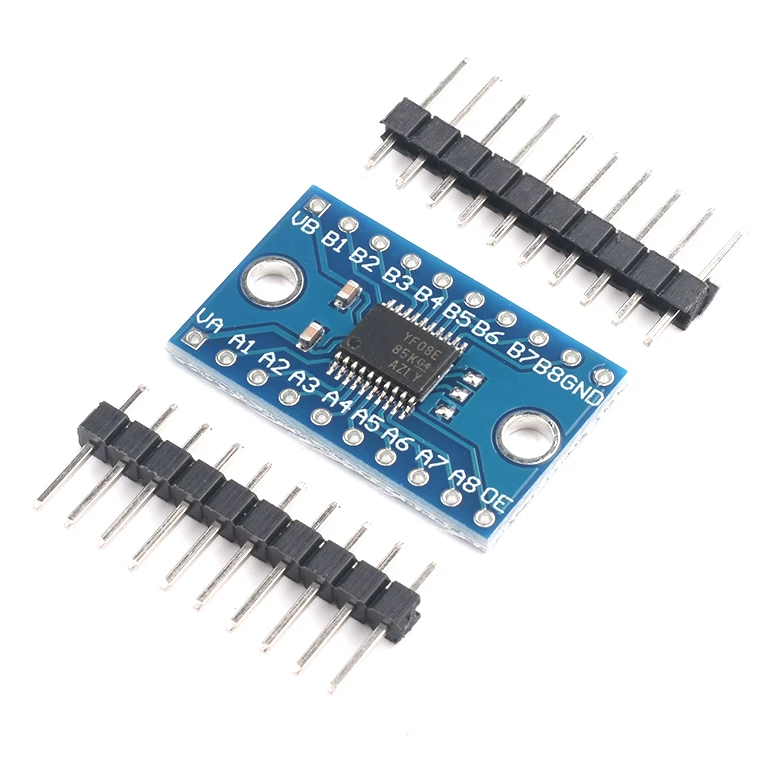
Most TXS 0108E breakout modules use standard through-hole header pins and can used with breadboards. However, check the particular board's pin spacing and header configuration before installation.
Which signals can the 8-channel TXS0108E translate?
The eight channels can translate digital logic signals between two voltage domains. Depending on the electrical characteristics and speed requirements, applications can include GPIO, I²C, SPI, and serial communication signals.
Can I use it for mixed-voltage sensor projects?
Yes. The TXS0108E can be useful when a sensor and microcontroller operate at different logic voltages. However, check whether the sensor interface is compatible with the TXS0108E's auto-bidirectional architecture.
Will this converter power my 5V module?
No. The TXS 0108E is a logic level translator, not a power converter. VCCB provides the voltage reference for the high-voltage side, but it should not be treated as a dedicated power supply for a 5V peripheral.
What is the TXS0108E used for?
The TXS 0108E is used to allow digital devices with different logic voltage levels to communicate. Typical applications include connecting 1.8V, 3.3V, and 5V microcontrollers, sensors, memory devices, and communication interfaces.
What voltage levels does the TXS0108E support?
The VCCA side supports 1.2V to 3.6V, while the VCCB side supports 1.65V to 5.5V. This enables common voltage translations such as 1.8V ↔ 3.3V and 3.3V ↔ 5V.
How does the TXS0108E detect signal direction?
The TXS 0108E uses internal circuitry to automatically sense signal changes and translate them between the A and B sides. Therefore, individual channels do not require a separate direction-control pin.
Conclusion
The TXS0108E 8-channel level shifter provides a convenient way to connect devices operating at different logic voltages. With eight bidirectional channels, automatic direction sensing, and support for common 1.8V, 3.3V, and 5V systems, it is suitable for Arduino, Raspberry Pi, sensors, SD cards, and other mixed-voltage digital applications.
Read More:
1. CC1101 Wireless RF Transceiver Module Board Guide
2. PAM8610 10W Stereo Class-D Audio Amplifier and Module board
HOT NEWS
TP4056 Charging Module Pinout, Working, and Applications
TP4056 Charging Module Pinout, Working, and Applications
2026-01-23
LR41 Battery Guide: Specifications, Equivalents, and Uses
LR41 Battery Specifications, Equivalents, and Uses
2025-12-14
Understanding A 0603 Resistor
0603 resistor,dimensions,marking code, values
2025-05-29
Understanding The CD4051 Analog Multiplexer
CD4051 analog multiplexer
2025-06-30
MT3608 Boost Converter - An In-Depth Guide
MT3608 Boost Converter
2025-09-04
Complete Guide to the 220 Ohm Resistor
220 Ohm Resistor
2025-07-28
The 0402 Resistor: A Comprehensive Guide
0402 Resistor
2025-05-06
Guide To The XL6009 Boost Converter
XL6009 Boost Converter
2025-09-05
Mini MP1584 DC-DC 3A Buck Converter Module: Complete Guide
Mini MP1584 DC-DC 3A Buck Converter Module: Complete Guide
2026-03-26
What Is A 1206 Resistor?
1206 resistor dimensions,footprint,value
2025-06-05