




 BOM
 Cart
 Product Catalog
The ADXL335 is a compact, low-power, three-axis MEMS accelerometer designed to measure acceleration, motion, tilt, and vibration along the X, Y, and Z axes. Featuring a ±3 g measurement range, analog voltage outputs, and adjustable bandwidth, it provides a practical solution for various motion-sensing applications. With its low current consumption, 1.8 V to 3.6 V operating voltage, and small 4 mm × 4 mm package, the ADXL335 is widely used in mobile devices, gaming systems, image stabilization equipment, and portable electronics. In this article, we will explore the ADXL335 pinout, technical specifications, features, applications.
1. What is ADXL335 Accelerometer?
2. Pinout
3. Technical Specifications
4. Applications
5. Features
6. ADXL335 Three-axis Accelerometer Sensor Module
7. Frequently Asked Questions [FAQ]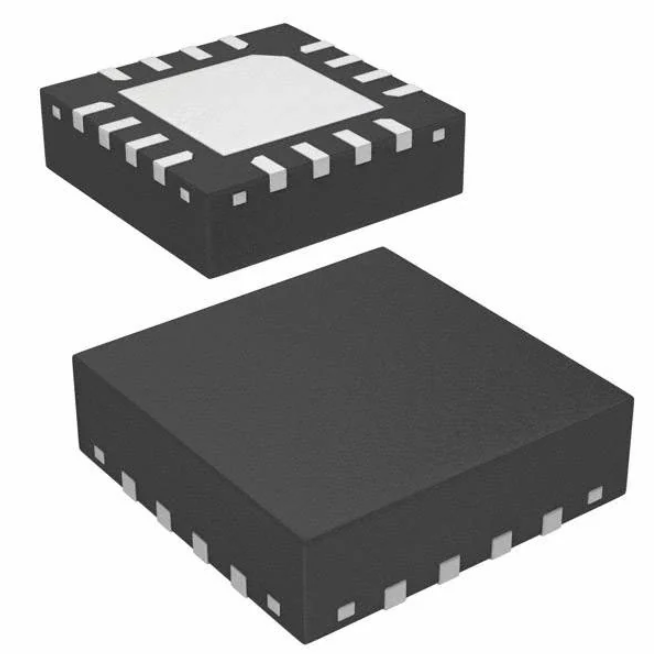
What is ADXL335 Accelerometer?
The ADXL335 is a small, thin, low-power, complete 3-axis MEMS accelerometer developed by Analog Devices. It measures acceleration along the X, Y, and Z axes and provides signal-conditioned analog voltage outputs. With a minimum full-scale measurement range of ±3 g, the sensor can detect both static and dynamic acceleration.
The ADXL 335 can measure the static acceleration of gravity, making it suitable for tilt-sensing applications. It can also detect dynamic acceleration caused by motion, shock, and vibration. Its three independent analog outputs allow a microcontroller or other processing device to monitor acceleration in each direction.
The sensor provides adjustable bandwidth through external capacitors connected to the XOUT, YOUT, and ZOUT pins. Can configure the bandwidth from 0.5 Hz to 1600 Hz for the X and Y axes and from 0.5 Hz to 550 Hz for the Z axis. This flexibility allows designers to optimize the sensor for different motion-detection and measurement requirements.
Operating from a single 1.8 V to 3.6 V supply, the ADXL 335 consumes approximately 350 μA of typical current. It is housed in a compact 4 mm × 4 mm × 1.45 mm, 16-lead LFCSP package, making it suitable for space-constrained, battery-powered electronic devices.
ADXL335 Pinout
The ADXL 335 uses a 16-pin LFCSP package with an exposed pad. Its pins provide power, common connections, self-test functionality, and three analog acceleration outputs.
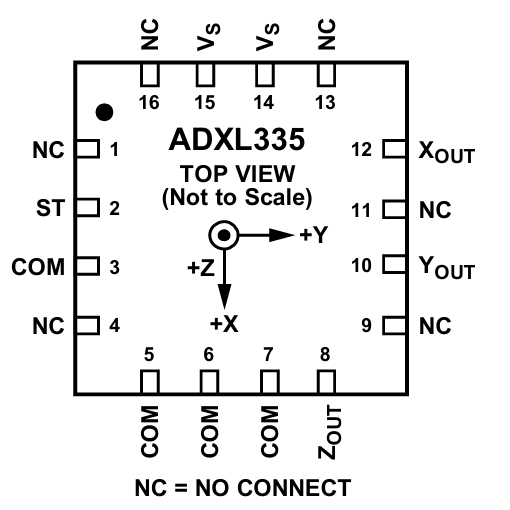
Pin No. | Mnemonic | Description |
1 | NC | No Connect |
2 | ST | Self-Test |
3 | COM | Common |
4 | NC | No Connect |
5 | COM | Common |
6 | COM | Common |
7 | COM | Common |
8 | ZOUT | Z-Axis Output |
9 | NC | No Connect |
10 | YOUT | Y-Axis Output |
11 | NC | No Connect |
12 | XOUT | X-Axis Output |
13 | NC | No Connect |
14 | VS | Supply Voltage (1.8 V to 3.6 V) |
15 | VS | Supply Voltage (1.8 V to 3.6 V) |
16 | NC | No Connect |
EP | Exposed Pad | Not internally connected; solder for mechanical integrity |
Pin Function Explanation
XOUT, YOUT, and ZOUT: These pins provide analog voltage outputs corresponding to acceleration along the three measurement axes. External capacitors connected to these pins determine the bandwidth of each axis.
VS: The supply voltage pins provide operating power to the accelerometer. The recommended supply range is 1.8 V to 3.6 V.
COM: These pins provide common electrical connections for the device.
ST: The self-test pin allows users to verify the sensor's mechanical and electrical response.
NC: These pins have no internal electrical connection and should be handled according to the manufacturer's datasheet recommendations.
Exposed Pad: The exposed pad is not internally connected and should be soldered to the PCB to provide mechanical stability.
ADXL335 Technical Specifications
The ADXL335 combines three-axis acceleration measurement, analog voltage outputs, and adjustable bandwidth in a compact surface-mount package.
Parameter | Value |
Manufacturer | Analog Devices Inc. |
Type | Analog Accelerometer |
Number of Axes | X, Y, Z |
Acceleration Range | ±3 g |
Sensitivity | 300 mV/g |
Bandwidth (X, Y Axes) | 1.6 kHz |
Bandwidth (Z Axis) | 550 Hz |
Output Type | Analog Voltage |
Supply Voltage | 1.8 V~3.6 V |
Typical Current Consumption | 350 μA |
Features | Adjustable Bandwidth |
Operating Temperature | -40°C~85°C |
Mounting Type | Surface Mount |
Package/Case | 16-LQFN Exposed Pad, CSP |
Supplier Device Package | 16-LFCSP-LQ (4 × 4 mm) |
ADXL335 Applications
The ADXL 335 is designed for cost-sensitive, low-power motion and tilt-sensing applications. Its three-axis measurement capability makes it useful in a wide range of consumer electronics, industrial devices, and portable equipment.
Common applications include:
Mobile Devices: Detects device orientation, movement, and changes in position for motion-controlled functions.
Gaming Systems: Supports motion-based gaming controllers and interactive devices.
Disk Drive Protection: Detects sudden shocks and physical movement to help protect storage devices.
Image Stabilization: Provides acceleration information for camera and image stabilization systems.
Sports and Health Devices: Measures body movement and activity in wearable electronics and fitness equipment.
Tilt Sensing: Detects changes in inclination and orientation in electronic instruments and control systems.
Motion Detection: Monitors acceleration, vibration, and movement in portable and embedded devices.
ADXL335 Features
The ADXL 335 offers several features that simplify integration into compact electronic systems while maintaining low power consumption.
Three-Axis Acceleration Sensing: The device measures acceleration along the X, Y, and Z axes, allowing it to detect movement, tilt, shock, and vibration in three-dimensional space.
Compact Package: It is available in a small, low-profile 4 mm × 4 mm × 1.45 mm, 16-lead LFCSP package, making it suitable for compact PCB designs.
Low Power Consumption: The typical current consumption is only 350 μA, making the sensor suitable for battery-powered and portable applications.
Single-Supply Operation: The ADXL335 operates from a single supply voltage of 1.8 V to 3.6 V, simplifying power supply design.
Adjustable Bandwidth: Users can select the bandwidth of each axis through a single external capacitor connected to the corresponding output pin.
High Shock Resistance: The sensor provides 10,000 g shock survival, offering improved robustness in applications exposed to mechanical shocks.
Temperature Stability: Excellent temperature stability helps maintain consistent acceleration measurements across its specified operating temperature range.
Analog Voltage Outputs: Three independent analog outputs provide acceleration information directly to microcontrollers and analog-to-digital converters.
Environmental Compliance: The device is RoHS/WEEE lead-free compliant, supporting environmentally conscious electronic manufacturing.
ADXL335 Three-axis Accelerometer Sensor Module
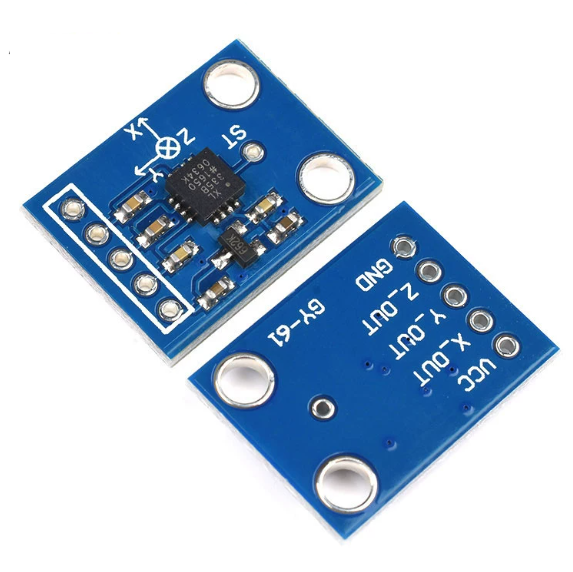
The GY-61 ADXL335 three-axis accelerometer module is a compact, low-power motion-sensing module designed to measure acceleration along the X, Y, and Z axes. It uses the ADXL 335 accelerometer chip and provides three independent analog voltage outputs corresponding to each axis.
The GY-61 module operates with a 3 V~5 V power supply, making it convenient for integration with microcontrollers and embedded development boards. Its X, Y, and Z analog output signals can be connected to ADC input pins to measure acceleration, detect movement, and estimate tilt and orientation.
With its simple interface, compact design, and low power consumption, the GY-61 is suitable for Arduino projects, robotics, motion detection, tilt measurement, and other three-axis acceleration sensing applications.
GY-61 ADXL335 Module Specifications
Parameter | Value |
Module Model | GY-61 |
Accelerometer Chip | ADXL335 |
Number of Axes | 3 (X, Y, Z) |
Operating Voltage | 3 V~5 V |
Output Type | Analog |
Output Channels | X, Y, Z |
Function | Acceleration and Tilt Measurement |
Frequently Asked Questions [FAQ]
What is the ADXL335 used for?
The ADXL335 is a three-axis MEMS accelerometer used to measure acceleration, movement, tilt, shock, and vibration. It is commonly found in mobile devices, gaming controllers, image stabilization systems, sports equipment, and other embedded applications requiring low-power motion sensing.
Is the ADXL335 analog or digital?
The ADXL335 is an analog accelerometer. It provides three independent voltage outputs through its XOUT, YOUT, and ZOUT pins. A microcontroller typically uses an analog-to-digital converter (ADC) to read these signals and calculate acceleration along each axis.
What is the operating voltage of the ADXL335?
The ADXL335 operates with a single supply voltage ranging from 1.8 V to 3.6 V. Its low-voltage operation makes it suitable for battery-powered devices and embedded systems. Designers should ensure that the supply voltage remains within the specified operating range.
What is the acceleration range of the ADXL335?
The ADXL 335 has a minimum full-scale acceleration range of ±3 g on its three measurement axes. This allows it to detect changes in acceleration caused by gravity, movement, shock, and vibration in general-purpose motion-sensing applications.
What is the sensitivity of the ADXL335?
The ADXL335 has a typical sensitivity of approximately 300 mV/g. This means its analog output voltage changes according to the acceleration applied along each axis. The actual output also depends on the zero-g bias voltage and operating conditions.
How do you adjust the bandwidth of the ADXL335?
The bandwidth is adjusted by connecting external capacitors to the XOUT, YOUT, and ZOUT pins. Each axis uses an individual capacitor, allowing designers to configure the sensor's frequency response according to the application's motion or vibration measurement requirements.
What is the difference between ADXL335 and ADXL355?
The ADXL335 provides analog voltage outputs and is designed for general-purpose motion and tilt sensing. The ADXL355 provides digital output with lower noise and better long-term stability, making it more suitable for precision vibration measurement, structural health monitoring, and navigation applications.
How much current does the ADXL335 consume?
The ADXL335 typically consumes approximately 350 μA during operation. Its low current consumption makes it appropriate for portable electronics and battery-powered motion-sensing systems where reducing power consumption is important.
Can the ADXL335 measure tilt?
Yes. The ADXL 335 can measure the static acceleration of gravity along its three axes. By analyzing the acceleration components, a microcontroller can estimate the sensor's orientation and inclination, making it useful for tilt detection and orientation measurement.
What is the price of ADXL335?
The price of the ADXL335 accelerometer IC varies depending on the supplier, order quantity, and packaging. Normally a 1,000-piece price starting at approximately $4.20 per unit. Distributor prices may be higher for small quantities. Prices are subject to change based on availability and market conditions.
Conclusion
The ADXL335 is a compact, low-power, three-axis analog accelerometer designed for motion, tilt, shock, and vibration sensing. With a ±3 g measurement range, 300 mV/g sensitivity, adjustable bandwidth, and typical current consumption of 350 μA, it provides a practical solution for a wide range of embedded applications.
Its 1.8 V to 3.6 V supply operation and small 16-lead LFCSP package simplify integration into portable electronics, gaming systems, image stabilization equipment, and sports and health devices. For designers seeking an affordable and straightforward three-axis acceleration measurement solution with analog outputs, the ADXL335 remains a useful option. For applications requiring lower noise and higher long-term measurement stability, the ADXL355 is an alternative worth considering.
For detailed electrical characteristics, recommended operating conditions, and PCB layout guidelines, refer to the official ADXL335 datasheet.
Read More:
1. RFM95W LoRa RF Transceiver Module 868 915 MHZ: Guide
2. LCD1602 Display Module 1602A 16X2 Compatible with Arduino R3 Mega2560 Raspberry Pi
3. CC1101 Wireless RF Transceiver Module Board Guide
ADXL335 Datasheet:
HOT NEWS
TP4056 Charging Module Pinout, Working, and Applications
TP4056 Charging Module Pinout, Working, and Applications
2026-01-23
Understanding The CD4051 Analog Multiplexer
CD4051 analog multiplexer
2025-06-30
LR41 Battery Guide: Specifications, Equivalents, and Uses
LR41 Battery Specifications, Equivalents, and Uses
2025-12-14
Understanding A 0603 Resistor
0603 resistor,dimensions,marking code, values
2025-05-29
MT3608 Boost Converter - An In-Depth Guide
MT3608 Boost Converter
2025-09-04
Mini MP1584 DC-DC 3A Buck Converter Module: Complete Guide
Mini MP1584 DC-DC 3A Buck Converter Module: Complete Guide
2026-03-26
The 0402 Resistor: A Comprehensive Guide
0402 Resistor
2025-05-06
Complete Guide to the 220 Ohm Resistor
220 Ohm Resistor
2025-07-28
Guide To The XL6009 Boost Converter
XL6009 Boost Converter
2025-09-05
TTP223 Touch Switch - Pinout, Datasheet & Applications

TTP223 Touch Switch - Pinout, Datasheet & Applications
2026-02-11