




 BOM
BOM Cart
Cart Product Catalog
The ICS-43434 is a high-performance digital MEMS microphone designed for audio recording, voice recognition, and sound detection in compact electronic devices. Featuring a 24-bit I²S digital output, a high signal-to-noise ratio (SNR), and a wide frequency response, this microphone can connect directly to compatible microcontrollers and digital signal processors without requiring an external audio codec.
In this guide, we will introduce the ICS-43434 microphone, explain its pinout and key specifications, explore its operating modes and applications, compare alternative MEMS microphones, and answer frequently asked questions about I²S audio interfaces.
7. Frequently Asked Questions [FAQ]
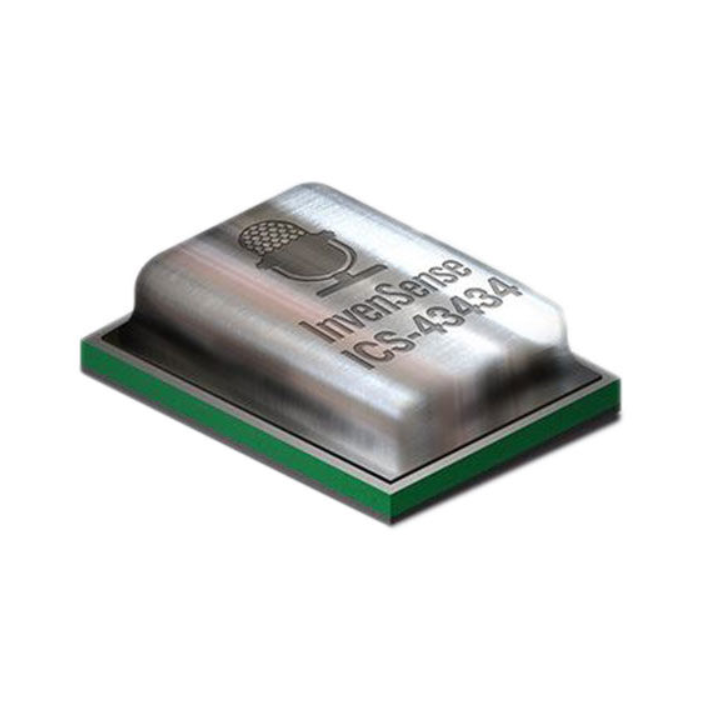
What is ICS-43434?
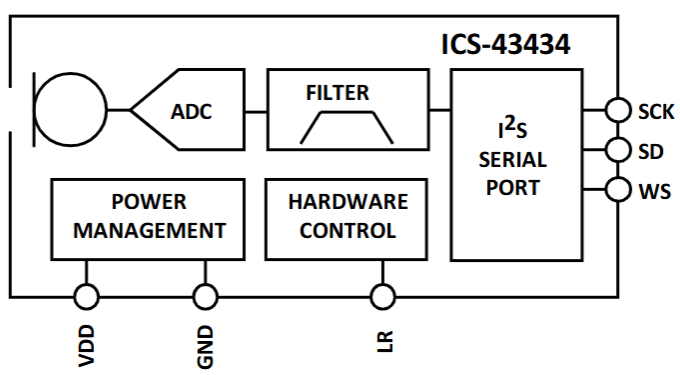
The ICS-43434 is a digital MEMS microphone with a bottom sound port and a standard 24-bit I²S output interface. It integrates a MEMS sensor, signal-conditioning circuitry, an analog-to-digital converter (ADC), decimation and anti-aliasing filters, and power management into a compact device. Its I²S interface allows direct connection to compatible microcontrollers and digital signal processors (DSPs) without requiring an external audio codec.
The microphone supports three operating modes: High Performance, Low Power (AlwaysOn), and Sleep. It delivers an SNR of up to 65 dBA and an acoustic overload point (AOP) of 120 dB SPL, providing reliable audio capture across a wide range of sound levels. Its frequency response extends from 60 Hz to 20 kHz, while a sensitivity tolerance of ±1 dB makes it suitable for high-performance microphone arrays.
Measuring just 3.50 mm × 2.65 mm × 0.98 mm, the ICS-43434 is ideal for compact, power-sensitive electronics. It is function-compatible with the ICS 43432 while offering comparable electroacoustic performance with lower power consumption and a smaller package.
ICS-43434 Pinout
The ICS 43434 has six pins for power, ground, clock signals, channel selection, and digital audio output. Understanding these connections is important when integrating the microphone into a development board or custom PCB.
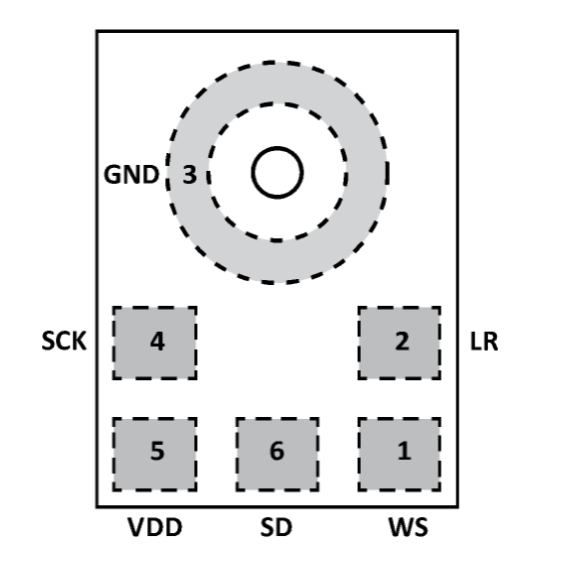
Pin | Name | Type | Function |
1 | WS | Input | Word select signal for the I²S interface; identifies the audio channel timing. |
2 | LR | Input | Left/right channel selection. Low selects the left channel, while high selects the right channel. |
3 | GND | Ground | Connects to the circuit ground. |
4 | SCK | Input | Serial clock input for synchronizing I²S audio data. |
5 | VDD | Power | Power supply input, 1.65 V to 3.63 V. Add a 0.1 µF decoupling capacitor between VDD and GND. |
6 | SD | Output | Serial digital audio output. The output becomes high-impedance when the microphone is not driving its assigned channel. |
Functional Block Diagram
ICS-43434 Specifications
The following table summarizes the main electrical, acoustic, and mechanical characteristics.
Parameter | Value |
Manufacturer | TDK InvenSense |
Series | ICS-43434 |
Microphone Type | MEMS silicon microphone |
Output Type | Digital I²S |
Directivity | Omnidirectional |
Frequency Response | 60 Hz to 20 kHz |
Sensitivity | −26 dBFS ±1 dB at 94 dB SPL |
Signal-to-Noise Ratio | Up to 65 dBA, depending on operating mode |
Supply Voltage | 1.65 V to 3.63 V |
Supply Current | 490 µA in High Performance mode; 230 µA in Low Power mode |
Maximum Acoustic Overload Point | 120 dB SPL |
Digital Output | 24-bit I²S |
Package Dimensions | 3.50 mm × 2.65 mm |
Maximum Height | 0.98 mm |
Port Location | Bottom |
Termination | Solder pads |
Package Shape | Rectangular |
Compliance | RoHS/WEEE compliant |
The stated current consumption depends on the operating mode. High Performance mode provides a higher SNR, while Low Power mode reduces power consumption for applications that prioritize battery life.
ICS 43434 Applications
The ICS 43434 is suitable for compact products that need reliable digital audio capture, low power consumption, and direct integration with embedded processors.
Wearable Devices
In smartwatches, fitness trackers, and other wearable electronics, the compact package and low operating current help minimize board space and power requirements. The microphone can support voice commands, audio recording, and sound-based interaction when paired with a compatible processor.
Smart Televisions and Remote Controls
Smart televisions and voice-enabled remote controls can use the microphone to capture spoken commands. Its digital interface simplifies integration with processors that support I²S, reducing the need for additional analog audio conversion circuitry.
Internet of Things (IoT) Devices
Smart home controllers, connected appliances, and voice-activated sensors can use the microphone for local voice input and sound detection. Low Power mode can help reduce energy consumption in devices that need to remain ready for user interaction.
Teleconferencing Systems
Conference speakers, communication terminals, and voice-enabled meeting devices can use digital microphones to capture speech. The consistent sensitivity tolerance is beneficial in multi-microphone arrangements designed for beamforming, noise reduction, and improved voice pickup.
Gaming Consoles and Accessories
Gaming headsets, controllers, and interactive accessories can incorporate the microphone for voice communication and voice-command recognition. Its wideband response supports speech capture, while the digital output can simplify connections to suitable audio-processing hardware.
Security Systems
Smart cameras, access-control terminals, and security monitoring devices can use the microphone to capture sound for event detection and audio recording. When combined with suitable software, the system can identify specific acoustic events or support two-way communication.
ICS 43434 Features
The component combines digital audio output, high acoustic performance, flexible operating modes, and a compact surface-mount package. These features make it suitable for both battery-powered electronics and more demanding audio applications.
High-Performance and Low-Power Modes
The microphone provides operating modes for different audio-quality and energy requirements. High Performance mode offers an SNR of 65 dBA with a typical current consumption of 490 µA. Low Power mode reduces current consumption to 230 µA, with an SNR of 64 dBA.
Parameter | High Performance Mode | Low Power Mode |
Sensitivity | −26 dBFS ±1 dB | −26 dBFS ±1 dB |
SNR | 65 dBA | 64 dBA |
Current Consumption | 490 µA | 230 µA |
Acoustic Overload Point | 120 dB SPL | 120 dB SPL |
Sample Rate Range | 23–51.6 kHz | 6.25–18.75 kHz |
High Performance mode is suitable for applications requiring greater audio fidelity, while Low Power mode is appropriate for continuous-listening systems where reduced power consumption is important. Can use sleep mode when the microphone is not needed, subject to the system's wake-up and operating requirements.
Digital 24-Bit I²S Interface
The integrated 24-bit I²S interface allows the microphone to send digital audio data directly to a compatible processor. This reduces the need for external analog-to-digital conversion and simplifies signal routing compared with an analog microphone design.
The host must support I²S and be configured for the microphone's clocking, channel selection, sample rate, and data format. I²S is distinct from I²C: I²S carries digital audio samples, whereas I²C is commonly used for control and configuration data.
Wide Frequency Response
The microphone supports a frequency response from 60 Hz to 20 kHz, covering the main audible range required by voice recording, voice recognition, conferencing, and many general-purpose audio applications. This wide response helps preserve useful speech detail and other audible sound information.
High Sensitivity Consistency
Its sensitivity tolerance of ±1 dB supports more consistent output levels between individual microphones. This is useful for microphone arrays in which differences between microphone sensitivities can affect beamforming, sound localization, and noise-reduction algorithms.
High Acoustic Overload Point
With an acoustic overload point of 120 dB SPL, the microphone can tolerate relatively loud acoustic inputs before reaching its overload limit. This characteristic is valuable in products that encounter varying sound pressure levels, although the final system's performance also depends on mechanical design and signal processing.
High Power Supply Rejection
The microphone provides high power supply rejection, specified at −100 dBFS. This helps reduce the effect of power-supply disturbances on the audio output. Proper PCB layout, supply decoupling, and grounding remain important for minimizing unwanted noise in the finished product.
Compact Package and Manufacturing Compatibility
The 3.50 mm × 2.65 mm × 0.98 mm surface-mount package allows the microphone to fit into small devices. It supports Sn/Pb and lead-free soldering processes and complies with RoHS/WEEE requirements, making it suitable for a range of consumer and embedded electronics manufacturing applications.
ICS-43434 Alternative
Several MEMS microphones can serve as alternatives, depending on whether the design requires an I²S digital output, a PDM interface, an analog output, or a different frequency response.
ICS-40720
The ICS-40720 is an omnidirectional analog MEMS microphone with a frequency response of approximately 75 Hz to 20 kHz. It operates from 1.5 V to 3.63 V and has a sensitivity of −38 dB ±2 dB at 94 dB SPL. It is suitable for systems that already include an analog microphone input or an external ADC.
ICS-43432
The ICS-43432 is a digital MEMS microphone with an I²S output and a frequency response of approximately 50 Hz to 20 kHz. Its supply range is 1.62 V to 3.63 V, and its sensitivity is −26 dB ±1 dB at 94 dB SPL. It is a relevant alternative when need similar digital audio functionality, although power consumption, package dimensions, and detailed specifications should be checked against the target design.
ICS-41350
The ICS-41350 is an omnidirectional digital MEMS microphone that uses a pulse-density modulation (PDM) interface rather than I²S. It operates from 1.65 V to 3.63 V and has a specified frequency response of approximately 50 Hz to 40 kHz, with sensitivity of −32 dB ±1 dB. It is worth considering when the host processor supports PDM and the application requires a wider frequency response.
ICS-40212
The ICS-40212 is an analog MEMS microphone with a frequency response of approximately 35 Hz to 20 kHz. It operates from 1.52 V to 3.63 V and has a sensitivity of −38 dB ±1 dB at 94 dB SPL. Its analog output makes it suitable for designs that use an external ADC or an analog audio-processing stage.
Alternative Comparison
Model | Output Interface | Frequency Response | Supply Voltage | Sensitivity |
ICS-43434 | Digital I²S | 60 Hz–20 kHz | 1.65–3.63 V | −26 dBFS ±1 dB |
ICS-40720 | Analog | 75 Hz–20 kHz | 1.5–3.63 V | −38 dB ±2 dB |
ICS-43432 | Digital I²S | 50 Hz–20 kHz | 1.62–3.63 V | −26 dB ±1 dB |
ICS-41350 | Digital PDM | 50 Hz–40 kHz | 1.65–3.63 V | −32 dB ±1 dB |
ICS-40212 | Analog | 35 Hz–20 kHz | 1.52–3.63 V | −38 dB ±1 dB |
When selecting an alternative, check the interface, pinout, supply voltage, sensitivity, acoustic performance, and package dimensions. Analog, I²S, and PDM microphones are not direct electrical replacements for one another without suitable changes to the host circuitry and software.
Frequently Asked Questions [FAQ]
What is ICS-43434 price?
The price of the ICS-43434 depends on the supplier, order quantity, stock availability, and packaging. Individual components cost more per unit than bulk orders. Normally US$1.50~ US$3.00. For an accurate quotation, compare current distributor listings and confirm that the product is the exact microphone model required for your design.
What is ICS-43434 I2S MEMS microphone breakout board?
An ICS-43434 I²S MEMS microphone breakout board is a small PCB designed to make the microphone easier to connect to a development platform. Depending on its design, the board provide power connections, accessible clock and data pins, and supporting components. Check its supply-voltage requirements and pin labels before connecting it to a microcontroller.
What is an I2S microphone?
An I²S microphone is a digital microphone that sends audio samples through the Inter-IC Sound interface. The interface uses clock and data signals to transfer digital audio to a compatible processor. Unlike an analog microphone, an I²S microphone integrates conversion circuitry and can provide digital samples without requiring a separate external ADC.
What is a digital I2S microphone?
A digital I²S microphone converts incoming sound into digital audio samples internally and transmits those samples through an I²S interface. A compatible microcontroller, DSP, or audio processor receives the data for recording, voice recognition, filtering, or playback-related processing. The host must support suitable I²S clocking and audio data formats.
How to connect I2S?
To connect an I²S microphone, connect its power and ground pins, then connect the serial clock, word-select clock, and serial data output to compatible host pins. Configure the processor's I²S peripheral for the microphone's supported sample rate, channel selection, and data format. Follow the microphone datasheet for pull-down resistors and decoupling.
What does I2S stand for?
I²S stands for Inter-IC Sound. It is a serial bus standard developed for transferring digital audio data between integrated circuits. Typical I²S signals include a bit clock, a word-select signal, and a serial data line. It is widely used in digital microphones, audio codecs, DACs, and embedded audio systems.
Conclusion
The ICS-43434 is a compact digital MEMS microphone that combines a 24-bit I²S interface, a wide 60 Hz to 20 kHz frequency response, a sensitivity tolerance of ±1 dB, and an acoustic overload point of 120 dB SPL. Its High Performance and Low Power modes provide flexibility for applications that require either stronger audio performance or lower current consumption.
With its small package and direct digital output, the microphone is a practical choice for wearables, voice-enabled remote controls, IoT products, teleconferencing equipment, gaming accessories, and security systems. Before implementation, verify the power supply, I²S configuration, pinout, sample-rate requirements, and mechanical package details to ensure compatibility with the target design.
Read More:
1. INMP441 Microphone Module MEMS High Precision: Specifications
2. MAX9814 Electret Microphone Amplifier Module Board: Guide
3. RFM95W LoRa RF Transceiver Module 868 915 MHZ: Guide
ICS-43434 Datasheet:
HOT NEWS
TP4056 Charging Module Pinout, Working, and Applications
TP4056 Charging Module Pinout, Working, and Applications
2026-01-23
LR41 Battery Guide: Specifications, Equivalents, and Uses
LR41 Battery Specifications, Equivalents, and Uses
2025-12-14
Understanding A 0603 Resistor
0603 resistor,dimensions,marking code, values
2025-05-29
Understanding The CD4051 Analog Multiplexer
CD4051 analog multiplexer
2025-06-30
MT3608 Boost Converter - An In-Depth Guide
MT3608 Boost Converter
2025-09-04
Complete Guide to the 220 Ohm Resistor
220 Ohm Resistor
2025-07-28
The 0402 Resistor: A Comprehensive Guide
0402 Resistor
2025-05-06
What Is A 1206 Resistor?
1206 resistor dimensions,footprint,value
2025-06-05
Guide To The XL6009 Boost Converter
XL6009 Boost Converter
2025-09-05
Mini MP1584 DC-DC 3A Buck Converter Module: Complete Guide
Mini MP1584 DC-DC 3A Buck Converter Module: Complete Guide
2026-03-26